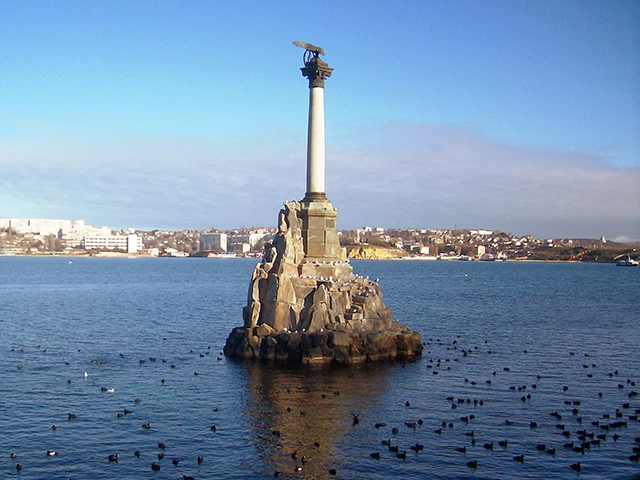
 The Monument to the Sunken Ships is recognized as the most famous monument of Sevastopol. Since its erection, it has been depicted hundreds of times on postcards, stamps and photographed by all guests of the city, and in 1969 and 2000 it adorned its coat of arms and flag respectively.
This monument is an imitation of a half-destroyed rock made of granite. A snow-white column made of diorite is fixed on it. A bronze double-headed eagle is planted on its capitol. The bird is turned to the sea, its head is crowned with a large imperial crown, and with both beaks it firmly holds a wreath. It is woven from laurel and oak branches. A sea anchor is suspended from it. The chest of the eagle protects the shield, which depicts a bas-relief of St. George the Victorious.
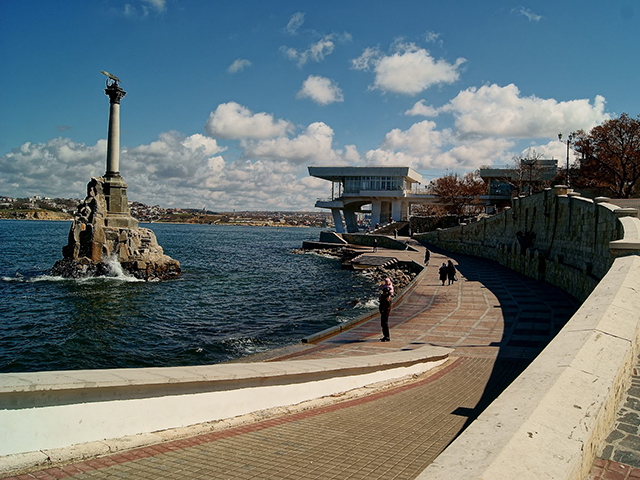 The base of the column, which can be seen from the side of Primorsky Boulevard, is decorated with a bronze bas-relief, in which the silhouettes of ships can be seen. On the granite slabs carved the name of the author and the explanation that the monument was created «in memory of the sunken ships» and is used as a warning sign for ships following in the waters of Sevastopol Bay.
Who is the author of this monument? Amandus Adamson, the best Estonian sculptor of the beginning of the last century. He was invited to the Crimea after he became famous throughout the Russian Empire for his work, dedicated to the sailors of the battleship «Rusalka», installed in the former Revel, now Tallinn. By the way, in the same Crimea, on the embankment of Miskhor, inspired Adamson has already created Mermaid and the sculptural group «Girl Arzy and the robber Ali Baba» for his personal kosht. But the creation of the monument in honor of the ships that sank into the abyss of the Black Sea, took place on the funds allocated by the state. Helped Adamson in this honorable cause architect Valentin Feldman, the author of a dozen of the best sacral sights of Sevastopol, and military engineer Enberg, versed in shipbuilding and perfectly aware of the reasons for the «murder of ships.
Thanks to the work of this international brigade of artists in 1905 in the waters of the Black Sea, at a distance of 23 meters from Primorskij boulevard, a unique monument was established. For more than a hundred years it has been serving the city and the memory of ships, steadfastly holding the onslaught of waves and climatic trickery.
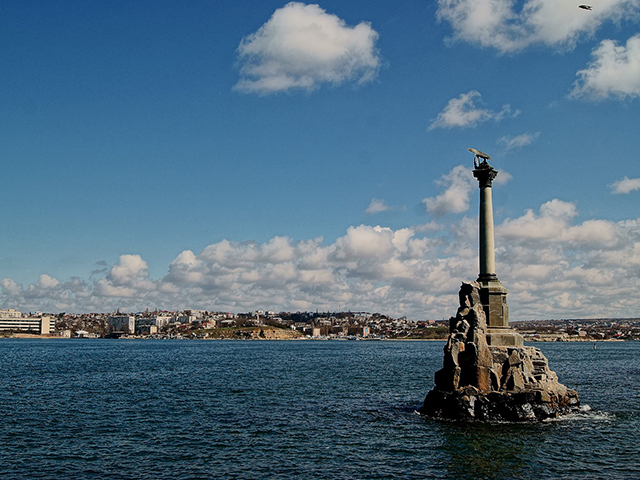 The creation of the monument was timed to one of the battles of the Crimean War — the First Defense of Sevastopol. The fact is that in 1854 in Sevastopol Bay was sunk a number of ships. It was done not by the enemy, but by their own. General Eduard Totleben, Count Eduard Totleben of Courland, was in charge of the city’s defense. It was his idea to put to the bottom legendary Russian ships — «Three Saints», «Silistria», «Gabriel», frigate «Sizopol» and corvette «Pilad» and a dozen of their colleagues in misfortune. The ships went to the bottom, blocking the bay from Mikhailovsky Fort to Nikolayevskaya Battery. This decision of Totleben is still a matter of debate, but the result was achieved. Not a single Anglo-French-Turkish ship entered the bay in those years. Another thing is the sentiments of sailors who saw their workplaces going under water or artists who mournfully reproduced this episode.
In memory of this deed of Totleben, as well as to show that the fairway of the bay was blocked, it was decided to put a memorial sign, which instantly turned into the brightest attraction of Sevastopol and a true symbol of the hero-city.
Location: Sevastopol, Primorsky Boulevard, between Artileriyskaya and Pivdennaya bays.
Top Attractions