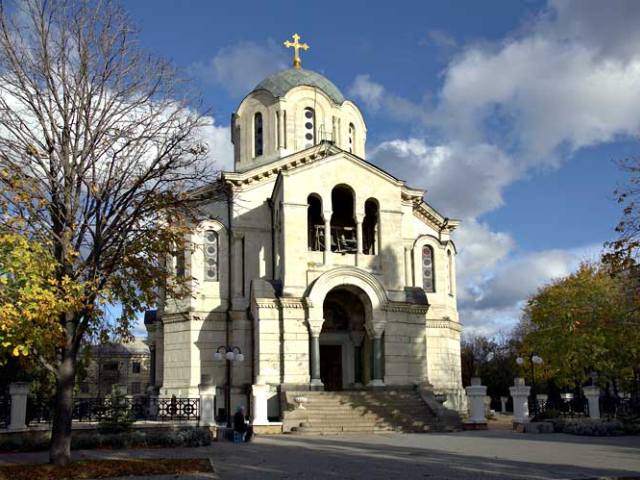
Sevastopol — the legendary hero-city — is rich in its historical past, depicted in numerous monuments, among which there are many temples. On the Central Hill rises Vladimir Cathedral — one of the main attractions of the city, a monument of architecture.
Back in 1825, the chief commander of the Black Sea Fleet and ports Admiral A. S. Gray (1775-1845) requested the highest permission to erect a monument on the ruins of Chersonesos — the place where Prince Vladimir was baptized. Architect K. A. Ton (1794-1881) developed the project of the monument-sobor in the Russian-Byzantine style: a cross-domed church with five chapters. In July 1829, the All-Russian subscription for fundraising began, which lasted until 1832. Voluntary donations came from different segments of the population, only in the Tauride province collected 527 rubles 95 kopecks. On September 5, 1837 the facade, plan and profile of the temple were approved by the highest court, but the order to begin construction was not followed, estimates were not made.
In June 1842, Admiral M.P. Lazarev appealed to Nicholas I with a request to build a cathedral not on the ruins of Chersonesos, but in the center of Sevastopol, because at that time there were few Orthodox churches in the city, and it was far to get to Chersonesos. His wish was fulfilled, a month later received the permission of the Emperor and began preparatory work. The construction was headed by the city architect V. A. Rulev. Having studied the area, he made additions to Ton’s project, the cathedral was supposed to be enclosed by a cast-iron fence with three gates and build two service houses. The area was cleared, part of the excavated land was used to level the relief, so that later the cathedral could be approached on horseback, the other part was taken out on carts. All works were carried out by teams of sailors of the Black Sea Fleet and were slow because of the hard rocky ground, which had to be blasted with gunpowder charges.
On November 9, 1850 the estimate for the construction of the cathedral of Inkerman stone with an underground floor was made. Inside the walls were supposed to be finished with marble, domes covered with gilded copper, which together with the fence and gates were made at the Izhora plant. Admiral Lazarev did not leave the construction of the cathedral without attention. He ordered in Italy a marble iconostasis and icons on copper boards. Lazarev discussed the location of the images with Archbishop Innocent of Kherson and Tauris.
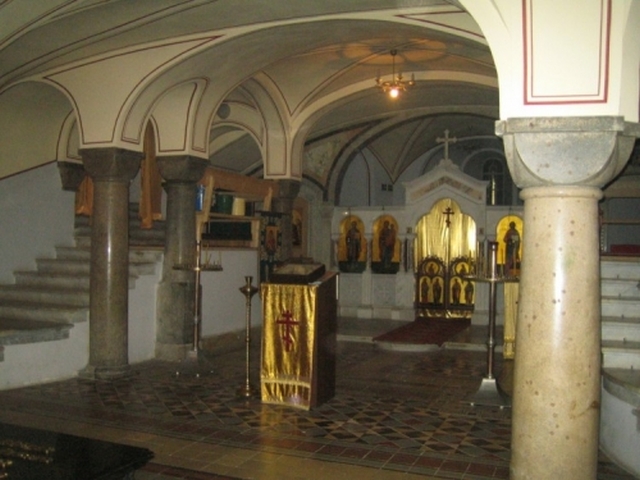
But in 1851 Admiral M. P. Lazarev died of a serious illness in Vienna, in memory of his merits they decided to bury the commander-in-chief of the Black Sea Fleet on the site of the future cathedral.
July 15, 1854 Archbishop Innocent of Kherson and Tauride solemnly consecrated the site of construction. However, soon the hostilities began, and the construction was suspended.
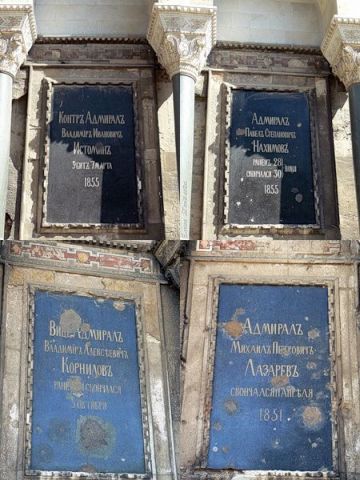
During the Crimean War, the unfinished Cathedral of St. Vladimir became the tomb of prominent admirals of the Russian Navy, including Admiral Nakhimov, a monument to the heroes of the defense of Sevastopol in 1854 — 1855.
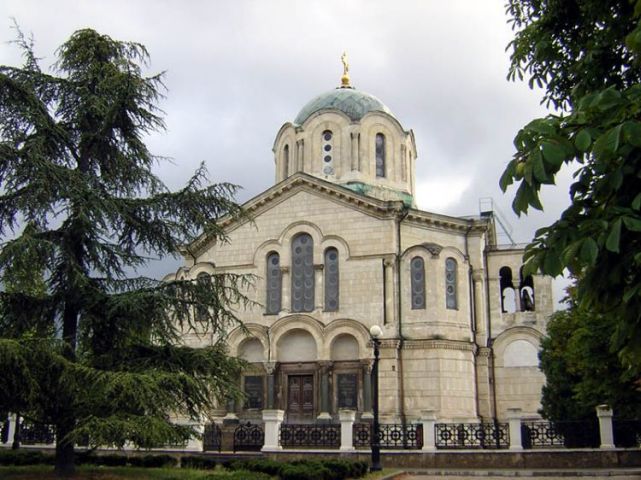
The construction of the cathedral was resumed in 1858, but already according to a different project. Its author was the architect AA Avdeev, at that time he lived in Sevastopol and was engaged in the construction of the church of St. Nicholas in the Bratsk cemetery. On the former foundation erected a single-domed church using elements of Russian-Byzantine style. A belfry was built over the western entrance, the northern and southern facades were decorated with triangular pediments with three semicircular arches, separated by columns of Crimean diorite.
Four black marble slabs with the names of the dead admirals and the dates of their deaths were built into the exterior. The lower church in the name of St. Nicholas was consecrated on October 5, 1881, the upper one in the name of St. Prince Vladimir was consecrated in 1888.
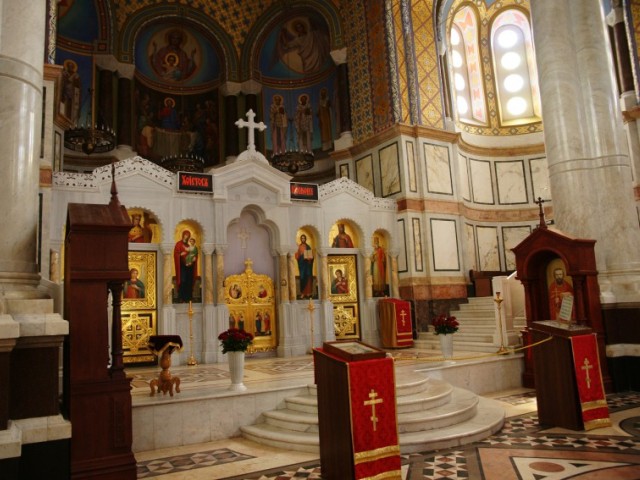
The interior decoration of the cathedral was characterized by solemn splendor. The walls were faced with dark maroon marble with light veins, brought from Italy. Especially beautiful was the floor made of marble of different colors. Work on the marble was performed by Italian sculptor V. Bonani, and the ornament was invented by artist R. Izello, he also painted the vault, arches and partitions of the temple. Icons and paintings of sacred content belong to the brush of the academician of historical painting I. E. Izello. Е. Karneev (1837-1896).
The upper temple was decorated with an expensive and elegant casket, made with funds raised by the families of Black Sea sailors in memory of the miraculous rescue of the Imperial family on October 17, 1888. The icon, painted by I. K. Aivazovsky. K. Aivazovsky, depicted the Savior walking on the waters and giving his hand to the Apostle Peter.
The Byzantine-style openwork doors and marble chancels above the entrance doors, bronze chandeliers combined with the rest of the interior decoration created an impression of elegance and harmony.
The church life of St. Vladimir’s Cathedral had its own peculiarities. There was no parish in the temple, so all the necessary work was done by sailors. Divine services were held only on Sundays, on church holidays, on birthdays and namesakes of members of the Imperial family, all memorable events connected with the Crimean War and important historical dates were celebrated, memorial services were held for soldiers who «laid down their lives for the faith and the Fatherland». The services were attended by the command
Black Sea Fleet and Sevastopol garrison, officers, representatives of the city government, aristocrats and ordinary citizens attended the services. Twice — on January 30, 1915 and May 15, 1916 — Emperor Nicholas II prayed in the cathedral.
In December 1920 in Sevastopol finally established Soviet power. St. Vladimir’s Cathedral was given to the Orthodox community for free use with the condition not to allow political meetings, sermons hostile to the Soviet power. However, the state policy of militant atheism gradually changed people’s attitude towards religion and the church. Repeatedly thefts were committed in St. Vladimir’s Cathedral, church utensils were stolen.
The public walking around in the evenings spoiled flowerbeds, broke trees, and smashed windows in the church. And yet services were conducted in it until 1932, then the temple was closed. In the building of the cathedral first housed workshops of the Aviation and Construction Society, then the warehouse of the political administration of the Black Sea Fleet. The cathedral was badly damaged during the Great Patriotic War and began to be restored in 1966. In 1972, St. Vladimir’s Cathedral became a branch of the Museum of the Heroic Defense and Liberation of Sevastopol.
In the late 80’s in St. Vladimir’s Cathedral began restoration work, which was carried out by Yalta Construction Department № 31, led by a team of V. Vasiliev. Vasiliev. Restorers managed to return the temple to its former appearance. Once again recreated a marvelous marble floor and wall cladding. Everyone entering the temple reads over the altar:
Behold the House of God, the Father created it.
Behold the House of God, the Son established it.
Behold the House of God, the Holy Spirit renew it,
Glory to you, Holy Trinity!
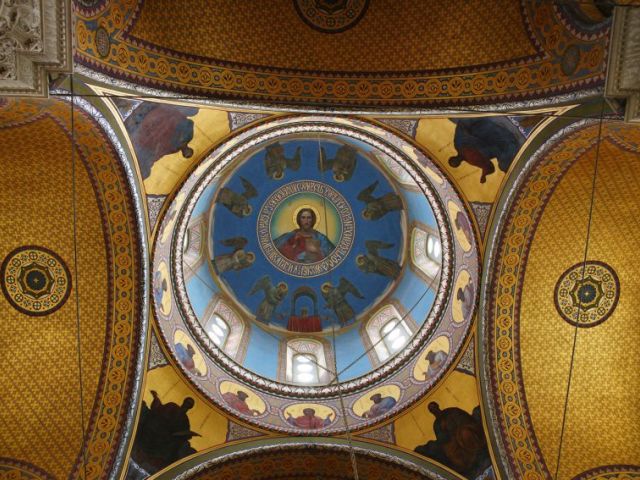
Above the entrance is a picture of the Last Judgment, above the southern entrance is an angel with a candle, writing down the names of people who came to the temple to pray. Above the heads of the believers, on the dome — the Lord and many angels. There are also written the words of the prophet Isaiah: «I created the earth and man on it. I have spread the heavens with my hand, and I have made all the stars…».
On October 19, 1999 the cathedral was consecrated again, and it began to hold services. In the Vladimirskiy Cathedral there are rare icons of the Mother of God «Derzhavnaya» and «Neupitaya Chasha».