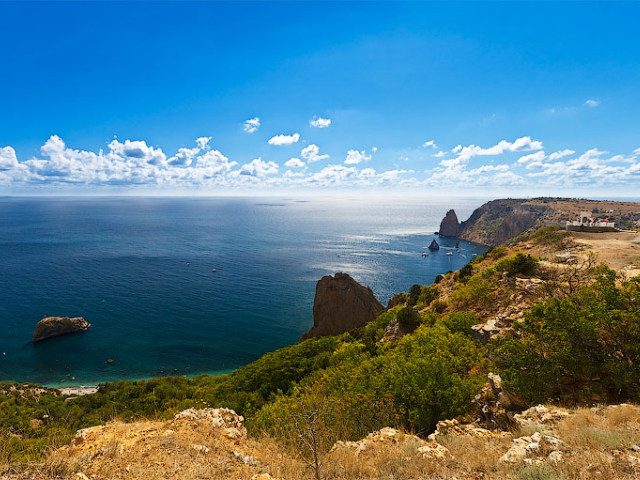
Cape Fiolent strikes the imagination with its special beauty: austere huge rocks, blue sea, then raging, furious, then smooth as a mirror, and endless blue sky. Fiolent means «God’s country» in Greek.
Ancient legends say that it was here that the temple of Artemis was located, in which Iphigenia served as a priestess. She offered bloody sacrifices to the gods, throwing down the steep cliffs of travelers who had lost their way. The historian Simeon Metaphrastus reports that the ancient temple of Artemis was destroyed in the I century, when Andrew the First-Called came to these places. And on the slope of the mountain they built a cave church, in which Bishop Basil, who had been expelled from Chersonesos, settled in 310.
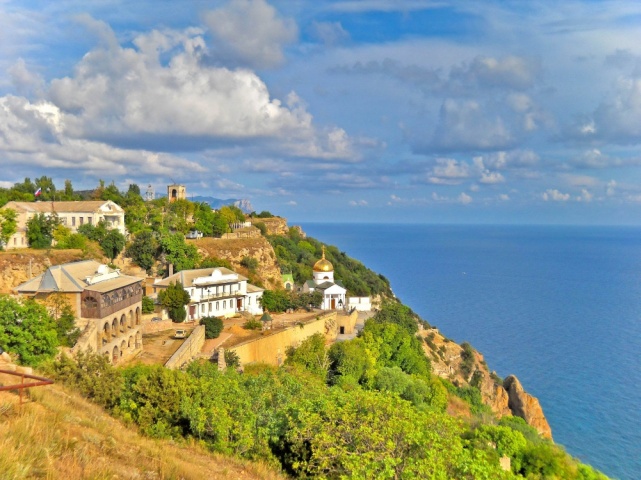
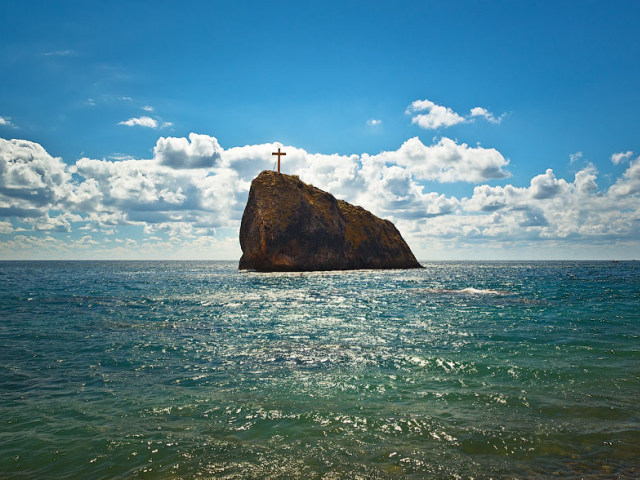
Saint George’s Monastery was founded in 891 thanks to the miraculous rescue of Greek sailors from a storm unprecedented for these places. Saved from certain death, the Greeks climbed the rock and there found an icon of St. George. Taking it they climbed to a nearby rocky shore. In gratitude for their happy salvation they founded a cave temple in a nearby cave, opposite the rock where St. George appeared, and installed there the icon they had found. The most devout of the saved Greeks stayed to live at the temple, forming a brotherhood. Scientists do not have documentary sources about the ancient period of the monastery’s existence, as it originally belonged to the Patriarchate of Constantinople and the archive could have been taken there by Archbishop Ignatius (Reondazhsky). In addition, in 1780 there was a fire in the house of Archbishop Ignatius, in which some documents were burned.
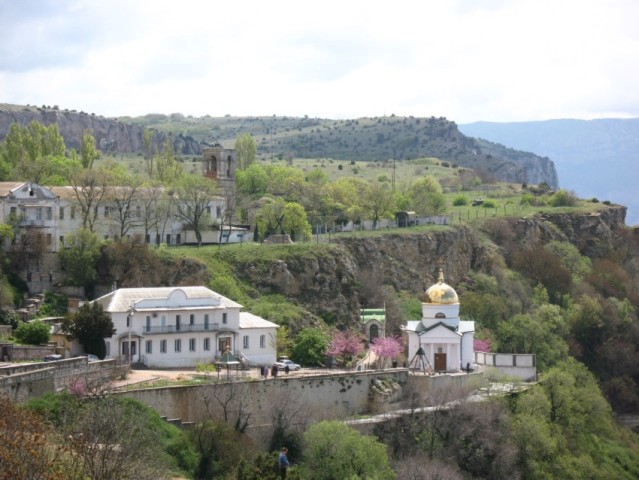
The first documentary mention of the monastery was made by the Polish ambassador to the Crimean Khanate and dates back to 1578. Chersonesos was handed over to the Genoese in 1350. Consequently, the abbot of the monastery Metropolitan Agafangel determined the time of appearance of the monastery in the middle of the XIV century. There are other assumptions about the time of the monastery’s appearance.
For several centuries St. George’s Monastery neighbored with representatives of other religions, first the Tatars, then the Genoese, and even later the Turks. God’s special grace all this time guarded the monastery. But by the middle of the XVII century, with the strengthening of the Crimean Tatar Khanate, life in the Orthodox monasteries, including St. George’s, greatly deteriorated. By the beginning of the XVIII century in the Crimea remained only four monasteries. In 1778, the remaining monks of St. George’s monastery left the Crimea. At the monastery remained only the old hermit hieromaniac Kallinik, who looked after the monastery buildings, lived 118 years and was buried in the monastery cemetery.
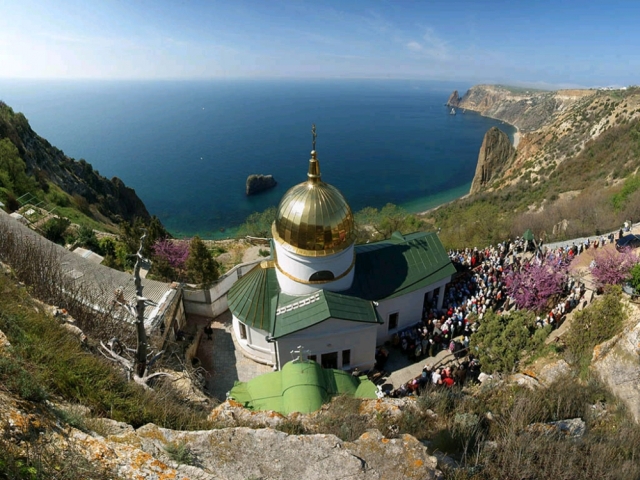
Life in the monastery resumed in 1792. Already in 1794 the monastery was subordinated to the Holy Synod, it was officially called the Balaklava St. George Monastery.
After the annexation of Crimea to Russia near the ancient Chersonese began construction of the main base of the Black Sea Fleet — Sevastopol. In 1806, the Holy Synod appealed to the Emperor with a proposal to make the St. George Monastery a base monastery for navy hieromonks. And already on March 23, 1806 approved the staff of the monastery: the abbot, five monks and thirteen hieromonks of the Black Sea Fleet. As the Black Sea Fleet grew, so did the number of hieromonks.
But, despite all of the above, the monastery lived poorly and greatly dilapidated. The stone church in the name of St. George became unsuitable for services. For the construction of a new church was collected by the whole world.
 .
.
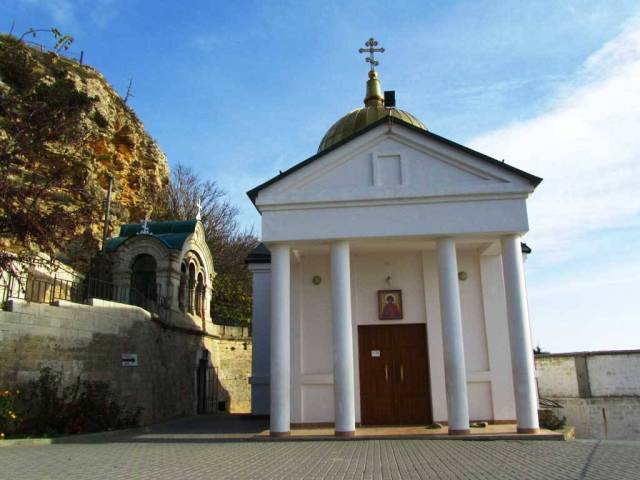
The construction of the new church began in 1810 and was completed in 1815. The temple was a building with one dome, set on a round light drum with wide semicircular windows. The entrance was decorated as a four-columned portico of Doric order and a triangular pediment. Large rectangular windows were decorated with white marble sills.
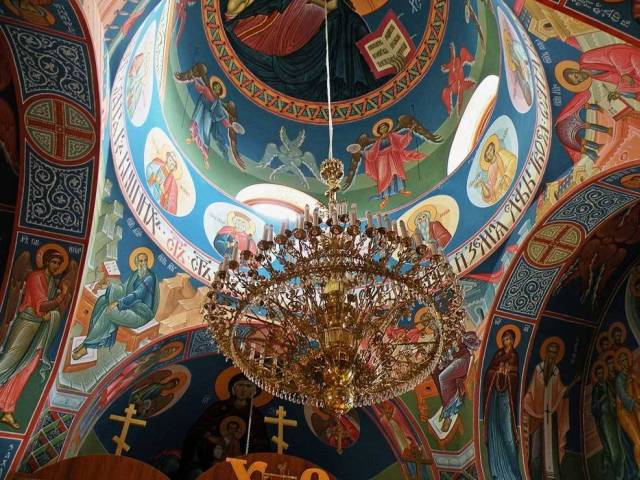
The interior decoration of the temple was very rich. The carved gilded iconostasis was made of wood by Sevastopol masters. Many icons were richly decorated with rhinestones, rubies, turquoise, crowns on the heads of Christ, the Mother of God and the saints, elements of clothing and crosses were made of silver or covered with gilding. In the altar in a gilded frame was an icon of St. Mary Magdalene. Above the Royal Gates the inscription: «Hermosa, confirmation to those who hope in you, confirm, O Lord, the Church which you have established by your honest blood» was made of cast silver letters.
At the same time with the temple, cells, a fountain and a refectory were built in the monastery. Later in the monastery built stone hotels and wings for naval officers, as well as various outbuildings.
In 1846 renewed the spring of St. George, built in 1816, whose water was considered the best in the Crimea.
In 1850 was consecrated in the name of the Holy Exaltation of the Life-Giving Cross of the Lord new church in the form of a three-nave basilica. The main entrance was designed in the form of a portico with a painted pediment and three arches. The building was completed by a small tower with a spherical dome. The interior was decorated with a two-tier wooden carved iconostasis.
The monastery has always had many generous donors and benefactors. It was patronized by Emperors Alexander I and Nicholas I.
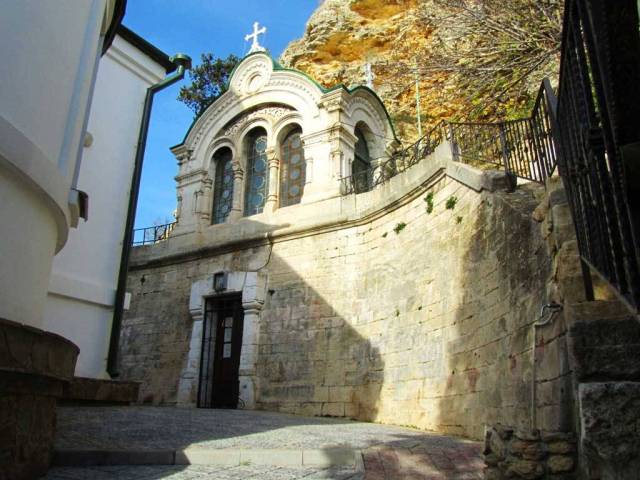
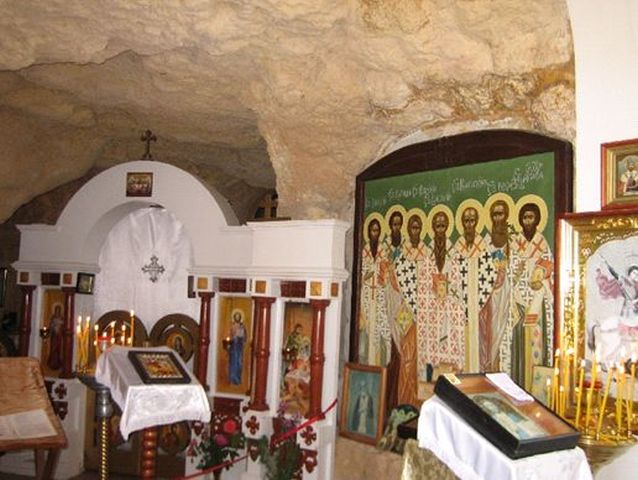
At the end of the XIX century the monastery celebrated its millennium. The hotel and cells were renovated for the holiday, a new road and a staircase of 800 steps were built to the sea, steps were carved on the rock of the appearance of St. George the Victorious and a stone cross with the dates «891 — 1891» and a copy of the found icon were installed. The ancient cave church was also restored and illuminated in the name of the Nativity of Christ. Its facade was made of Inkerman stone. The second tier resembled a chapel pressed against the rock. The central arch was decorated with a light Byzantine arcade, a cross was installed on the top, the throne and pulpit were carved in the rock. The interior decoration was a gilded wooden carved iconostasis.
After the establishment of Soviet power, all the lands and buildings of the monastery became the property of the state, a state farm «St. George Monastery» was established here, where monks were enrolled in various positions. However, the temples were not closed and services were held in them.
In 1929 the monastery decided to liquidate and its property was given to the Spa Trust. At the request of the faithful they gave them the Church of the Exaltation of the Cross, but in 1930 closed and it. The cross on the rock of the Holy Apparition was broken and thrown into the sea. Thrown into the sea bulldozed and the Church of St. George, damaged during the earthquake of 1927. In its place they built a dance floor for vacationers.
During the Great Patriotic War turned into ruins hotel, fraternal building and refectory. The necropolis was also damaged.
After the war and until recently a military unit was located on the territory of the monastery.
Today St. George Monastery is in a state of restoration after years of neglect during the Soviet era. In 1991 a metal cross was erected on the rock of the Holy Apparition. On May 6, 1993, the monastery celebrated its first Divine Liturgy in many years.
In recent years the cave church of the Nativity of Christ has been revived, the monastery territory is being improved. In 2000, a solemn laying of the church in honor of St. George the Victorious. At the site of the future altar set a stone, in which they placed a capsule with a memorable note. The restored temple will be a monument to all those who contributed to the revival of the monastery.
It is also pleasing that today not only the architecture of the monastery is being restored, but also its glorious traditions connected with the Navy. In 1997 the St. Andrew’s flags of several naval units and ships were consecrated in the monastery. Sailors help in the restoration of the monastery, and the monks tell them about the glorious history of the monastery, faith and the Church. It is not uncommon to see young soldiers praying in the monastery church, and this is a real reward for their spiritual leaders. Maybe soon there will be priests serving on the ships, as before.