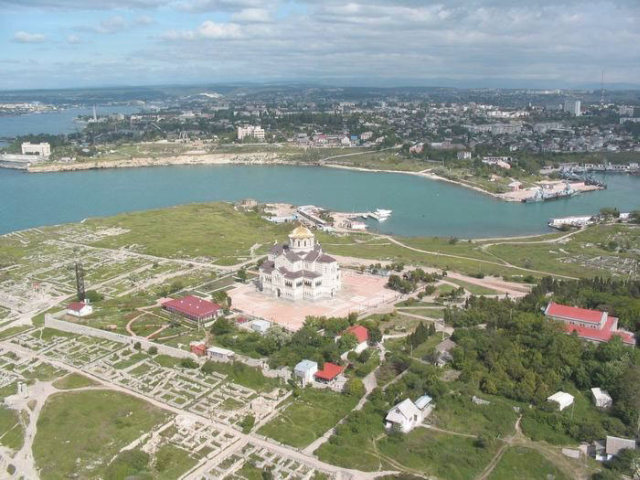
 The St. Vladimir’s Cathedral in ancient Chersonese is one of the most outstanding architectural constructions of the city of Sevastopol, it amazes with its majesty, extraordinary beauty and proportionality of lines. St. Vladimir’s Cathedral of Chersonesos is an all-Orthodox shrine, a temple-monument immortalizing the adoption of Christianity by Prince Vladimir.
For the first time the idea of immortalizing the place of Baptism of Prince Vladimir was expressed in 1825 and belonged to the Commander-in-Chief of the Black Sea Fleet and ports Vice-Admiral A. Greig. It was on his initiative that archaeological excavations were conducted in Chersonesos in 1827 under the direction of K. Kruse, who discovered the ruins of ancient Christian temples, and among them — the remains of a cross-shaped church in the center of the main square of the city. In the early 30s of the XIX century historians F. Dubois de Monpere and N. Murzakevich assumed that the Grand Duke received Holy Baptism in this very basilica. Already in 1850, at the request of St. Innocent, Archbishop of Kherson and Tauris, St. Vladimir’s Monastery was founded here.
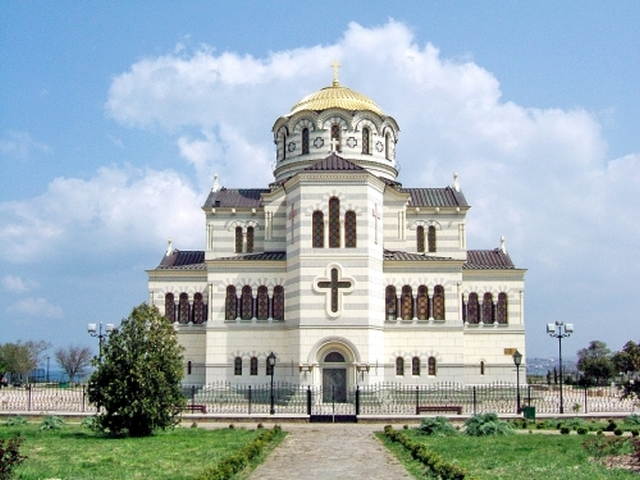 During the first defense of Sevastopol in 1854-1855 the monastery was occupied by the French. From the church they made a firing position and fired from here Russian troops, who were behind the Quarantine Bay. By the end of the defense of Sevastopol, the monastery and the church lay in ruins.
After the Crimean War, the Chersonese Monastery was restored, Emperor Alexander II ordered the annual July 28th procession from Sevastopol to Chersonese and gave permission to build a cathedral church. The cathedral was intended to embody the memory of the greatest event — the Baptism of Russia, and also was to become a symbol of spiritual continuity between Byzantium and Russia. It is a symbol of the transition of the East Slavic world from paganism to Christianity.
The laying of St. Vladimir’s Cathedral took place in 1861 in the presence of the royal family and Emperor Alexander II himself, who laid the foundation stone of the temple. Alexander II personally approved the project of the cathedral on the territory of the Chersonesos Monastery.
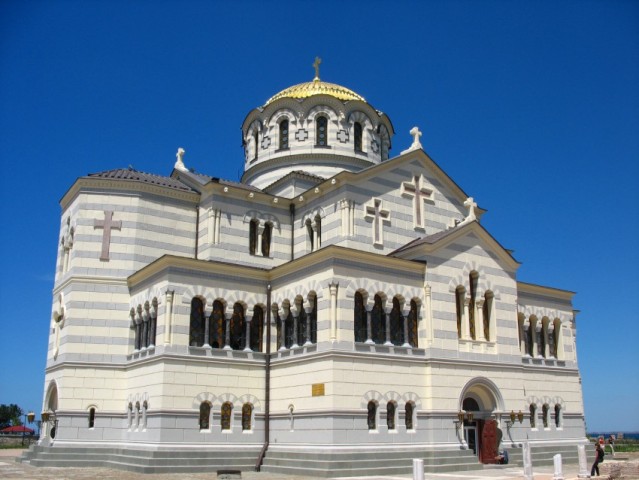 The author of the project was the academician of architecture D. I. Grimm. St. Vladimir’s Cathedral was the first outstanding construction designed by D. I. Grimm. This work earned the architect the title of professor and the right to teach at the Academy.
The cathedral became one of the largest temples in Russia. Its height was 36 meters, the external volume — 20 500 cubic meters, the total area of the premises — 1 726 square meters, the diameter of the dome — 10.5 meters, the internal height of the upper temple from the floor to the vault of the dome — 24 meters, the height of the main cross above the dome of the cathedral — 2.85 meters. The temple can simultaneously accommodate up to 1,000 parishioners.The walls of the cathedral even at the level of the second floor reached a meter thick.
The interior decoration amazed with its splendor — columns of valuable marble, mosaic floors. The Vladimirskiy Cathedral was painted by famous artists of that time — academician of painting A. I. Korzukhin, who took part in the painting of the cathedral. I. Korzukhin, who took part in the design of the Cathedral of Christ the Savior in Moscow, Professor T. Neff, N. Maikov, I. Malyshev. 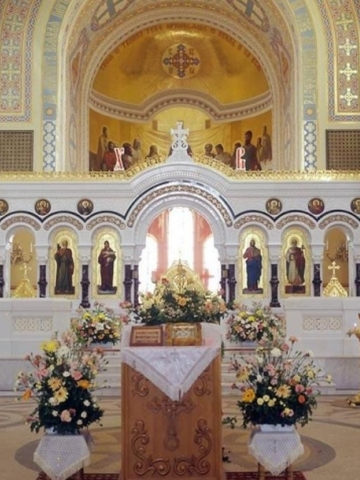 The work was led by the author of the Foros Church project A. Chagin. Chagin. Money and funds for the construction of St. Vladimir’s Cathedral were collected by subscription by the whole Russia. When the subscription period ended, people demanded to extend it. But still due to the lack of funds the construction of the cathedral was delayed for three decades.
The right side-altar of the cathedral was consecrated on July 12, 1892 in the name of Prince Alexander Nevsky.
The left side-altar of the cathedral was consecrated in the name of St. Andrew the First-Called.
In the lower church of the cathedral there was also a right side chapel in the name of St. Martinian. In this side chapel were buried Archbishop Martinian, who died in 1898, and the abbot of the monastery, Most Reverend Innocent (Solotchin), who died in 1909.
In 1859 from the Small House Church of the Winter Palace in St. Petersburg to Chersonesos was transferred in a marble ark in the form of the Gospel a part of the relics of St. Prince Vladimir. 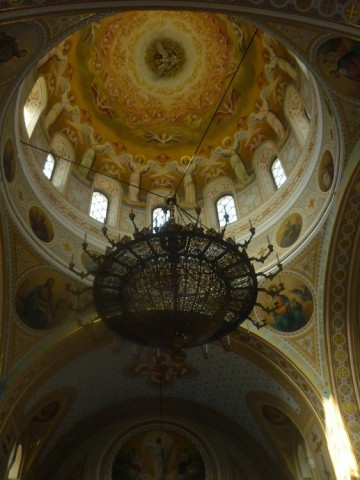 This relic after the construction of the Vladimir Cathedral was placed in the lower temple next to the historical ruins of the ancient basilica. In the altar of the upper temple there was a list of the miracle-working Korsun icon of the Mother of God, according to legends, brought by Prince Vladimir from Chersonese. In total, relics of 115 saints were transferred to the cathedral.
In 1924, the Chersonesos Monastery was closed, and the St. Vladimir’s Cathedral was handed over to the museum.
During the Great Patriotic War the temple was significantly damaged, the walls cracked, the interior decoration was almost completely destroyed. By order of the German Oberstvo Kolba the cathedral was mined and blown up. The explosion was so strong that it collapsed the ceilings between the lower and upper tiers, collapsed the remains of the dome. In the upper part of the cathedral, the construction seams separated, almost all the plaster collapsed from the walls, along with priceless paintings. The temple was entering the most tragic decades of its existence.
The cathedral suffered so much, and it was so huge that no one dared to raise the question of its restoration in the first post-war years.
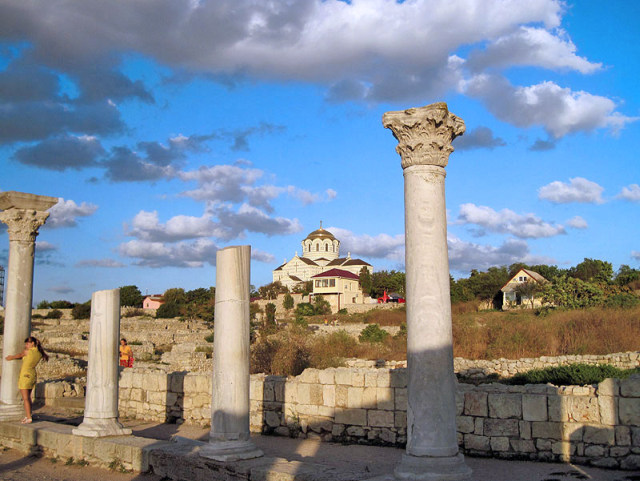 The ruling bishop, Metropolitan Lazar had to put a lot of work to achieve the restoration of this great shrine. The issues of its restoration were decided at the highest state level. The beginning of the restoration of the cathedral was laid by the family of the President of Ukraine in 1998, when Lyudmila Kuchma laid a commemorative capsule with an address signed by the head of state. Under the patronage of L. D. Kuchma restoration work began.
In 1992 services were resumed here. In 2002, for the first time in the last 77 years, an Easter service was held in St. Vladimir’s Cathedral, served by Metropolitan Lazar of Simferopol and Crimea, attended by the President of Ukraine L. D. Kuchma and the leadership of Autonomous Republic of Crimea.
On April 3, 2004, the Primate of the Ukrainian Orthodox Church, His Beatitude Metropolitan Volodymyr of Kyiv and All Ukraine, in the presence of the President of Ukraine L. D. Kuchma, performed the consecration of the restored St. Vladimir’s Cathedral of Chersonesos.