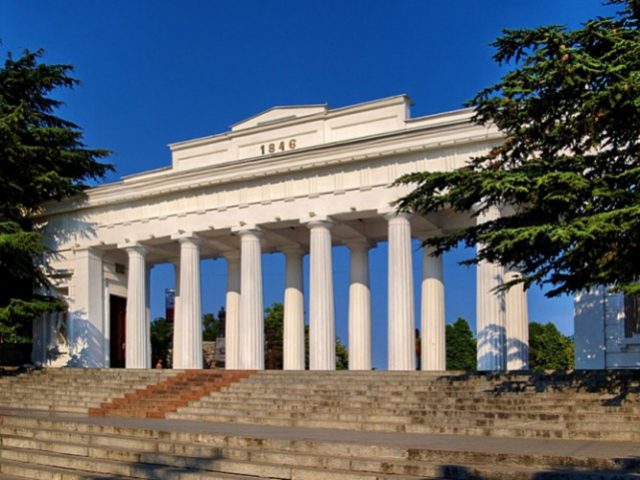
 The Earl’s Wharf appeared in Sevastopol in 1783. It was a rudimentary boat berth, built of tarred oak stakes. It was exactly like the one in Yalta before General Vorontsov came to the city, or in Amsterdam while it was a simple fishing village along the Amstel River.
A milestone event in the life of the future monument of history and architecture was the visit of Catherine the Great to the city in 1787. Unlike Potemkin villages, by the arrival of the sovereign the wooden Sevastopol pier was equipped with real stone steps, which allowed the Grafskaya Wharf to stand firmly at the entrance to the city from the sea and for a quarter of a millennium to play the role of a visiting card of Sevastopol.
The main role in turning the Grafskaya Wharf into a symbol of the hero-city belongs to Colonel John Whapton. In 1844 the English engineer finished the plan of strengthening and ennobling the main city pier, and in 1846 he proudly accepted the buildings created according to his plan.
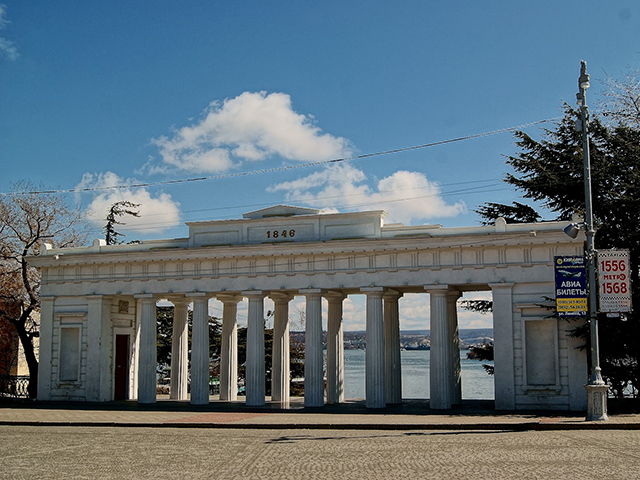 The jewel of Earl’s Wharf is the snow-white Colonnade, built along the western shore of the South Bay. The Colonnade consists of 9 columns of Doric order, united by an entablature with a rather modest attic. It bears the date of construction. Between the columns there is space for 8 propylaea. This is a term from the sphere of higher architecture, which denotes a parade passage or passageway. In this case, to the wharf. Colonnade and propylaea originated in ancient Greece. John Wapton probably got the idea from the Acropolis in Athens. Or maybe in one of the European capitals — Berlin or Budapest, famous for their triumphal Brandenburg Gate and the Colonnade of the Seven Kings respectively, built in neoclassical style.
An excellent addition to the Sevastopol landmark was the staircase. It is much wider than the well-known Potemkin staircase. It consists of 4 flights and is decorated with lions, which were carved out of marble by Italian sculptor Ferdinando Pellicio by special order.
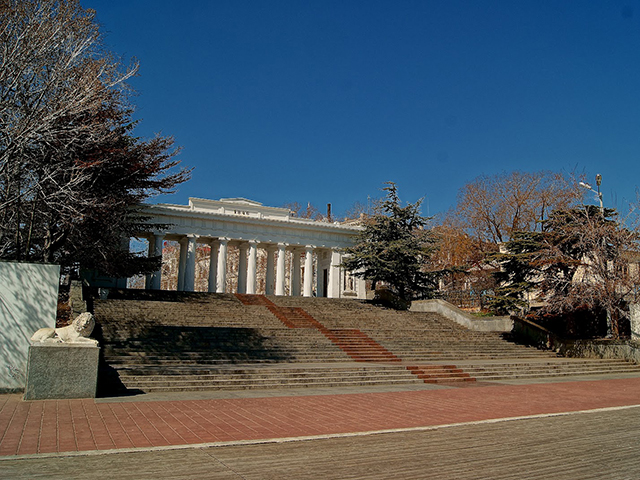 Today, except for the columns of Inkerman limestone and marble lions, Earl’s Wharf «acquired» a number of memorial plaques. One is dedicated to Nakhimov’s victory in the Battle of Sinop. Another tells about the fact that it was from here in 1905, Lieutenant Schmidt went to the cruiser «Ochakov» to lead the uprising. The third plaque is dedicated to the migrants, most of whom were naval officers who left the city after the defeat of General Wrangel. Another memorial plaque was erected in honor of the liberation of the hero-city from the Nazi invaders. The last memorial plaque is dedicated to the cruiser «Chervona Ukraina», which was bombed by the Germans and finished off by Soviet troops.
Naturally, such an object as the Grafskaya Wharf, more than once fell into the epicenter of hostilities. During the Crimean War it was used to supply the fort-port with ammunition. During World War II, not a single bomb dropped from the airplanes of both warring parties exploded near it. Therefore, in 1968 a tandem of architects Artyukhova and Mikhailenko led the restoration of the front entrance to the port city.
The Grafskaya Wharf fulfills its parade, triumphal role, which was originally conceived, even today. It is from it that the parades held on the Navy Day start. Having come on vacation in Sevastopol, the guests of the city, standing on the Grafskaya Wharf, will be able to admire the ships of both fleets, leisurely following from the Southern Bay to Sevastopol Bay.