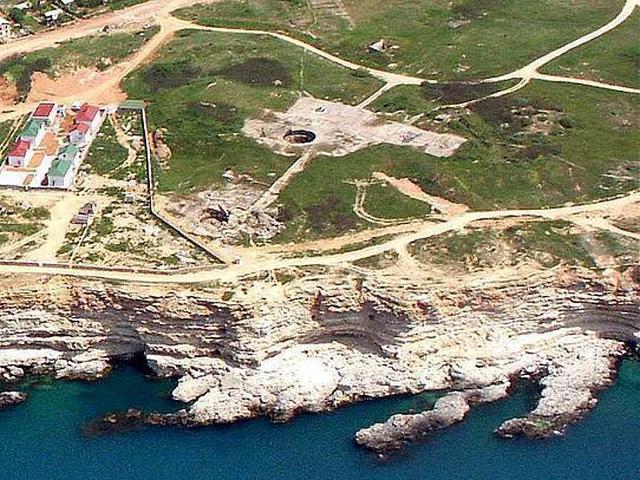
 The necessity to create super large caliber coastal batteries near Sevastopol was motivated by the unsuccessful defense of the naval fortress of Port Arthur during the Russo-Japanese War of 1904-1905, when the fire capabilities of Russian coastal batteries were much lower than the capabilities of Japanese ship artillery when covering the base from artillery fire of Japanese surface ships. The decision to create batteries of extra-large caliber was made by the Russian General Staff in 1910, and in the fall of 1929, the tower shore battery under No. 35 was finally put into service.
The battery was a powerful fortification structure with high survivability and impressive combat power. Battery No. 35 met important operational and technical requirements:
 — protection from three hits of 405 mm naval shells at the point of concrete walls, taking into account penetration and spalling;
— protection against three hits of two-ton aerial bombs at the point of coverings or at the bottom of vertical walls, taking into account penetration, explosive action and splintering;
— protection against penetration of poisonous substances — gaseous, atomized, liquid and solid.
The work of the battery personnel, including those in towers, without gas masks and chemical suits during chemical attacks and contamination of the terrain in the esplanade of the battery with persistent poisonous substances, full autonomy of the battery (its own electricity, water, steam, sewage) was provided. Replacement of worn-out gun bodies by the battery personnel in a combat situation. Application of the latest fire control and communication devices (telephone, radio).
 Battery #35, was armed with four 305-mm guns in two two-gun turrets, which were manufactured by the Obukhov factory in 1914-1916. The battery’s fire control was conducted from two command posts — the main and the reserve, 300-450 meters away from the artillery blocks. Each command post had a combat deckhouse (vertical armor thickness 406-mm, horizontal — 305-mm), a rangefinder yard with a 6-meter Zeiss rangefinder, a communication center, an autonomous power station, placed underground in three floors. Still deeper (about 20-25 meters below the ground surface) were the rooms of firing control devices. The command posts were connected with the artillery blocks by underground galleries laid in the rock at a depth of about 20 meters. The gallery of the reserve command post had a side branch that led out to the seashore and served for the outlet of sewage and drainage pipes, as well as a backup exit.
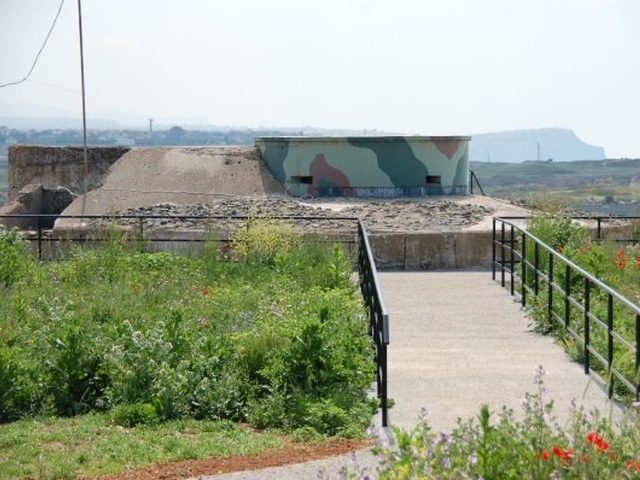 The location of the battery allowed firing in a circular sector (0-360), i.e. on land, ground targets, enemy manpower, armored vehicles and field artillery. Therefore, battery No. 35, as well as battery No. 30, later became the basis of the artillery fire system in the heroic defense of Sevastopol. The firing range of the batteries allowed them to keep under fire of their guns a huge territory around Sevastopol: in the north up to Bakhchisarai inclusive, and in the south up to Simeiz and Baidar Gate. For the defense of land approaches to the battery were built five reinforced concrete pillboxes for three machine guns each, with a thickness of walls and floors up to 0.5 meters. All the above-ground structures of the battery were camouflaged; a special metal frame was made over the main entrance, covered with camouflage netting.
According to the peacetime staff of the battery consisted of 12 commanders, nine officers, 62 junior officers, 151 Red Fleet soldiers, total 234 men.
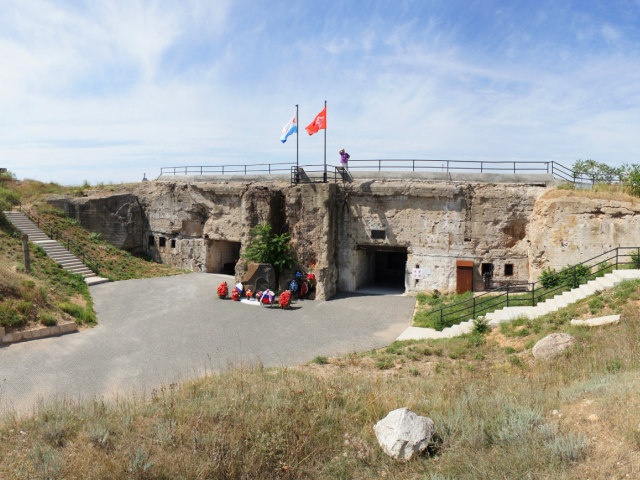 Battery #35 played an important role in the heroic defense of Sevastopol. As part of the 1st separate artillery division of the main base of the Black Sea Fleet together with the turret battery #30 it was a kind of «backbone» of the artillery defense system of the fortress and inflicted serious damage to the enemy in manpower and equipment.
After the war battery No. 35 was not restored, but its casemates were used as ammunition cellars, command post and personnel quarters of the four-gun 130-mm battery No. 723, located near the array of battery No. 35.
In 1963, after the military abandoned the area, the Executive Committee of Sevastopol City Council adopted a decision, according to which the territory of the 35th coastal battery was taken under the protection of the state. However, no concrete measures were taken to preserve the historical site. The battery was deteriorating, construction and household garbage was accumulating in its casemates and on the adjacent territory.
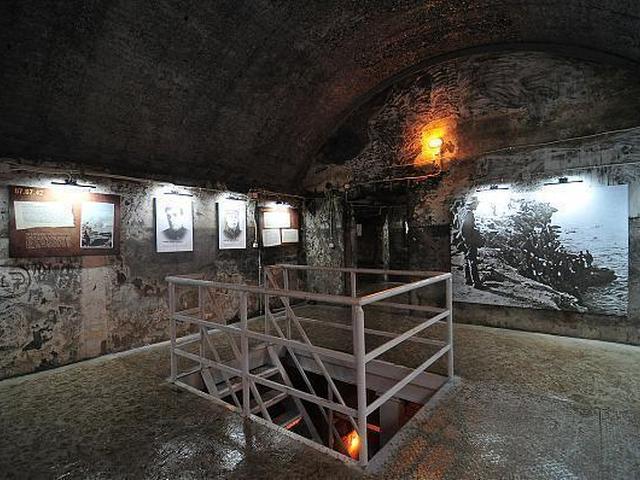 At the turn of the 80s-90s the interest to the previously «closed» pages of the defense of Sevastopol increased. The territory of the battery explored search parties, historians. Here were held meetings of veterans, timed to July 3, the date of the official end of the defense of Sevastopol 1941-1942.
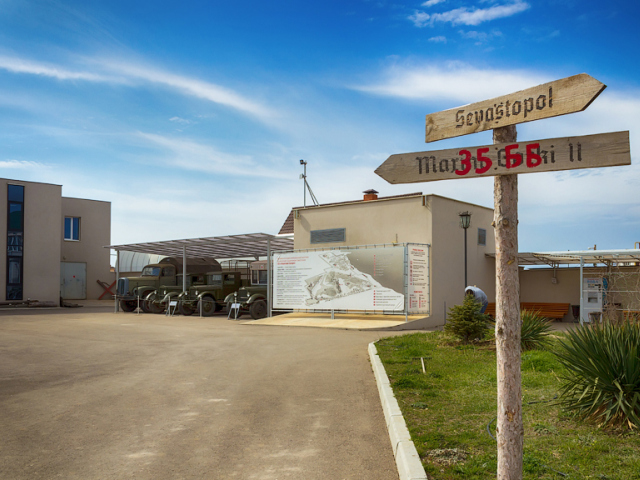
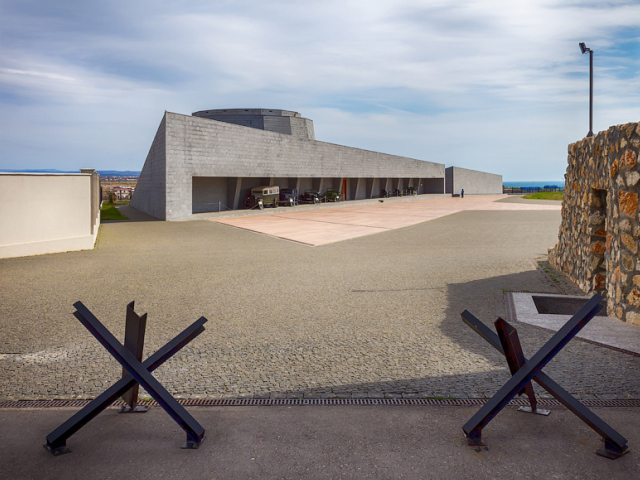
In 2007 began the creation of the Museum Historical and Memorial Complex to the heroic defenders of Sevastopol «35th Coastal Battery». Thousands of people — specialists of various professions — took part in its construction. The memorial complex was created on non-state funds. The main part of the costs of design, construction, maintenance and development of the complex was assumed by the enterprises of the industrial group «Tavrida-Electric» (General Director A.M.Chaly). The architectural concept and design were developed by architect A.I.Khomyakov (Moscow). The project and working documentation were executed by CJSC Sevastopol Stroyproekt (Director V.I.Loshanyuk).
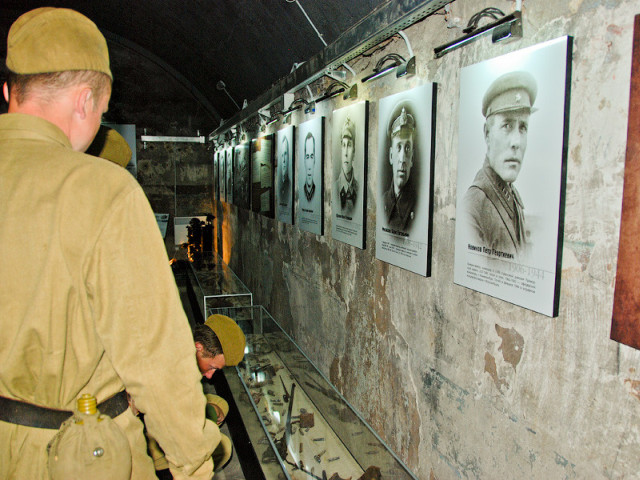 Creation of a museum complex of such scale (the area of the memorial is about 8 hectares, underground structures are about 5 000 square meters) is an unprecedented event not only for Sevastopol, but also for the whole post-Soviet space. This is an example of careful attitude to our common history, to the memory of those who defeated fascism in the Great Patriotic War of 1941-1945.
The exposition of the museum is located in the casemates of the coastal battery No. 35, the exhibits of which tell about the history of the battery and its participation in the heroic defense of Sevastopol in 1941-1942, about the events related to the last battles on Cape Chersonese, the fates of soldiers and commanders.
The museum exposition is divided into three excursion routes. As a rule, visitors go through the 1st and 2nd or 1st and 3rd routes. The tours end with a visit to the Pantheon of Memory.