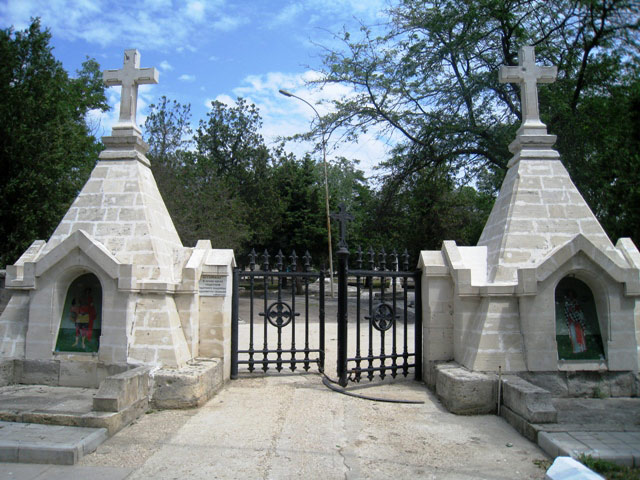
The Bratsk Cemetery complex with the Church of St. Nicholas is one of the strongest memorial structures even in Sevastopol, which is not poor in such facilities. Both structures were the result of the Russian Empire’s participation in the war against the coalition formed by the Ottoman and British Empires, France and the Kingdom of Sardinia. The war raged in the Caucasus, the Danube Delta, and the Baltic. But for unknown reasons, it was the Crimean peninsula that became the area of greatest confrontation.
The reason for the war was the weakening of the Ottoman Empire, supported by Great Britain, and the desire of Nicholas I to «pull away» from the weakening Muslim monster of the ancestral Christian lands — Bulgaria, Moldavia, Slovenia, Montenegro. This idea was strongly disliked by Napoleon the Third, who suspected in strengthening Russia’s position in the Balkans a threat to his imperial power. The reason for the war was the occupation of the Moldavian and Wallachian Principality by Russian troops, after which Turkey and its associates declared war on it.
The Crimean War brought misfortune and failure to all parties involved in the conflict. The Ottoman Empire was declared bankrupt, the British government resigned, and Russia found itself at the bottom of a financial hole from which it was able to climb out only 14 years after the end of the war. But no amount of money can estimate the deaths of 250,000 people who died directly in battle or died of wounds and disease.
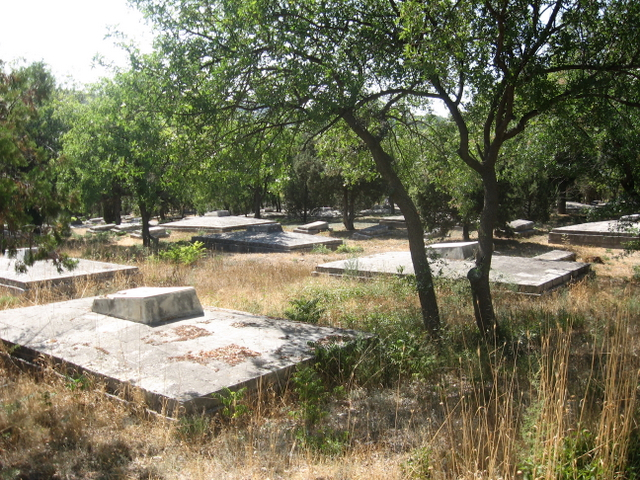
It is to the memory of Russian soldiers who died for nothing during the Crimean War that the Bratskoye cemetery is dedicated. It is located in the area of Kurina Balka, on the northern shore of Sevastopol Bay. Today it is the territory of the Nakhimov district. During the battle for Sevastopol all the dead were taken to the northern shore of the bay, which at that time was not inhabited by people. In addition, there was a hospital where Pirogov worked, so those whom the famous surgeon and nurses could not help, were also buried on this side of Sevastopol Bay.
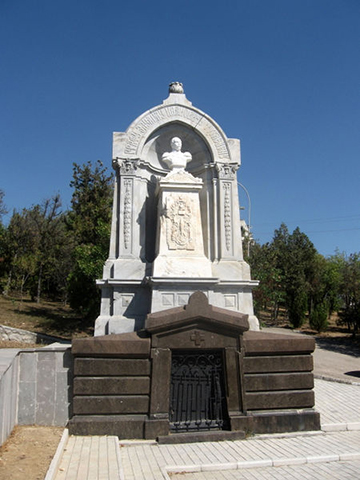
In total, the wasteland of the North Side accommodated 472 (!) mass graves, in each of which were laid at least a hundred Russian soldiers. Of separate interest to researchers are 130 personal graves. In them rested the highest ranks — General Khrulev, Princes Golitsyn and Gorchakov, Rear Admirals Maksutov, Kumanin, Serebryakov, Narbut and Manto. Count Eduard Totleben deserves a separate sentence. First, he commanded the defense of Sevastopol and ordered the sinking of ships in the local bay. And secondly, it was he who gave the cemetery the name Bratskoye, a few years before he rested there himself. It is noteworthy that the mass graves of the lower ranks are mostly neglected or covered with simple concrete slabs. The monuments of the higher ranks are fine structures of white marble, with a bust of the «master», columns and a small epitaph. The whole Bratskoye cemetery is surrounded by a powerful fence made of Inkerman limestone. The new gate of the cemetery reproduces the silhouette of the famous St. Nicholas Church, erected on a hill on the territory of the memorial complex.
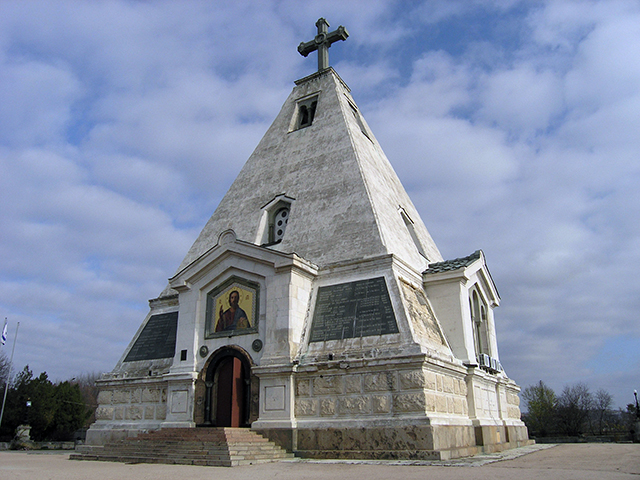
If the cemetery appeared during the war — in 1854, the temple began to be built immediately after the end of the war — in 1857. This is the only one of its kind sacral construction on the territory of Crimea and Ukraine: a Christian church, which is made in the form of an Egyptian pyramid. Thus, the architect Avdeev sought to convey the idea of eternity and meaninglessness of war. By the way, for this project he was awarded the title of academician of architecture, the only one in the entire Russian Empire.
Unlike the Egyptian ones, the Crimean pyramid is crowned with a massive metal cross. The outer first tier of the unique church of St. Nicholas is covered with diorite slabs. On it are written the names of the units that fought for Sevastopol. In the middle of the temple is edged with black-marble slabs, on which are engraved the names of 943 high officials who distinguished themselves during the defense of the city.
The doors of the church are made of bronze by master Adolf Morano, and in the middle it was painted with frescoes in the Byzantine style, similar to those that decorate the Venetian Cathedral of St. Mark. A little later, the frescoes were replaced by Italian mosaics copying the original subjects.
These sevastopol attractions, the cemetery and the temple, were badly damaged during World War II. The bell, the top of the temple, and the graves of soldiers were repeatedly hit by shelling and used as fortifications by Soviet and German fighters. Today, the cemetery has been put in order, the church is being restored, and services are regularly held in it for the repose of the soldiers who rested in this land.