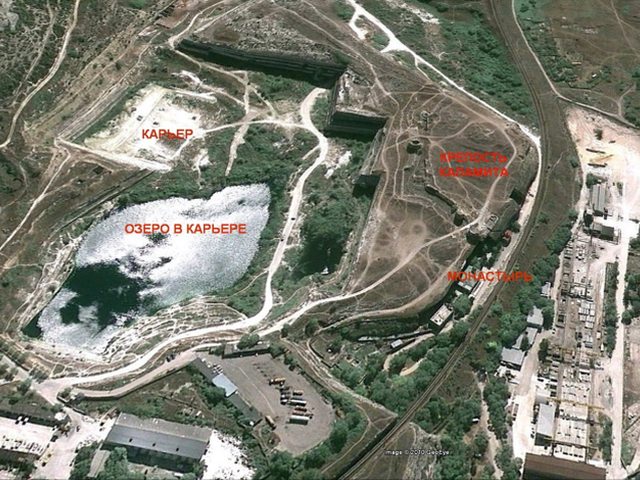
The remains of the fortification structures of the Fortress of Kalamita are located on the top of Monastirskaya Gora at the mouth of the Chernaya River, above a deep precipice. Originally on the site of the fortress was a fortification, founded by the Byzantines in the VI century. to protect the approaches to the city of Chersonesos. At the end of XIV — beginning of XV century in order to resist the Genoese colony Cembalo Crimean feudal princes Teodoro lay the fortress on the former Byzantine fortification. At first, defense walls and a gate tower were erected. Subsequently, the walls were additionally reinforced with five more two-tiered square open towers, which protrude 3.5 meters beyond the line of curtain walls. However, the insignificant thickness of the walls (about 1 m) and the poor quality of the structures had a negative impact on the defense capability of the fortification.
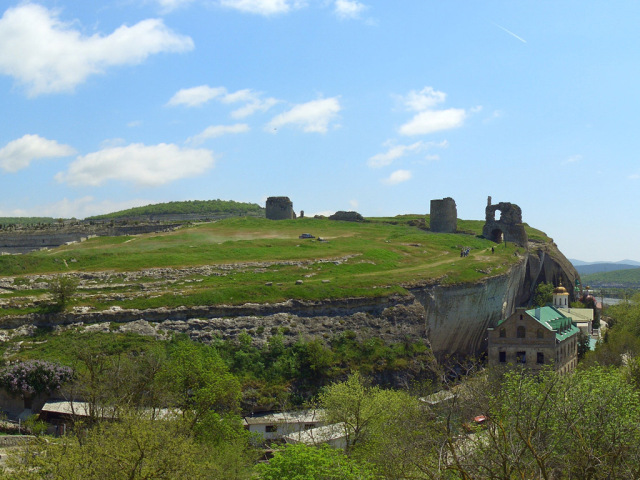
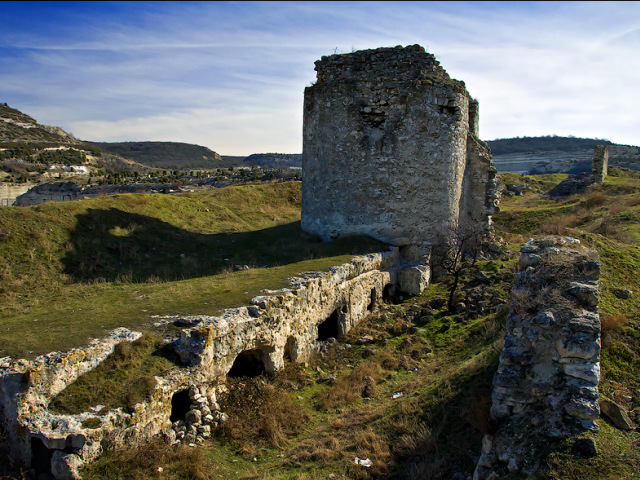
In 1434 the fortress was captured and devastated by the Genoese. Subsequently, they partially strengthened it, rebuilt several towers. But soon, in 1441, forced to leave the fortification to the previous owners. Later, the Theodorites did not carry out any significant actions to rebuild the fortress. In 1475 it was easily captured by the Turks and called Inkerman (cave-fortress). In XVI-XVII centuries they strengthened the defense walls and existing towers, erected a new round tower, adapted the fortification to combat modern at that time firearms. The fortress consisted of six towers connected by four curtain walls. Three of them have not survived. The thickness of the fortress walls was from 1.2 to 4 meters, the height of the towers reached 12 meters, the curtain walls 8-10 meters. The upper open areas of the towers and curtain walls were protected by parapets with teeth.
 .
.
The total length of the fortifications of Kalamita is 234 meters, the area of the fortress is 1500 m2. Unfortunately, only fragments of the tower structures have survived from the former fortress.
In the precipice of the limestone mountain, on top of which the fortress is located, contains a cave monastery connected to it by a staircase with several tiers of temples and cells carved in the rock. It was founded in the VIII-IX century. Hence the name — cave fortress, or Inkerman. The Kalamita Fortress and Klimentovsky Cave Monastery as an integral complex is a unique landmark of defense and sacral architecture of Krym.
 .
.