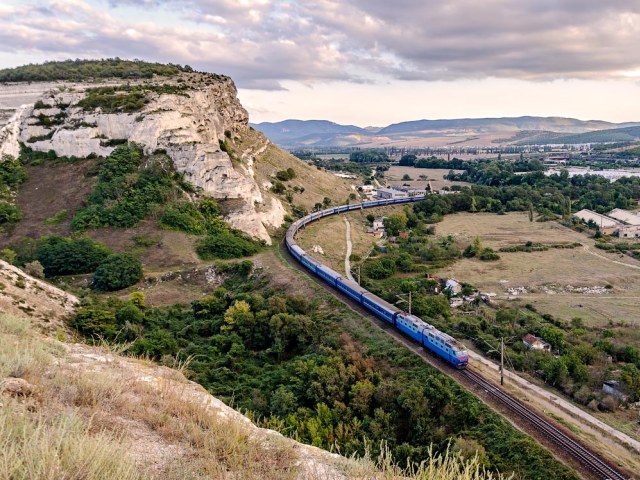
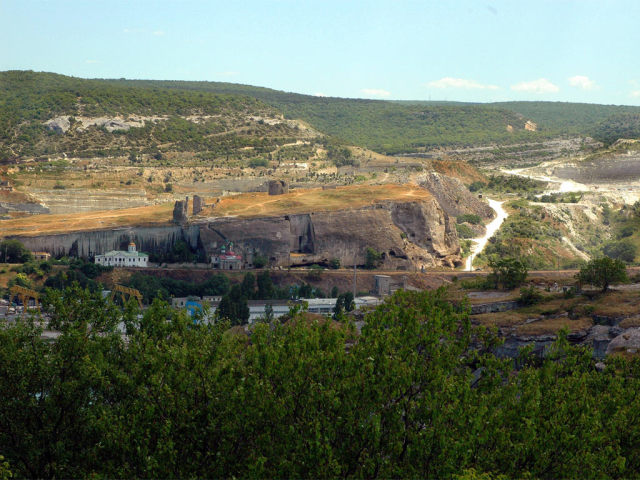
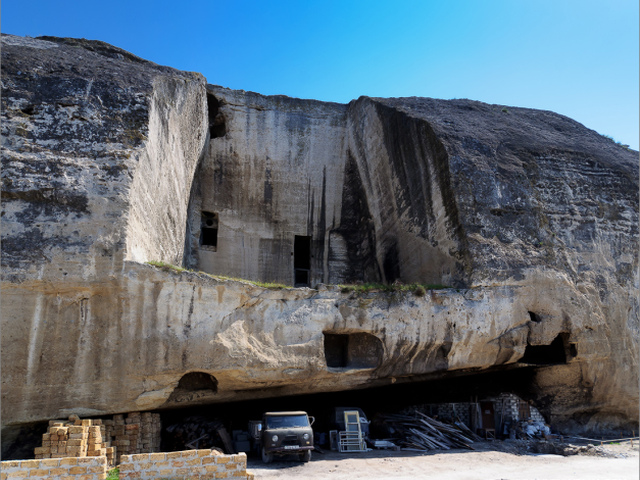
Inkerman is a famous suburb of Sevastopol. Here they mine Inkerman stone — dense white limestone, which is used for cladding of buildings. This stone has been mined since time immemorial, so there are many catacombs and caves in the rocks.
It was here, in the Monastery and Zagaitan rocks that a cave monastery was founded. Church legend connects the foundation of the monastery with the name of the Holy Martyr Clement — Bishop of Rome from 92 to 101. In Caesarea Clement received baptism from the Apostle Peter, after which he continued his journey with him, sharing all the labors and dangers. For his preaching activity and righteous life Clement was ordained by the apostle Peter as bishop of the city of Rome. He converted many idolatrous Romans to Christianity, which incurred the wrath of the Roman Emperor Trajan (94 — 117 AD). In 94 BC Emperor Trajan exiled Pope Clement to hard labor in the northern province of the Roman Empire — on the Tauride Peninsula, in the city of Chersonesos, or Korsun, not far from which, in the Inkerman valley, were quarries.
Through the labors of St. Clement and his disciples, up to 75 churches were built in the Crimea. The cave church in the name of St. Ap. Andrew the First-Called, according to legend, was cut down by St. Clement himself. The rulers of Chersonesos did not like the activity of St. Clement, so they decided to execute him. A heavy anchor was tied around the saint’s neck and he was thrown to the bottom of the sea in the Cossack Bay. This happened in the year 101. A year later the sea receded, and in an underwater grotto people saw the remains of the righteous. Every year on the day of the death of the saint Christians came to the place of execution and on the exposed bottom went to worship the holy relics. Subsequently, they were transferred to a small island (now Cossack Island) in the middle of the bay, on which, according to legend, the hands of angels built a church.
And in the former quarries there was a monastery. When in this part of Crimea strengthened the influence of the feudal principality of Theodoro, at the end of the North Bay, at the mouth of the Black River was founded seaport Avlita, and for its protection Mangup prince Alexei rebuilt the ancient fortification, turning it into a fortress Kalamita. Here, under the protection of a formidable fortress, approximately in VIII-IX centuries and a cave monastery was founded.
 .
.
The caves served the first monks as both dwellings and outbuildings. Temples were also built in caves, the altar, throne and pews were cut out of stone. All rooms were connected by staircases cut in the rock. Being close to a large commercial port, the monastery lived well.
In 1475 Crimea was conquered by the Turks. They rebuilt the fortress and called it Inkerman, which means «cave fortress». Obviously, a Christian monastery could not exist next to a Muslim fortress and gradually fell into disrepair. Some scholars believe that the monks went to Cape Fiolent and founded there Georgievskij monastery. The revival of the ancient monastery began after the annexation of Crimea to Russia. In 1787, the monastery was visited by Empress Catherine II and foreign august persons accompanying her.
 .
.
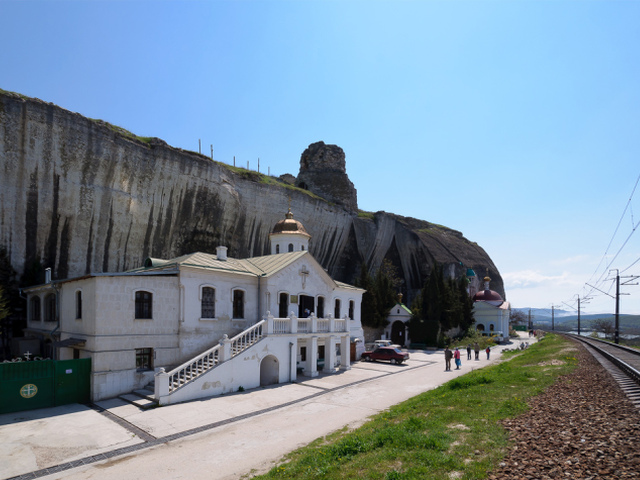
The Inkerman Monastery was renewed and consecrated in the name of St. Martyr Clement. The reconstruction of three cave temples began. The temples were cleaned of debris and stones, renewed paintings. October 15, 1852 was consecrated church in the name of the Holy Martyr Clement. The temple had the form of a basilica, once two rows of columns divided the space of the church into three naves. Only a part of the columns has been preserved till nowadays. A long corridor leads to the church, in which stone benches are cut out — obviously, here the worshipers waited for the beginning of the service. In the apse there is a two-stage synthron, in the center of which are the remains of the high place. Above it in the wall there is a niche for the altar image. Here is also carved a large cross, its ends are extended and small crosses in a circle adjoin them.
On the right side of the temple there was an ancient side chapel in honor of the Apostle Andrew — small, with a low ceiling. The altar was separated from the rest of the church by a solid rock partition with the Royal Gate in the middle. In 1867 another cave church was opened, dedicated to the Roman bishop St. Martinian. The apse was enlarged in the rectangular-shaped church covered with a semicircular dome.
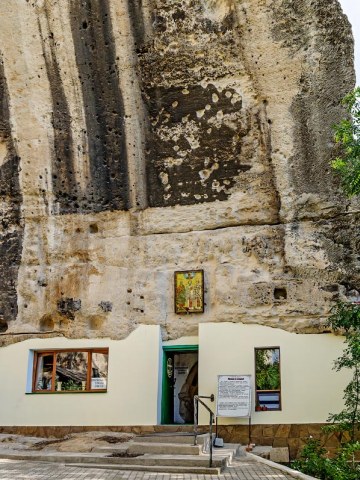
Two years after the opening of the monastery, the Crimean War broke out. The monastery was also seriously damaged. Enemy cannonballs and bullets did not destroy the cave temples, only traces of them on the walls remained, but the British looted all the property of Inkerman monastery.
In the 60-ies of the XIX century. were restored ancient temples, built the house of the abbot with a house church (consecrated August 13, 1867 in the name of the Holy Trinity), restored the spring of St. Clement.
In 1875, completed the construction of the railroad, connecting Sevastopol with the station Lozovaya. It passed near the Monastery Rock. The noise of passing trains broke the centuries-old silence of the monastery, but the number of pilgrims increased. To comfortably accommodate them, the monastery in 1896 built a hotel that could accommodate 24 people.
In 1895, in memory of the rescue of the royal family in the railway accident near Borki station on October 17, 1888, a church in the name of the Great Martyr and Healer Panteleimon was built and consecrated. The architectural peculiarity of this temple was that the altar part was cut out in the rock, the rest of the temple was above ground.
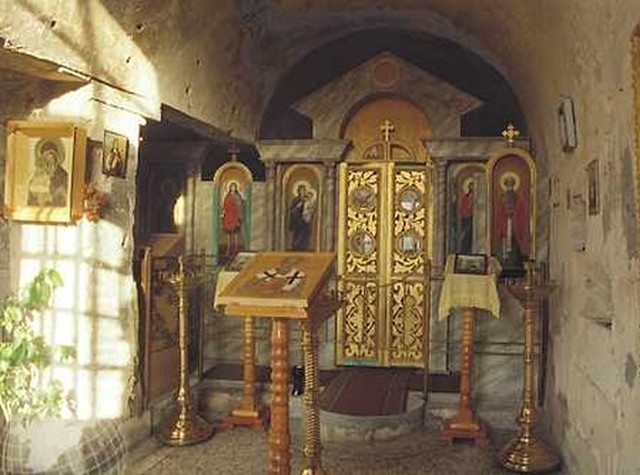
In 1905 several temples appeared in the monastery at once. During the reconstruction of the same year the rock walls were whitewashed, but because of the whitewash one could see 8 figures of saints in baptismal robes with halos over their heads. Above the throne was the image of Christ in the cup. At the bottom of the image there was an inscription — the prayer of the servant of God Zotik with his wife and children. This inscription is dated 1272.
Already at the beginning of the XX century in the temple there were burials, three tombs cut out in the floor of a small cave next to the temple have been preserved.
In 1905, in memory of the Crimean War on the upper plateau was built a church in the name of St. Nicholas of Myra (designed by architect G. P. Dolin). The church, cross-shaped in plan, had two aisles.
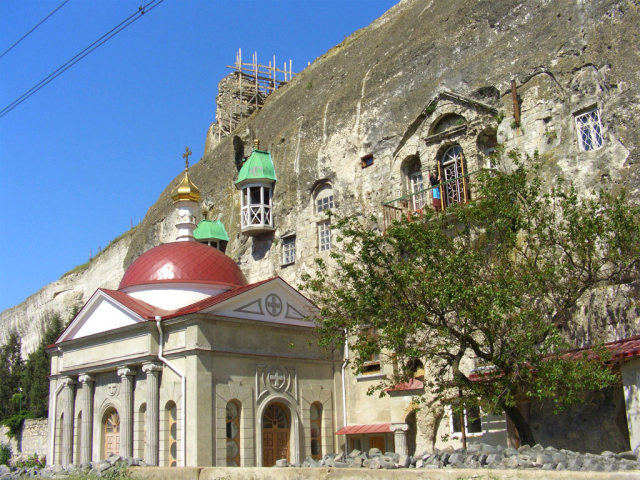
September 27, in the presence of Grand Duke Alexei Mikhailovich and veterans of the Crimean war was consecrated cave church in honor of the icon of «Joy of All Who Sorrow». The church was built on the site of the ancient St. Sophia Church, cut out in the cliff of the Kamolenomannaya beam.
 .
.
By 1910 the architectural appearance of Inkerman Monastery was finalized. There were built two residential buildings for the brethren, in one of them arranged a house church in honor of the Annunciation of the Blessed Virgin Mary. A parochial school was opened at the monastery, which was attended by 37 boys. In 1917, 25 monks and 122 novices lived in the monastery, 147 people in all.
During the Civil War the monastery supported the White Army of Baron Wrangel. After the establishment of Soviet power in the Crimea, all the lands of the monastery were nationalized and transferred to the disposal of the labor artel, which included the monks. In 1926, at a meeting of the Presidium of the Sevastopol District Executive Committee it was decided to close the St. George and Inkerman monasteries.
In 1927 an earthquake severely damaged the Annunciation and St. Nicholas churches, it was decided to dismantle them (closed in 1926 the church of St. Nicholas on the upper plateau was completely destroyed in 1932). The chapel, built on the grave of soldiers, was dismantled in 1927. In 1928 closed the church of the icon of «Joy of All Who Sorrow». The spring, discovered miraculously by St. Clement, dried up in the 1930s (possibly — in connection with the ongoing construction work), and its water, according to one version, gradually flooded the quarry for the extraction of Inkerman stone, located on the other side of the Monastery Rock.
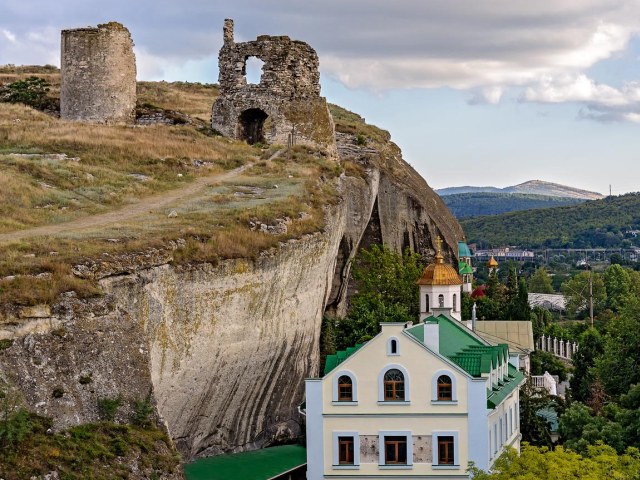
In 1991, by the labors of Archimandrite Augustine, under Bishop Vasily of Simferopol and Crimea, the Inkerman Monastery was restored. Restoration work began, the temples and cellular buildings were restored.
In the cave church in the name of St. Clement is kept a particle of relics from his holy head, transferred to the monastery with the blessing of His Beatitude Volodymyr, Metropolitan of Kyiv and All Ukraine. The reliquary with the holy relics is installed in the side aisle of St. Klimentovsky Church.