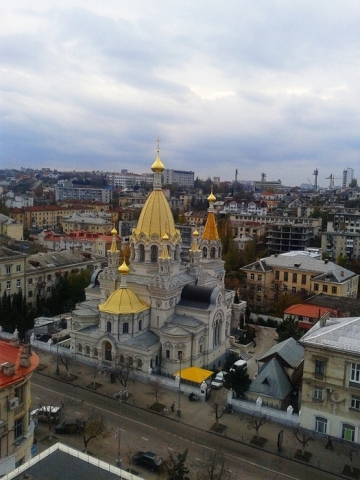
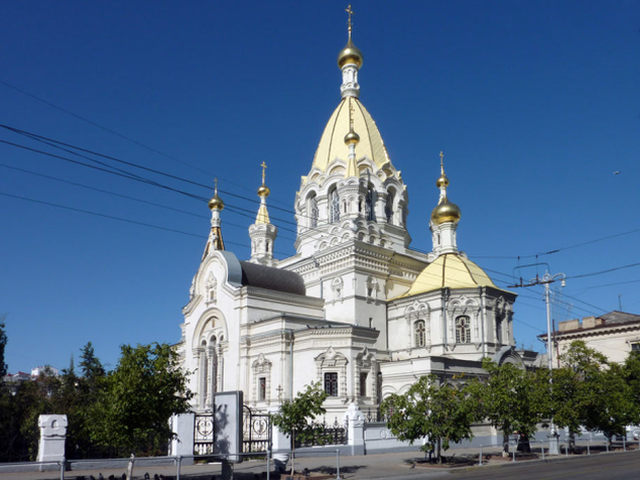
On one of the most beautiful central streets of Sevastopol — Bolshaya Morskaya — is the Cathedral in the name of the Intercession of the Mother of God. It was built from 1892 to 1905 on the project of the famous architect and artist-acquarelist V. A. Feldman (1864). A. Feldman (1864 — 1928). As a model, the architect took stone Russian temples of the XVI century. The cathedral is quite massive, but it does not leave a heavy, crushing impression. On the contrary, it stretches upwards, towards the sky: the lancet vault, and each of the four turrets surrounding the dome, and the slender bell tower, which is connected to the temple by a rectangular continuation of the central volume. The turrets and bell tower have a hipped roof topped with onion-shaped poppies. The cathedral is decorated with architectural elements in Old Russian style: kokoshniks, cornices with stucco friezes, arched window designs. The refectory adjoins the cathedral from the western side, inside which there are two rows of pillars and a staircase leading to the choir. The entrance to the refectory is through a porch with a stone staircase similar to a closed gallery.
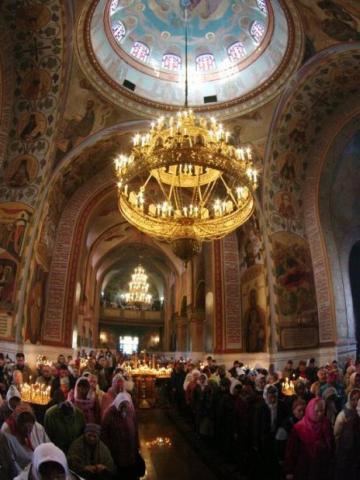
This temple was loved by the people of Sevastopol, it was visited by people of different classes: sailors and their families, servicemen and officers. The cathedral included two temples: the upper — in the name of the Protection of the Blessed Virgin Mary and the lower — in the name of the Holy Great Martyrs of Faith, Hope, Love and their mother Sophia.
The Holy Great Martyrs suffered for Christ in Rome under Emperor Hadrian in 137. St. Sophia was a widow and raised her three daughters in Christian piety. News of the beauty, intelligence and education of the young maidens reached the emperor, and he ordered to bring them to him. The emperor ordered the girls to offer sacrifices to pagan gods, but they, prepared by their mother’s prayers and exhortations, fearlessly confessed their faith in Jesus Christ. All three girls, Faith, 12, Hope, 10, and Love, 9, were brutally tortured before their mother’s eyes and then beheaded. Their mother Sofia, after burying her daughters, died on their grave three days later out of grief. The people buried her side by side. Sophia did not suffer bodily torture, but for her mental suffering the church called her, like all her daughters, a martyr.
During the Great Patriotic War, the cathedral housed a hospital. One day a tragedy happened: a bomb hit the south aisle and everyone who was there was killed. They were buried in a large mass grave next to the church.
After the war, the cathedral was restored, and services were held there until 1962. Then it was closed and handed over for use to the archive. Over the years, the archive documents became more and more numerous, and a larger room was needed to store them, but nothing suitable was found for a long time.
The revival of the cathedral began in 1992, when released from the archival documents of the northern side chapel in the name of St. Great Martyr Panteleimon, it was re-consecrated on April 8. And at the beginning of 1994 the whole building was handed over to the Church, by that time the domes and crosses were almost completely restored.
A tragic event took place in the temple on September 17, 1993. During the evening service, one of those present in the temple, a very young man, set fire with a militant incendiary mixture to a side chapel of the Cathedral in the name of St. Panteleimon, in which parishioners were praying at that moment. Fortunately, God did not allow the death of people, except for the arsonist himself, he, engulfed in flames, could not be saved. The high temperature melted the concrete of the floor, but the iconostasis survived, the fire hardly touched it. Now this iconostasis decorates the Seraphim aisle of the cathedral.
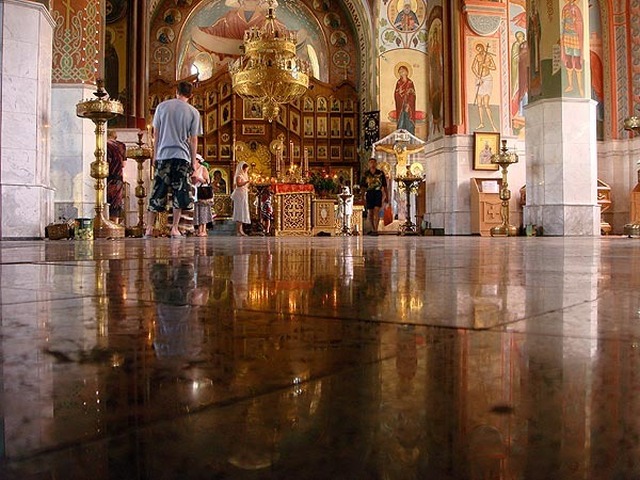
In 1998 began work on the interior painting of the temple. The first to paint the side chapel of St. Panteleimon, its walls decorated with eleven stories from the life of the saint and the image of the Savior. Worked on the frescoes creative team of artists from Kiev: Sergei Odainik, Viktor Kozik, prepared sketches Vadim Kozik. Metropolitan Volodymyr (Sabodan) blessed them for this work, he also helped them with advice on what subjects to address and how to design the general painting. S. Odainik designed a wonderful iconostasis, and he also designed the pattern for the floor of the cathedral.