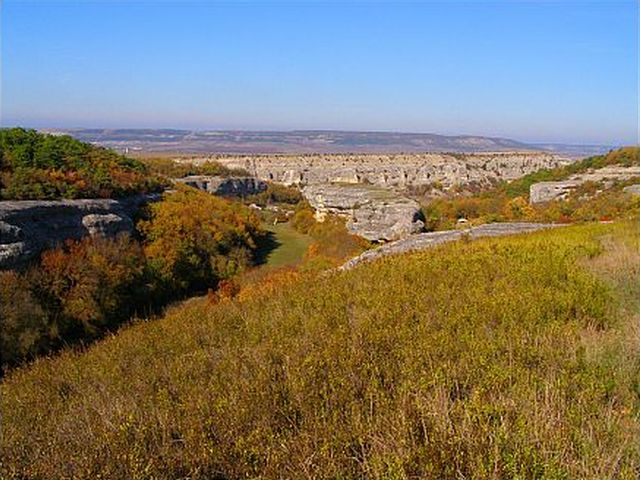
Crimea can be explored to infinity. Other considers himself a real mountain wolf: he was on Chatyr-Dag, on Demerdzhi was, Karabi caves were climbed, BKK is a passed stage, Chernorechka in one day. What can surprise such a person? And ask him: «Have you been to Kyzik-Kulak-Kaya?». That’s where our omniscient traveler gets confused: «Where is it? I haven’t heard anything…» — He will mutter to himself under his nose.
Our mountain wolves do not reach such places. They skip by, rushing to the high and alluring peaks. And so they sometimes miss simply unique objects.
Krasny Mak village of Bakhchisaray district has never been a «tourist Mecca». Excursion buses do not come here, and backpackers rarely come here. And for nothing! It is worth looking at the outlines of the surrounding rocks, how unusual they are. Formed by nummulite limestones and processed by atmospheric processes, they have acquired absolutely fantastic outlines. Nature has created a lot of things: «monkeys», «sharks», «turtles» and «crocodiles». And to the west of the village she built a whole fortress wall with «towers» (Bash-Kaya).
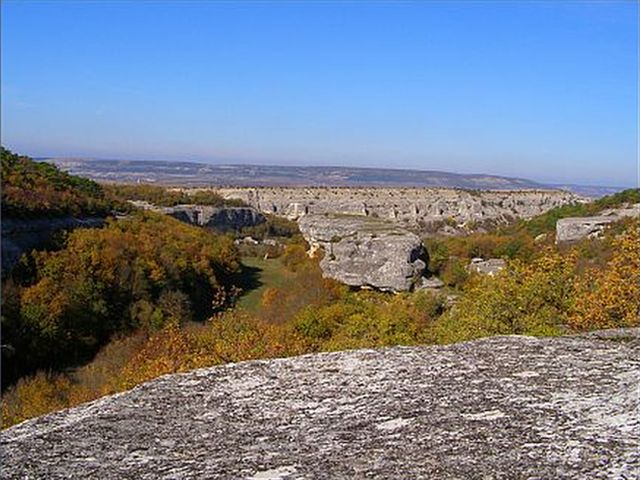
Several parallel ridges approach the village from the south. Between them is hidden oblong-shaped Ostanets Kyzyk-Kulak-Kaya. Its long name is interpreted by local historians in different ways: both the rock «sheep’s ear» and «sorrel rock» (kuzukulak — sorrel (kr.-tat)).
In shape, it resembles a submarine that has surfaced between the shores of the bay.
From the highway Kyzik-Kulak-Kaya is not visible, from Krasniy Mak it is hardly noticeable. Therefore, hikers usually have no idea of its existence.
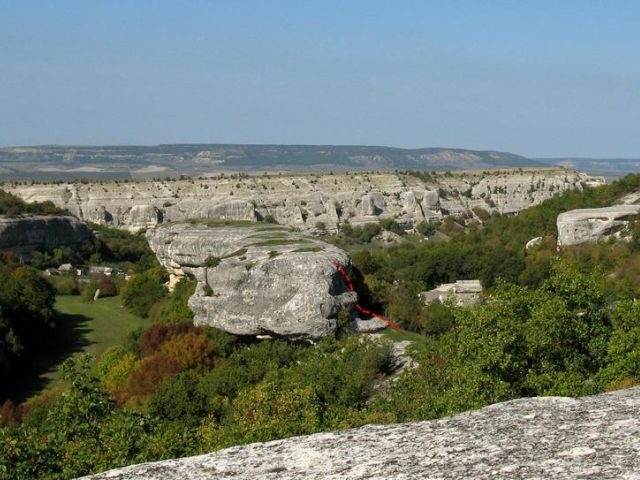
But the place is very interesting. The first interesting point is that Kyzik-Kulak-Kaya is a completely isolated plateau. There are no gentle slopes allowing free ascent there. Such a lost world! You can climb the plateau only by rope! By the way, someone has already taken care of it. In the southern part of the plateau, where the cliffs are the lowest, there is a piece of black rubber band hanging from the top. It is true that you still need to get to it. First on the lower ledge, then along the ledge to the rope. Part of the surface of the lower ledge is sloping, there is no reliable support. There is nothing to hold on to — the rock is almost smooth. It is not easy to move. But emotions!!!
 .
.
The rope itself is also a pleasure for extreme climbers. It is tied to a couple of stunted junipers on the top and when trying to hang on it suspiciously stretches. That’s why it serves, rather, for psychological support. Ancient notches in the rock help. Just parallel to the rope. These are not even notches, but rather faintly expressed depressions that allow you to put your foot on something, thinking at the same time: «will it or won’t it slip»? The depth of notches is about five centimeters, the surface is almost polished. Whether the ancients suffered from adrenaline addiction and loved entertainment with risk for life, or whether over the centuries the notches have been greatly erased, but they are a very symbolic support. The only comforting thing is the fact that the locals regularly climb up there. They have several television antennas fixed there.
A small «lost world» awaits those who are not afraid of the difficulties of climbing. The surface of the remnant is absolutely flat, as if it had been roughened with a planer. Table Mountain is a table mountain. Narrow and long. It is 10-15 meters wide and about 400-500 meters long. On the edges — smooth bare stone, in the middle, in some places, a thin 20-30-centimeter layer of soil. Orange shards of pottery peep out from under stunted grass and moss. There are a lot of them. In one place there is a whole scattering. Sometimes there are large pieces. Probably, earlier there were more of them and the assortment was more diverse. At least in «materials to the archaeological map of the South-West Crimea» by I. Repnikov about finds it is told so: » …. insignificant turf layer, thickness 0,2-0,3 m, in it a considerable quantity of red-lacquer ceramics of late Hellenistic and Roman pore of 2 c BC and till the beginning of 2 c AD. Fragments of black and gray vessels with carved ornament and some fragments of «Megarian» relief cups….».
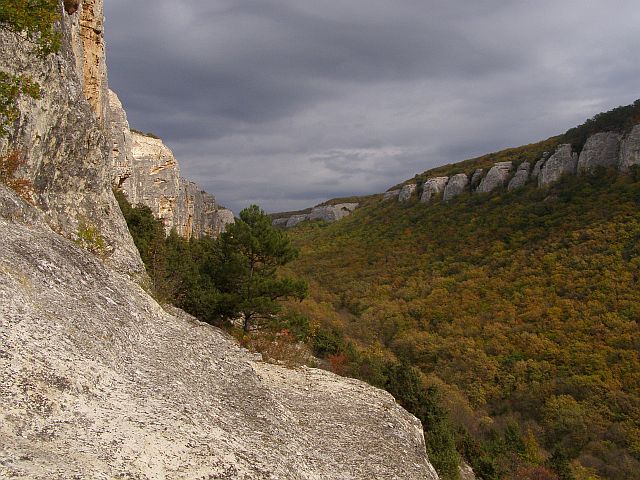
Pottery finds are common in ancient settlements or shelters. But their territory is never so dotted with pot shards as we see here. It is not clear for what purpose so many dishes were brought to the remnant. The most probable assumption is the cultic purpose of the site. The flat plateau resembles an altar arranged by nature itself.
To the south there is another peak. Just as flat. A little higher and a little shorter. The ascent to it is the same, from the south and also not without extreme. But just a little bit. Quite accessible extreme. Along the ledge there is the same chain of depressions, only horizontal. It is convenient to get to the plateau by it.
And here was found ancient pottery! But curiously enough, it’s quite different. More simple, even primitive, from rough, without ornamentation, vessels.
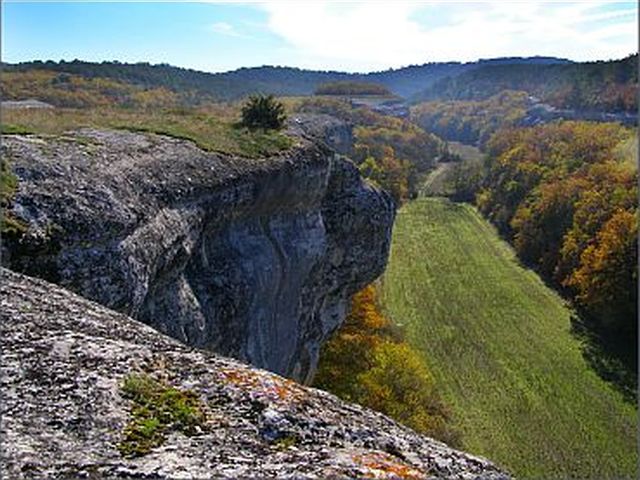
Part of the southern peak is occupied by forest. The name Tau-Kaya (tau-les (kr-tat)) is quite appropriate here. On the eastern edge is a glade with thickets of bush jasmine. And the most picturesque part is a rocky cape at the northern end. From here you can perfectly see the whole Kyzik-Kulak-Kaya in a very photogenic angle. And just to sit here is very good. To think, for example, about our ancient ancestors. For what purpose they came here? What did they bring in those jugs and amphorae, the shards of which are lying under our feet? What did they ask their Gods for? Two mountains: Kyzik-Kulak-Kaya and Tau-Kaya. How they differed for people of the past. Why were offerings brought to the first one in a «noble» container, and to the second one in a simpler one? Sanctuaries of different social groups? Different peoples? Different periods? Different Gods, finally? How many more mysteries hide our ancient Taurica.
 .
.
Repnikov in «materials to the archaeological map…» mentions «burials with jugs», which were found by local peasants when plowing the valley to the east of Kyzik-Kulak-Kaya. Probably there was a necropolis there. So there was a settlement somewhere nearby.
Under the rocky canopy on the western side of Tau-Kai there are obviously artificial cuttings. So the people of Tui did something in the Middle Ages? Unfortunately, the area is poorly studied archaeologically, and it is difficult to get answers to the questions. What’s left? Just admire the landscape. It deserves it.