Most people associate the name of Admiral Nakhimov with the ship of the same name, which sank in 1986. This steamship was built in Bremen in 1925. It made cruises in the Mediterranean Sea, and during the Second World War it was registered in the port of Gdansk as a hospital ship. Sinking. It was raised by Soviet divers from the bottom of the Baltic Sea and redeployed to the Black Sea, where under the name of «Admiral Nakhimov» it cruised between the ports of the Crimean Peninsula and the Black Sea coast of the Caucasus.
When the «Admiral Nakhimov» sank, pulling 423 people into the abyss, his name came to symbolize misfortune. Only a few people know that his «godfather» — Pavel Stepanovich Nakhimov was a god of victory and an idol of the Russian Navy. In a heavy, bloody war, his abilities allowed the Russian squadron of the Black Sea Fleet to defeat the Turkish. This battle is called the Battle of Sinop. It took place in 1853 and was the only victorious operation of Russian troops on the Black Sea during the Crimean War.
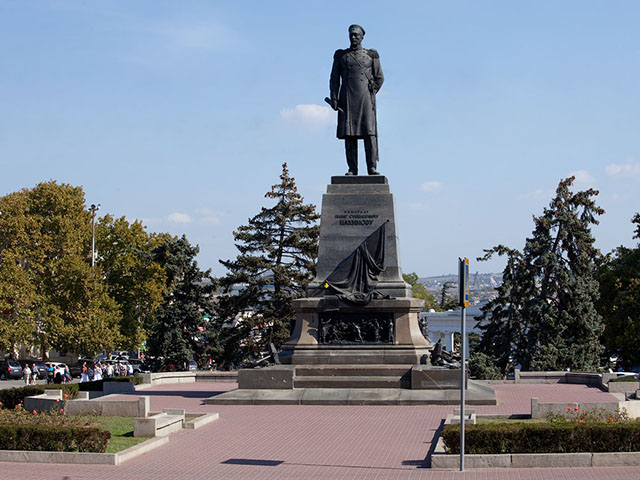
By the 45th anniversary of the Sinop victory, a monument dedicated to Admiral Nakhimov appeared in Sevastopol. Why in Sevastopol and not in Sinop, Yalta or Gurzuf? Because this city is the main base of Russian and now Ukrainian ships stationed on the Black Sea. The memorial to the revered naval commander was designed by General Bilderling, who dabbles in fine arts, and executed by sculptor Schroeder, the author of the empire’s best monuments to Kruzenstern, Bellingshausen, and Peter the Great.
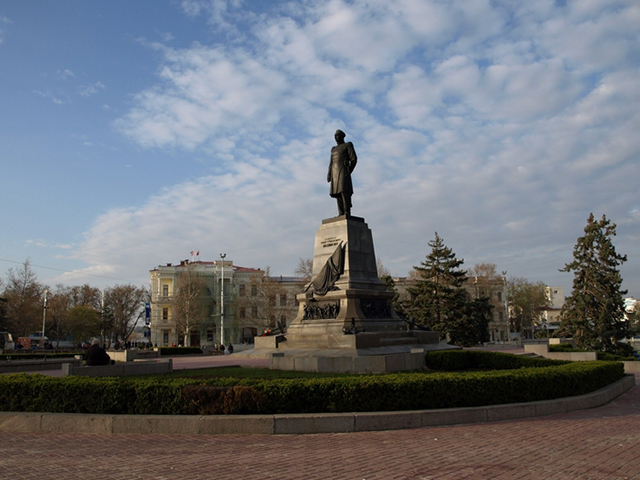
The monument to Nakhimov is a truncated two-level cone made of granite. On it stands Admiral Nakhimov, looking into the distance. In one hand he holds a telescope, the other rests on the saber of Osman Pasha, the Turkish commander he defeated. The figure of the admiral is made of bronze and surprises viewers with a hidden energy, which the metal alloy shackles could not hide. In the first, basic tier of the cone are embedded 3 bronze plates with high reliefs. One is dedicated to the Battle of Sinop. Another is dedicated to the heroic 4th bastion. The third one is dedicated to the speech made by the admiral before the battle. The academic nature of the structure is diluted by the half-dropped flag and broken anchor chains, which enhance the overall impression made by the monument.
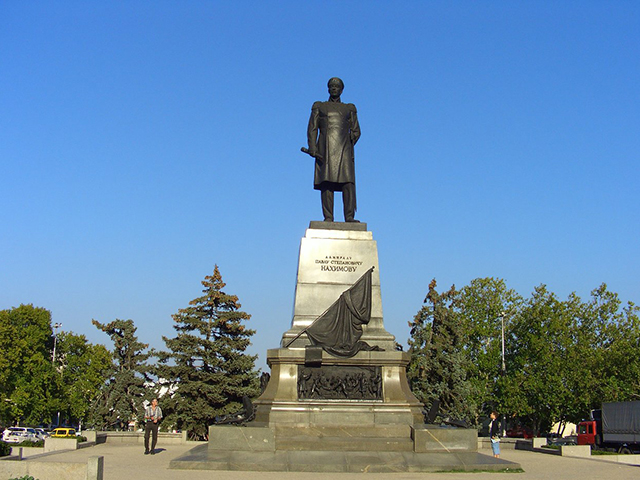
The monument was installed in the center of Nakhimov Square. Tsar Nicholas II came to the city for its opening. The further history of the monument is similar to the ship of the same name. In 1928 it was dismantled, declaring the admiral a tsar’s servant. And on the preserved pedestal in 1932 installed Lenin, the work of Kozlov. By decision of the city council in 1959 Lenin was moved to the square with the same name, and Admiral Nakhimov was returned to the pedestal.
Given that many imperial sights of Sevastopol, and the monument to Nakhimov among them, were destroyed under Soviet rule, sculptors Tomsky and architect Arefiev cast a new figure of the admiral, trying to reproduce as much as possible the one that was lost. They succeeded, and today Admiral Nakhimov, as alive, stands over the city again, covering Sevastopol Bay and the fleet.