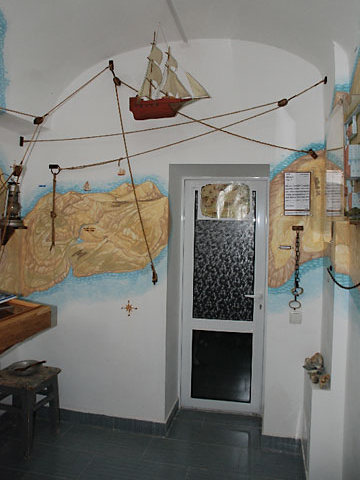
In Sevastopol, the A. S. Grin’s Museum Room was opened in the building of the former prison (4 Insurrection Square) and the National Museum of Heroic Defense and Liberation of Sevastopol (NMHOL). The opening of the exposition took place on the eve of the 130th anniversary of A. S. Grin’s birth and in the year of the 50th anniversary of the NMHEA (2010). Museum room A. Grin became the sixth object of the museum. The authors of the exposition: Olga Zavgorodnyaya, a leading researcher of the NMHEP and artist Vladimir Adeev.
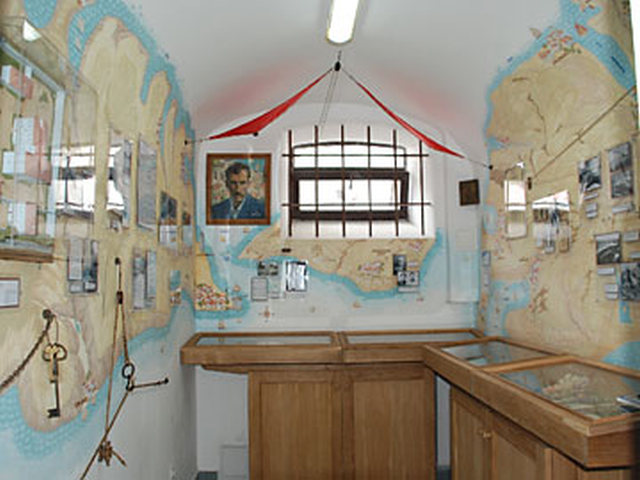
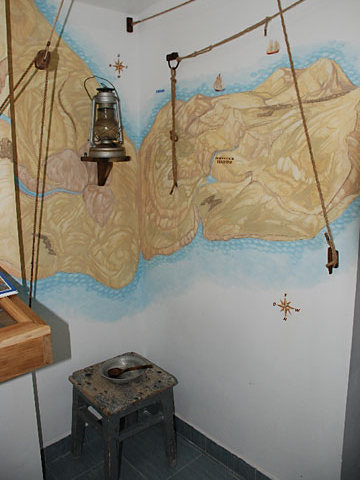
The exposition is located in the former solitary confinement cell in the basement of the building. The perimeter walls of the room are painted by V. V. Adeev, a member of the Union of Artists of Ukraine, who initiated the creation of a museum in Sevastopol, dedicated to his favorite writer. The subject of wall painting was the image of the map of Sevastopol and its bays with the indication of the places of the city described by A. Green in his works. The wall painting became the background of the exposition. To create the atmosphere of a prison cell a number of objects were used — a grate, shackles, a kerosene lamp, keys, a bowl, a mug, a spoon, a stool.
 .
.
The exposition is decorated with sea ropes, a ship model, red cloths symbolizing scarlet sails and revolutionary banners, as well as lyrics of poems and songs created by political prisoners of the early 20th century.
The beginning of the exposition introduces the history of the Sevastopol prison, which was built in 1898 and operated until 1959. A certain place in the exposition is given to the social and political situation in Sevastopol in 1903-1905, the activities of various political parties. The next section is devoted to the stay in Sevastopol of A. Grin. Grin, who appeared in the city on September 22, 1903 as a representative of the SR party for revolutionary agitation and propaganda among the troops of the garrison. Under the surname Grigoriev he rented a room in the apartment of S. I. Nevedrova on Teatralnaya Street, in the house number 6 (now Schmidt Street). The first days A. Grin wandered a lot around the city, familiarizing himself with the future routes of work. He visited the Historical Boulevard, the Central City Hill, Nakhimovsky Avenue, Malakhov barrow, in Chersonese. A. Grin wrote: «Subsequently, some shades of Sevastopol entered my cities of Liss, Zurbagan, Gel-Gyu, etc.».
On November 11, 1903 A. Grin was arrested for propaganda of revolutionary ideas and imprisoned in Sevastopol prison, where he spent almost two years. After an unsuccessful escape attempt on December 17, 1903, prepared by members of the SR party, A. Grinevsky was placed in solitary confinement in the basement of the building. Here he was deprived of walks, smoking, reading books, writing utensils.
On October 17, 1905, Emperor Nicholas II issued the Manifesto «On the Improvement of the State Order,» in which he promised political freedoms to the people. Sevastopol residents were convinced of the falsity of the Manifesto the very next day: the meeting on the Historical Boulevard was dispersed by the police. The protesters gathered again, already on Primorsky Boulevard, where they marched under red flags to the city prison and demanded the release of political prisoners. Shots were fired in response, 8 people were killed and about 50 wounded. On October 20, funeral of the shooting victims took place, which resulted in a mass demonstration. On October 21, 1905 the government announced an amnesty. On October 24, A. Grin was released from prison.
Staying in Sevastopol prison left a deep trace in the soul of the future writer. At the end of his «Autobiographical Story» A.S. Grin wrote: «So deeply entered me prison! For so long I was sick of prison».
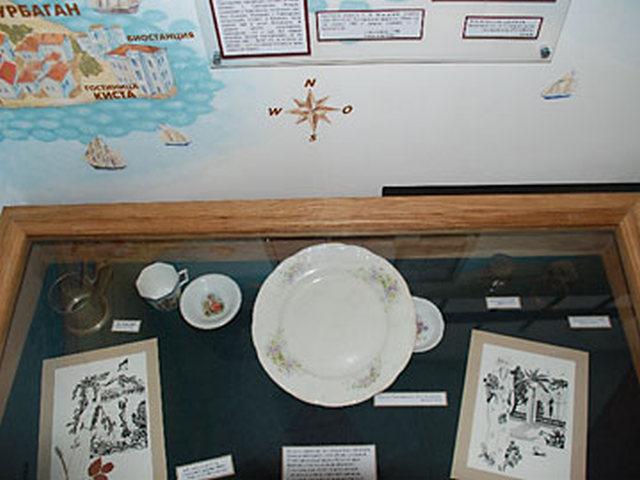
In Sevastopol prison A. Grin made sketches of his stories «To Italy» (December 1906), «The Little Captain» (1908). The events of 1903-1905 were reflected in the stories «At leisure» (1907), «Little Committee» (1908), «Third Floor» (1908), «Little Conspiracy» (1909). In December 1905, A. Green left Sevastopol for St. Petersburg. It was already another man, seized by a thirst to write. The events of the Sevastopol period in the life of A. S. Grin, reflected in the materials of the stands, are complemented by the items of four oak showcases. They contain books by A. Grin, copies of etchings by artist S. G. Brodsky and drawings by Nadia Rusheva, engravings by V. V. Adeev based on the works of A. S. Grin. V. Adeev’s engravings based on A. Grin’s works, copies of the writer’s manuscripts, copies of pages from his works that reflect the events of 1903-1905, objects that may have surrounded the writer and objects mentioned in his works.