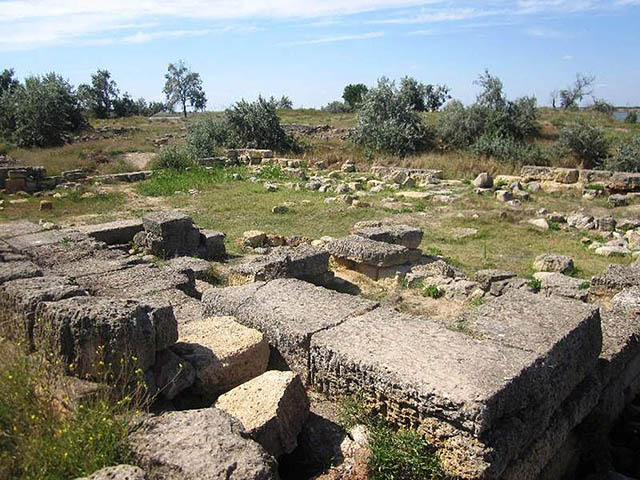
Many tourists know that on the territory of Crimea there are no less monuments of antiquity than on the lands of modern Turkey, Greece and the Apennine Peninsula. One of the largest, comparable in size only with Troy and Pompeii, was Greco-Scythian settlement «Seagull». It is located on the north-western outskirts of Evpatoria. This is the village of Zaozerne and the territory of the former pioneer camp «Luchisty».
Unique Evpatoria settlement was accidentally discovered in 1959. During the extraction of sand in the village quarry, bare part of the tower. Works on the quarry were stopped and excavations of the settlement began. The main role in the study of this «gift from the past» belongs to the staff of the Faculty of History of Moscow State University. Since 1967 their «Crimean archaeological expedition» has been functioning. Its work did not stop even when Ukraine gained independence. At the same time, the lion’s share of finds replenishes the local museum of local lore.
One of the most important tasks on the excavations of «Seagull» is to set the date of the founding of the settlement. According to the official version it was done by Greeks from Chersonesos in the IV century B.C. According to the unofficial legend — the archaic settlement was founded by Olviopolites in the V century B.C. This is confirmed by the discovery of a separate room made in the technique of rusticated masonry. It was used by the inhabitants of Olvia — migrants from Miletus, who settled in the area of the Dnieper-Bug estuary in the early VI century BC. Whatever it is, but in the territory of the «Seagull» found 3 cultural layers — Greek, Late Scythian and Saltovo-Mayatsky.
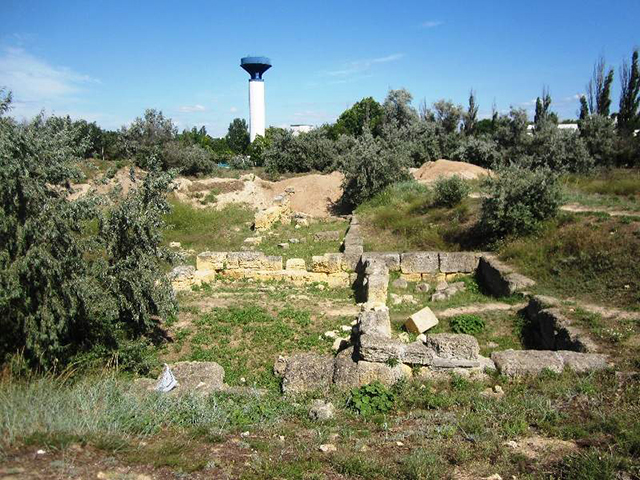
Let’s leave the search for the starting point of the beginning of the Greek period of «Seagull» to historians! It is only known that in the IV century BC this settlement was a choroi — the land of Chersonesos. The inhabitants of the settlement were engaged in growing wheat and grapes. By sea they delivered finished products to Chersonese. This is evidenced by two rows of warehouses excavated near the eastern wall and the remains of port facilities.
The scheme of the settlement of the Greeks from Chersonesos, that from Olbia, corresponded to the typical scheme of building of the Hellenistic polis. On an elevation — the Acropolis with sanctuaries and a place for gathering of citizens. Because of the realities of the time and the status of a colony in a foreign land, the Greeks had to enclose their polis with a fortified wall with square corner towers. Remember, one of them was found first. The entrance to the city was from the west, from the sea, and the eastern side was fortified with an additional tower.
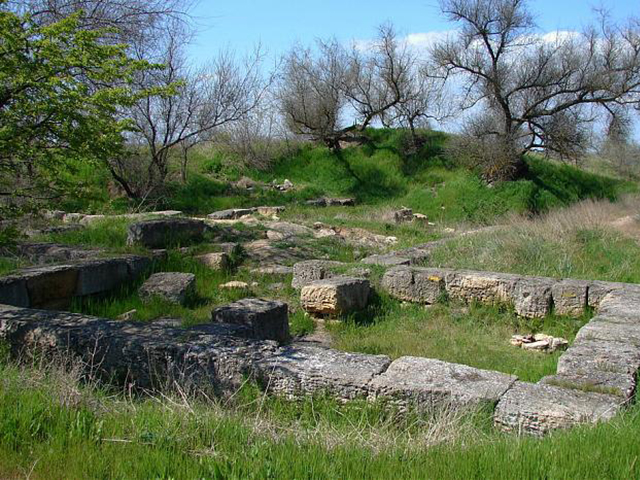
It is with the Greek period that the most interesting finds of «Chaika» are connected — 3 manor houses of people belonging to different professions, clay jars — pythoses, an altar, several terracotta statuettes of Aphrodite, Heracles and one brass statue of Amazon — the first copy of the work of the famous sculptor Lysippus.
When at the end of the II century BC the Hellenes were forced out of the city by the Scythians, the settlement was «enriched» with a necropolis, stone-paved streets and trading rows. In the I century BC the Scythians left the city for unknown reasons. For many years it stood in desolation, until in the VIII century representatives of the Saltovo-Mayatsk culture appeared here. These were the tribes of semi-nomadic Alans and Bulgars, who were under the protectorate of the Khazar Kaganate. Many samples of watered pottery with ornamentation in the form of wavy lines were extracted from this cultural layer.
And although the ancient settlement «Seagull» has already entered the list of attractions of Evpatoria, but the process of extracting cultural values from the ground is not yet complete. Every season Moscow archaeologists find objects that shock narrow specialists. Having planned holiday in Crimea, in the area of the former Greco-Scythian polis, you will be able to observe, and if you are lucky, to take part in the excavations of the new Ukrainian Troy-and-Pompeii.