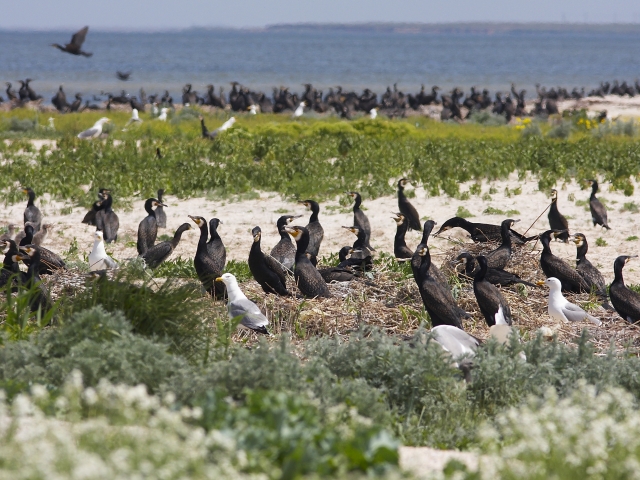
Even Crimean residents will not all answer you where the Labyazhie Islands Reserve is located and what these islands are remarkable for. But, perhaps, it is good, as well as the fact that they are hidden away from the noisy resort villages and beaches.
North of Cape Tarkhankut, behind the Bakalskaya Spit, in the Karkinitsky Bay of the Black Sea, near the village of Portovoi (old name — Sary-Bulat) once, more than a hundred years ago, there was a spit with lush vegetation and even a source of drinking water. Local residents used to drive their cattle there for the whole summer as a free pasture. But over the years the spit was washed away and three rather large islands appeared. They began to be called Sary-Bulatskie, and the name Lebyazhie appeared later. Naturally, cattle grazing was stopped there, and the fertile places began to be intensively inhabited by birds. The local population began to take advantage of it in every possible way: they extracted meat of commercial birds (they also traded in delicacy swan meat), the scale of bird fluff and eggs collection was such that allowed to use eggs not only as a food product, but also in building mortars for special strength of buildings.
It should be said that the sea, having created islands from the spit, did not rest on this, and after some time from three islands six smaller pieces were «cut». And such a number of them was until recently, when suddenly one of the islands restless sea swallowed up, washing in return again a small spit. So after all the vicissitudes of local relief formation the islands became five. They got the name Lebyazhie with the easy hand of the German scientist Brauler, who visited here at the end of XIX century. The scientist saw a huge colony of swans and screech swans and assumed that this was their nesting place. Apparently, he happened to be on the islands in July-August, because to this day, in these months thousands of these royal birds come here to shed, as in Andersen’s fairy tale, their old feathers and grow new ones.
During the molting period, swans cannot fly and choose these islands and the waters of the shallow bay covered with grass, which they enjoy feeding on, as the safest. However, swans do not build nests here and do not raise chicks, although some swans live on the islands throughout the year. These are young birds, which do not lay eggs until 4-5 years old, as well as adults, which for some tragic reasons have lost their pair.
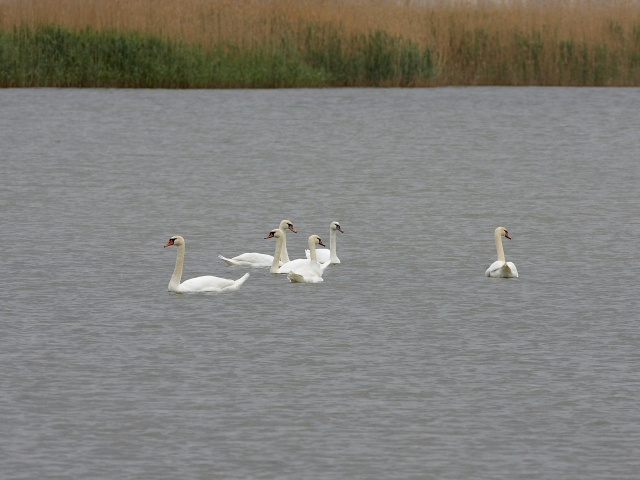
There are legends about swan fidelity, and although, indeed, swans form monogamous unions and live in pairs, but in case of losing a partner they do not throw themselves to the ground from a height, and most often look for their second half again. On our islands there is also such a «dating club» for lonely swans.
Quite a lot of swans come here for wintering (up to 5 thousand individuals), because the bay practically does not freeze, and if it does, there are always big ice holes. Sometimes, in severe cold weather, some swans fly to the beaches of Yalta, Sevastopol, Evpatoria. People feed them there. And then the birds return to their quiet, cozy, safe island kingdom-state, which since 1949 is officially an ornithological branch of the Crimean State Reserve.
This means that on the Lebyazhie Islands not only it is not allowed to hunt birds, but also to disturb them in general, as well as to fish, collect medicinal plants and generally conduct any activity.
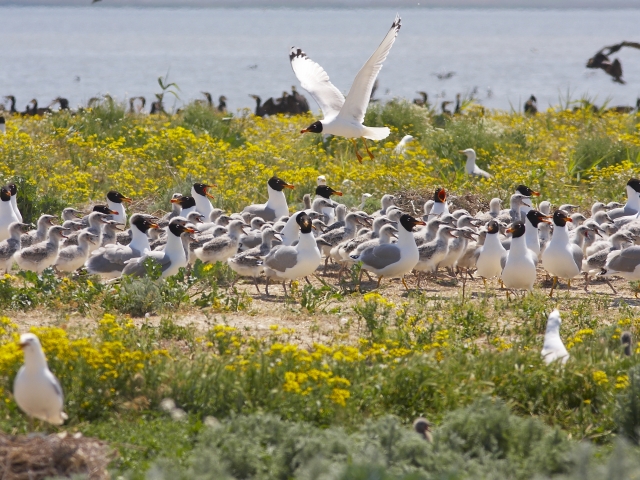
The islands themselves cover an area of 52 hectares and the surrounding shallow waters 9,612 hectares. The adjacent water area of the Gulf of Karkinitsky and coastal lands of Razdolnensky and Krasnogvardeysky districts are also protected. Only gamekeepers and ornithologists who observe birds of prey at different times of the year are allowed to be here. After all, besides swans on the islands you can see 260 species of birds, 49 of which are listed in the Red Book! Such, unfortunately, now rare birds as: spoonbill, caraway, yellow heron, white-eyed blackbird, little cormorant, stilt walker, chigrava, thin-billed pintail, bustard, steppe kestrel, dalmatian pelican, etc. The number of birds left in the world is only 250. There are only 250 to 50 of them left in the world. Some of them nest here, others come only in winter, others rest on their migrations. The most numerous colony of birds of the Lebyazhie Islands belongs to the gulls (among others the Herring Gull or Martyn). There are more than 5 thousand pairs of them.
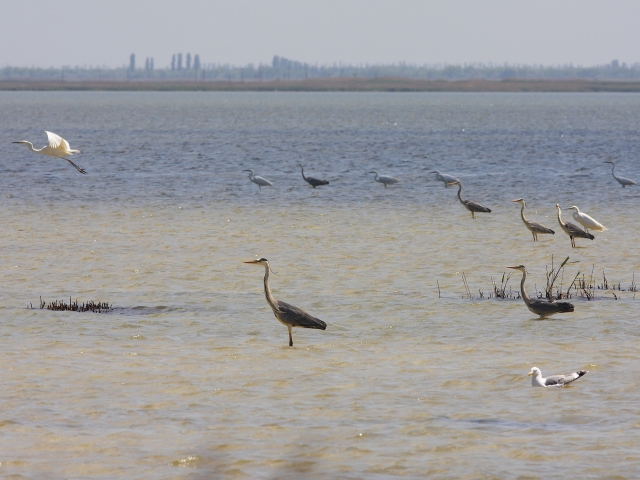
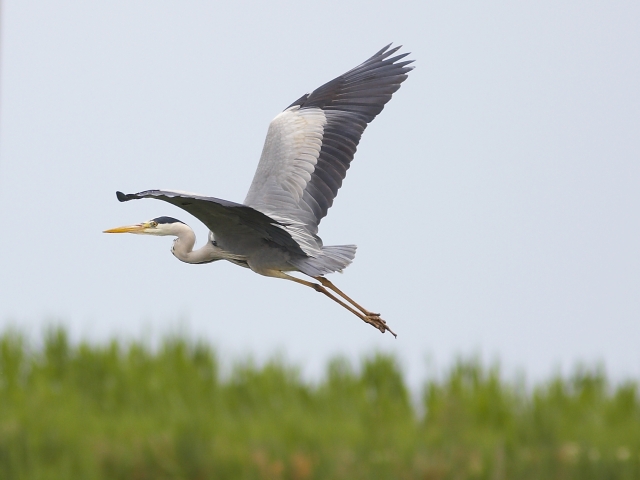
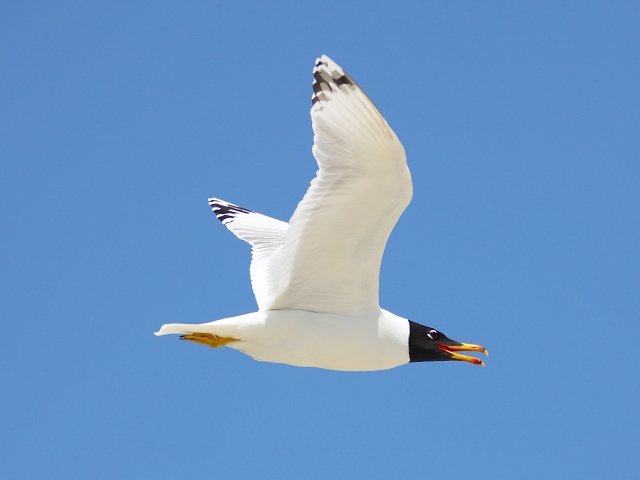
The largest one, the Black-headed Gull, is also listed in the Red Book for its rarity. Their only colony on the Black Sea lives on these islands. There is also a colony of the gray heron, the largest bird in the south of the European part of the CIS.
Recently, pink pelicans have appeared on the nesting grounds. Numerous flocks of migratory birds on their way to Africa, Europe and Asia also stop on the islands: turukhans, snails, sandpipers, terns, ducks, white-fronted and gray geese, swallows, skylarks, thrushes, wagtails. There are up to 75-100 thousand of them in clusters at a time, and during the day, at the height of the flight — up to a million! It is not without reason that Lebyazhie Islands have a protected international status, because it is extremely important to preserve this «rest station» on the thousand-kilometer migration route of many birds.
Ornithologists conduct constant research work to study all these birds and changes in conditions in the reserve. I am glad that these conditions have gradually improved. For example, as a result of reduction of intensity of chemical treatment of rice checks, coastal areas and the bottom of the sea have become overgrown with grass, which is the main food base for birds. There are more fish and other marine life in the bay. Protection of the lands from poachers has improved: the staff of gamekeepers has doubled, equipment has appeared (cars, boats, although, of course, they are not enough). We also managed to protect these places from attempts to issue hunting licenses, ostensibly to earn money for development….
Although the reserve is considered an ornithological reserve, but along with birds, fish (seahorse, spike, beluga, Black Sea salmon) and animals are also protected here: marine (dolphins such as the dolphin afalina, azovka and white-footed dolphin) and terrestrial (big marmot, white polecat; endangered species of steppe viper and yellow-bellied stripe). But of course, the main dream of local specialists remains the organization of Karkinitsky reserve, which will include the whole bay, as well as Bakalskaya spit and salt lake Bakalskoe. Then instead of a branch there would be an independent reserve. Maybe Lebyazhie Islands will be lucky and they will be taken under the guardianship of a rich and generous man, not indifferent to our animals and birds, as once the reserve Askania Nova was lucky with a wonderful Baron Faltzfein.