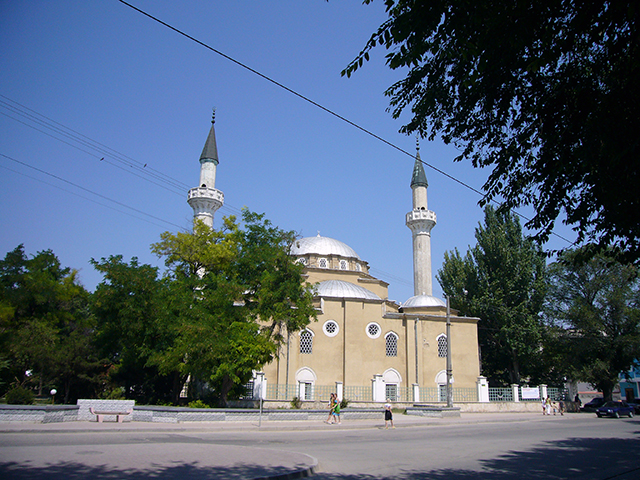
Mosques in Crimea look as natural as Sultan Ahmet’s Kaaba in Istanbul, Al-Azhar in Cairo or Qutubiya in Marrakech. Not to mention those places for «making the earthly bow» that have become an ornament of Mecca, Medina and Jerusalem. The matter is that since 1441 in Northern Black Sea coast the so-called Crimean yurt or khanate was formed. The capitals of the monarchy at different times were the settlements: Kyrk-Er, Salachik and Bakhchisaray. Men from the Girey family were successively replaced at the head of the state. The main base of the Khanate, until the annexation of its lands by the Russian Empire, was the Crimean peninsula.
That is why the Khan-Jami or Juma-Jami mosque shone over Evpatoria. The word «Juma» in the classification of Muslim religious buildings means that the temple is designed for collective Friday prayers, which gathers the entire community.
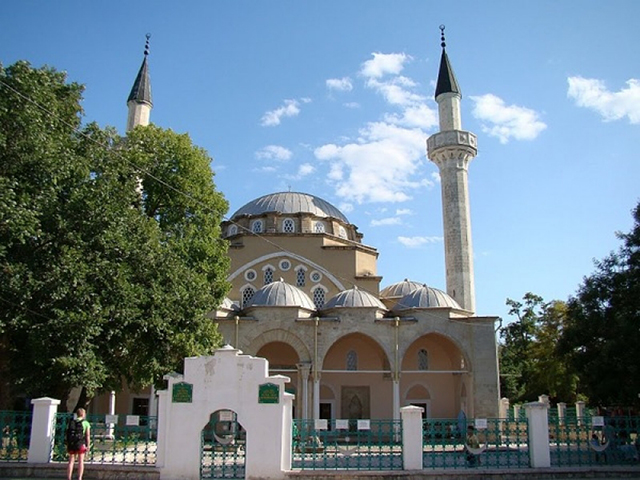
Evpatoria Juma-Jami was founded in 1552. This is the era of the rule of Devlet the First Girey. Its project Khan personally ordered Istanbul architect Khoja Sinan. Firstly, the Crimean Khanate and the Ottoman Empire were allies. Secondly, this architect was the author of the Suleymaniye and Shahzade mosque. In one of them is buried Sultan Suleiman with Roksolana, in the other — their firstborn son Shah-zade Mehmed. It is known that during the construction of Istanbul temples, Hoja Sinan communicated with Roksolana, who personally supervised both projects.
Historical and architectural curiosity is the fact that Evpatoria Juma-Jamiya and Istanbul Suleymaniya Khoja Sinan built in parallel. The fact is that the budget of the Crimean Khanate was burdened with exhausting wars with Ivan the Terrible. Therefore, after the exhaustion of another bag of gold, the architect went back to Istanbul, and when the money appeared, returned to Evpatoria to work on the beautiful Khan Jamia.
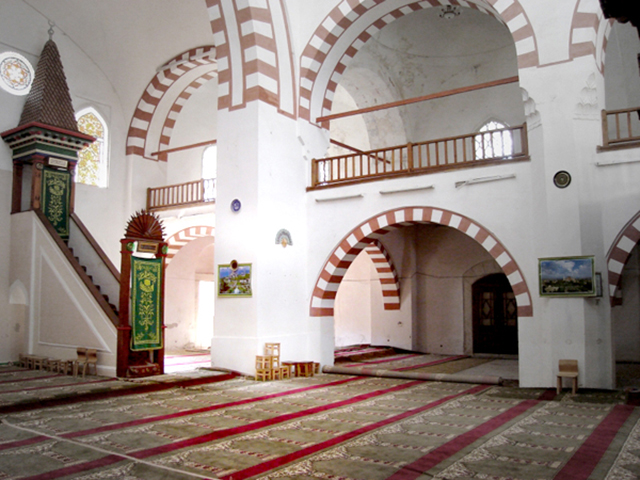
So, the guests of Evpatoria will be able to see one of the most beautiful temples of Crimea. It is a huge quadrangular building, erected on the principle of «increasing volumes». The roof of the mosque is a giant hemisphere or dome. Under it there are 16 windows, providing the temple with excellent natural lighting during the daytime. The central hall is surrounded by a gallery, which is covered with a unique roof — a three-row of small domes. On the sides of the temple 2 minarets rise. Like all Muslim temples, Khan Jami Mosque is oriented towards Mecca, towards the Black Stone of the Kaaba.
After the Kuchuk-Kaynarrdzhi Treaty was broken in 1783 and Catherine the Great declared Crimea-Taman-Kuban as Russian provinces, the mosque was in oblivion, half-asleep and desolation. This state lasted until 1985, until the Soviet state has not allocated money for the restoration of an architectural monument of universal scale. In 1990, the Crimean Tatars, who returned to their homeland en masse after Stalin’s deportations, succeeded in returning the temple to the community.
The Juma Jami Mosque cannot be called just a attraction of Yevpatoria. Istanbul mosques of the same author are known all over the world and included in all sorts of UNESCO lists, created to preserve monuments for future generations. Coming to Krym, you can see a real architectural masterpiece and a symbol of the revival of the Crimean Tatars.