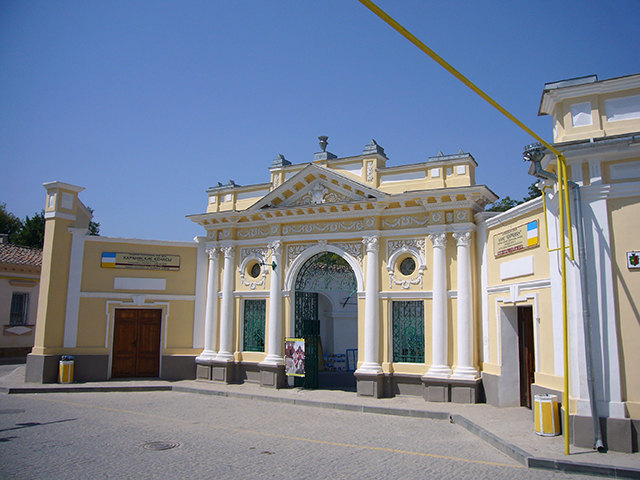
Yevpatoria, a popular city of Crimea among tourists, has many interesting sights, including religious ones. Among them — not only Christian churches and temples, but also shrines related to other religions. One such shrine is the Karaite Kenas Complex, which annually attracts thousands of travelers of different faiths.
Since 1837 Evpatoria became the main spiritual and administrative center of the Karaites in Russia. This happened largely due to the fact that after the annexation of Crimea to Russia in 1783, the Karaites felt at ease in the lands that had become peaceful and left their cave towns (Chufut-Kale, Mangup-Kale, etc.), having received a number of benefits from the Russian government due to the support they had given Russia during the Crimean War.
Already in 1803, brothers Samuel and Solomon Babovich from a well-known Karaite family received permission to build a temple complex on the site of the old kenasa (kenas are temples among the Karaites). The temple complex was built gradually until 1900. First in 1805 was built the Big Kenasa (prayer house), then in 1815. — Small Kenasa on the site of the old temple, in 1890. was completed construction of the portal of the main entrance to the complex. The temple complex decorated Yevpatoria: despite the fact that their construction was not led by outstanding architects — Samuel and Solomon Babovichi graduated only from the parochial Karaite church school and had no other education, the ensemble, built under their leadership, turned out to be impressive and thoughtful in layout.
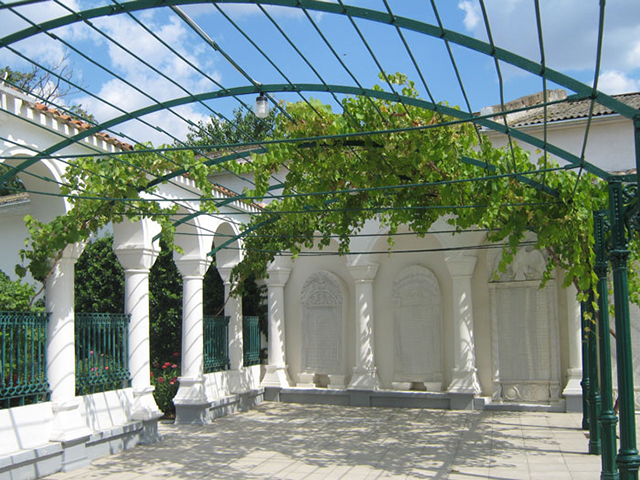
The buildings of both kenas are two-storied, on the second floor of the Big kenas the windows are lancet, and on the Small kenas — semicircular. The entrances are designed in the form of lancet arches decorated with carved stone. The roof is four-pitched, made of tiles. According to the canons of construction altars in the buildings are oriented to the South, and in the northern part there are barred balconies for women, which leads to a separate entrance. The northern facades are framed by glazed arched verandas-galleries, called «azara» by the Karaites. In the azara the elders of the community waited for services and organized meetings of believers.
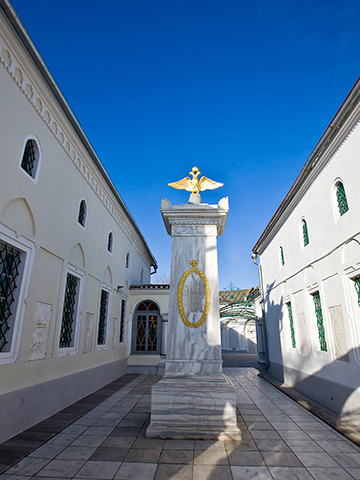
The first courtyard leads from the main entrance, from above it is covered with vines (the oldest is 150 years old) — hence the name Vinogradniy. At the end of it there is an obelisk dedicated to the visit of Alexander I to the kenas in 1825, and in one of the niches there is a fountain. The second, following Vinohradnyi courtyard is called Marble because of the marble arcade and slabs, followed by the courtyard of Waiting for Prayer, where there are benches and entrances directly to the temples. All the courtyards are arranged enfilade, and each guest gets from one to another in sequence, but from the Marble courtyard you can get not only to the courtyard with the obelisk, but also to the lapidarium, where the exposition of tombstones from the ancient Karaite cemetery is open.
Thus, today the temple complex, which occupies an area of 0.25 hectares, includes: two kenasas — Big and Small, a religious school building, a canteen, a farmyard and courtyards (Grape, Memorial, Marble, Waiting for Prayer, Ritual), a monument to Alexander I, an ethnographic museum, a cafe of national Karaite cuisine, a library. Visiting this attraction, you can learn a lot of interesting things about the Karaites and their culture, life, religion, get acquainted with this people, recognized as one of the smallest nationalities in the world (today there are only about 2 thousand people). Today, during vacation in Evpatoria to see the ancient Karaite kenasses seek to see all the guests of the city, and for everyone it becomes an interesting, exciting and leaving the most pleasant memories of the experience.