 The center of such an ancient city as Lviv makes a very vivid impression on tourists — with its stunning architecture and unique atmosphere, which is always unique in such cities. But there are in the center of any such city the most important, interesting and beautiful places, the center of cultural and business life. In Lviv this place is Svobody Avenue. Everyone who came to Lviv at least for a few hours should walk along it — it allows you to make the first and correct first impression of the city!
Svobody Avenue is located in the very heart of Lviv — in its historical center, after Rynok Square it is the second Korzo — a pedestrian and walking zone. Stretching for 350 meters from the south it is bounded by Mitskevich Square with a monument to the beloved and respected poet in Ukraine, and from the north — by another famous landmark: the Opera House, built in 1900 and became one of the main attractions of the city and the country. A walk along Svobody Avenue is a great opportunity for every tourist to see the stunning sights of Ukraine and make an impression of Lviv: figuratively, it can be called a touch to its soul — a bit contradictory, as every developed being should be, but enchanting with its beauty and spiritual richness.
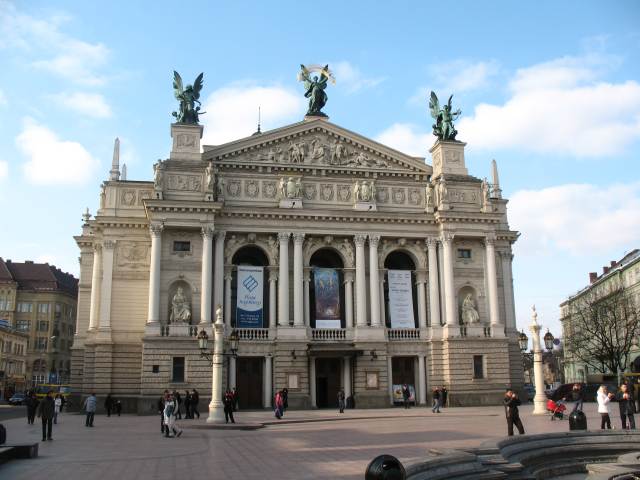 The building of Liberty Avenue with the structures that can be seen here now, began in the XVIII century, when it was decided to dismantle the dilapidated Lviv fortifications. Where nowadays the even side of the avenue is located, before the XVIII century there was a swampy area with houses of suburb residents. In 1887-1888 the Poltva River was blocked and the construction of its left bank began, where now there are buildings of the odd side of the avenue. Walking along it became fashionable already at the beginning of the 19th century, and by the end of that century it acquired its present appearance.
You can start to get acquainted with Freedom Avenue either from the northern side from the Opera House or from the southern side from Mickiewicz Square. Wherever you start from, you will see a spectacular perspective — beautiful old buildings in Baroque, Neo-Renaissance and Classicism styles. The luxurious buildings are complemented by interesting sculptural groups, which can be seen both on the street itself and on the buildings.
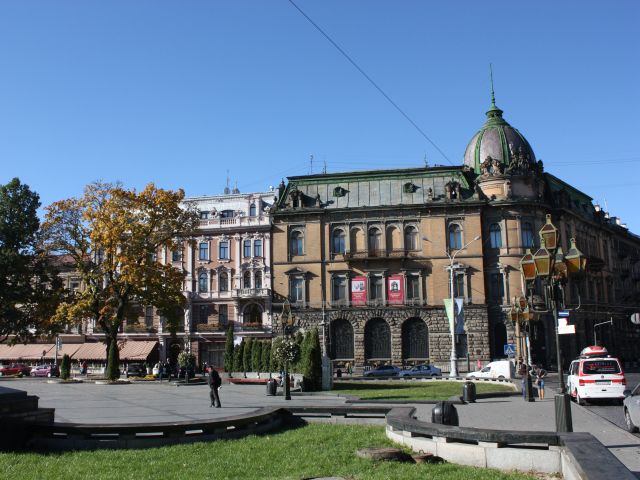 One of the most interesting sculptural groups is located under the dome of the building number 15 — the former Galician Credit Bank and now the Museum of Ethnography. It depicts the Statue of Liberty sitting between two young men and is considered one of the unique objects — it is the only seated Statue of Liberty in the world. This sculpture was conceived as a symbol of economic prosperity of Galicia and now it is not overlooked by any guide or tourist. However, the building itself, which is considered to be the second most important work of the famous Polish architect Julian Zacharewicz, is also worthy of attention.
If you want to see the Museum of Ethnography and the sculpture on its roof, don’t miss out on building No. 11/13 — the Grand Hotel, built in 1892-1893 (architect Erasmus Harmatnik) and decorated with works by sculptor Leonard Marconi, which to this day, since its construction, is considered one of the most comfortable hotels in the city. And across the street from it, the house No. 17 attracts attention — it is the former Prague Bank, built in 1911-1912 in the late Secession style (architect M. Blech), now it houses a branch of Prominvestbank.
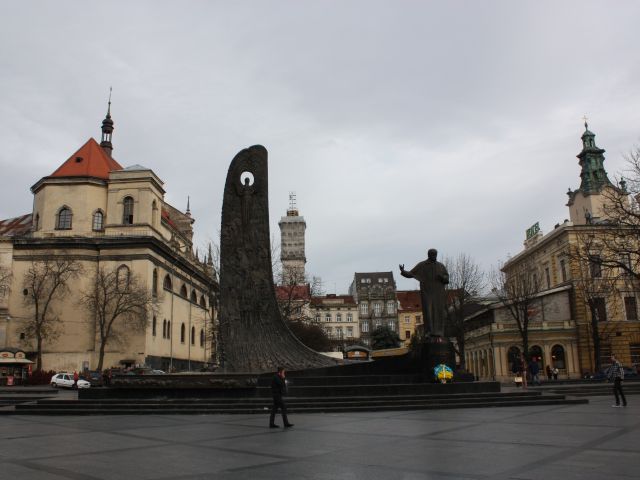 monument to Ukrainian poet T.H. Shevchenko on the right side of the pedestrian alley. On the other side of the street behind the monument you can see the ancient building Costel of St. Peter and Paul of the Jesuit Order (11 Teatralnaya Street), erected in the early 16th century — it is one of the main sanctuaries of the city in the early Baroque style! Not far from the temple on the other side of Ivan Podkovy Square is an exquisite two-storey building of the Vienna Coffee House — it was erected in 1829. It was erected in 1829 (architect M. Bresini) and rebuilt in the 1880s in the Neo-Renaissance spirit. The first coffee house in the city was opened here, and today the hotel «Vienna» (house No. 12) is working here.
The next interesting building — at No. 18 — is the Faculty of Economics of Lviv University, built in 1950-1952 on the site of the Austrian provincial government building destroyed at the beginning of the last century. Built in the Stalinist Empire style (architects I. Persikov and G. Shvetsko-Vinetsky), it harmoniously complemented the architectural appearance of the avenue.
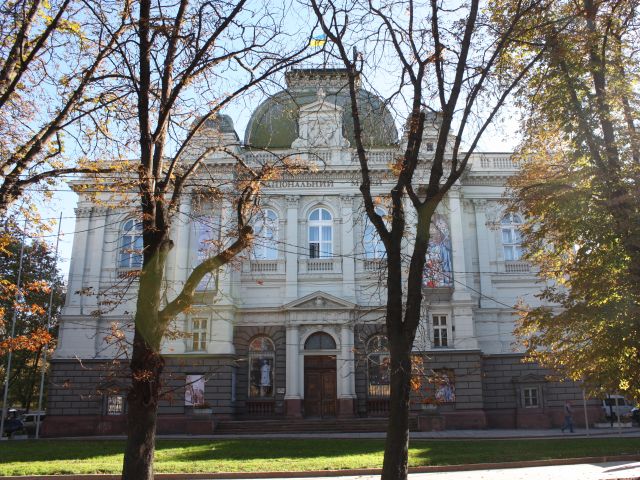 The building at No. 20, impressive in its appearance alone, today houses National Museum is the only building that was originally built for the museum (then it was the Industrial Museum) in 1904 (architect J. Yanovsky) — today it is one of the last monuments of Lviv historicism. And on the other side of the avenue opposite it, house No. 35 is another landmark: the Fellers’ Passage (built in 1902, architect A. Shleen), erected in the Neo-Renaissance style.
The spectacular completion of the beautiful architectural ensemble of Svobody Avenue is Opera Theater, after which the avenue passes into V. Chernivol avenue. Chernivol.
You can walk along Freedom Avenue and admire its magnificent buildings for hours, and a detailed description of all its buildings, each of which deserves attention, would take dozens of pages. It is better to come here and see this beauty with your own eyes — it is a Mecca for every connoisseur of classical architecture, as well as the whole city, because the sights of Lviv are truly impressive and numerous.