 The memory of Taras Shevchenko has never been neglected. Even in the era of the Soviet Union, quite harsh to any manifestations of nationalism, his works were given a third of the hours of the school program on Ukrainian literature. Every student knew «Zapovit» by heart. In Kanev «with glamor» was arranged Taras’s grave, and in Kazakhstan, where the great Kobzar served his exile, there is a settlement Fort-Shevchenko, where it is still fashionable to call sons by the native Ukrainian name Taras.
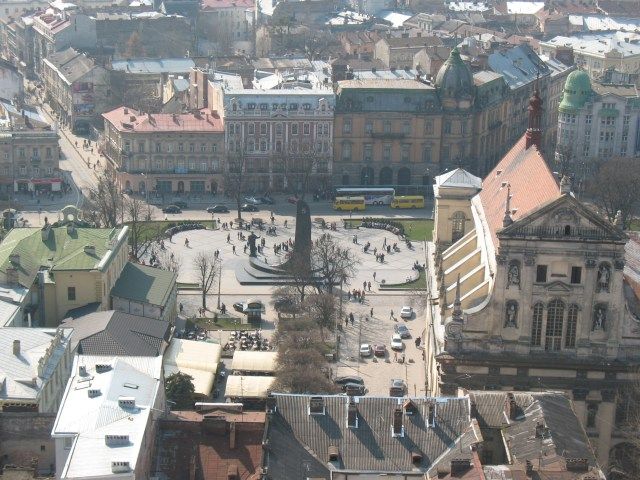
Therefore, there is nothing surprising in the fact that when in Lviv, after Ukraine’s independence, the place on Liberty Avenue was empty after the dismantled monument to Lenin, the public and the city council unanimously decided to establish a monument to T.H. Shevchenko.
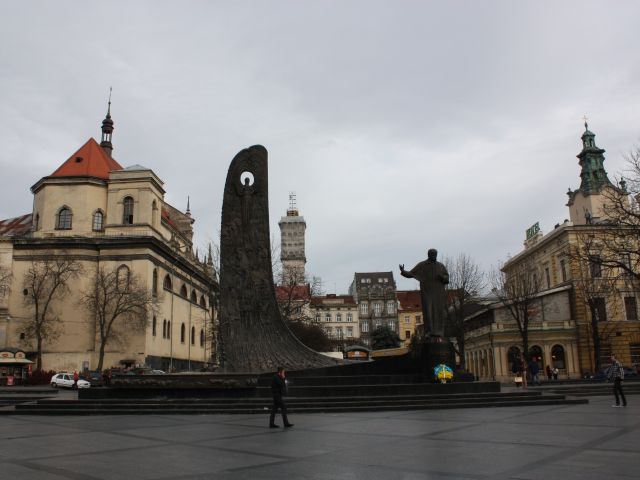 To make the Kobzar appear as soon as possible on one of the most luxurious streets of Lviv, the project prepared for the relevant competition back in 1987 was used. None of the sketches submitted to the regional and republican competition was recognized as ideal at that time. But time did not wait, so the project recognized as «relatively best» was launched. It belonged to a quartet of young sculptors and architects V. Sukhorskie, A. Sukhorskie, Y. Dyba and Y. Kromey respectively.
By the first Independence Day — August 24, 1992, the stunning architectural ensemble of the former Legions Street, Hetmanski Valov, Opernstrasse and Museumstrasse, Adolf Hitler’s Platz, Lenin Avenue and the present-day Liberty Avenue was decorated with the figure of Kobzar. The Ukrainian diaspora provided a significant part of the funds for the memorial.
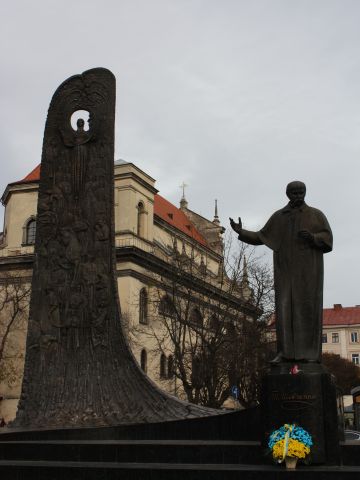 The monument to Taras Shevchenko is a static figure, the height of which is 4.45 meters. On it, the main Ukrainian poet, former slave of Pan Engelgart, as well as the famous Ukrainian artist and cartographer is depicted as a mature, wise «thoughts», husband. The figure is completely hidden by a cloak, as in the legendary sculpture of Balzac by Rodin. Only the movement of his right hand and the tilt of his head conveyed the address of Kobzar to his compatriots. The bronze figure is mounted on a massive pedestal of gray-black granite, symbolizing the difficult share of the main Ukrainian «Haydamak» and «Slave».
In 1995, Shevchenko’s image was supplemented with a bronze stele. It was erected behind the Kobzar’s back with a slight shift to the right. It is a wave, 12 meters high, which rises above Svobody Avenue. It has been called «the wave of national revival,» and in the silhouettes and faces carried by it, one can easily recognize the strongest and most patriotic personalities of Ukrainian history. At the crest of the wave with a through halo is the Mother of God, called to protect the young state.
Due to the idea and energy emanating from the monument, it is recognized as the strongest landmark of Lviv of the new time. More than once it happened that the feet of those who came on vacation to Lviv, involuntarily carried them here to see and listen to the Kobzar’s instructions and sip the ozone raised by the «wave of revival»!