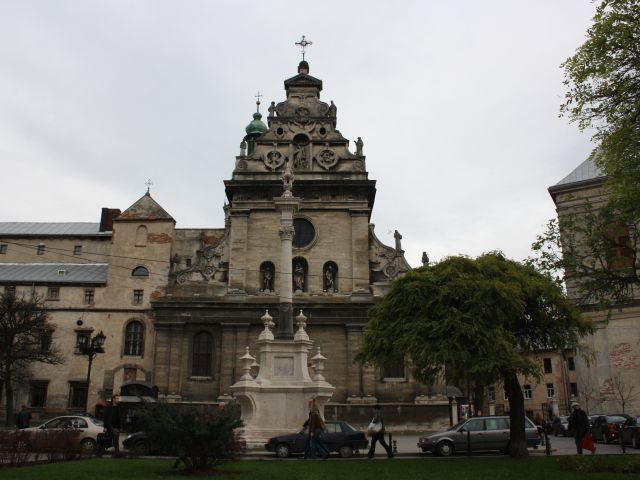
 The architectural ensemble of the former Bernardine Church is one of the «visiting cards» of ancient Lviv. Located in the center of the city, this monument of sacral architecture invariably attracts a lot of attention of tourists and visitors.
The former Bernardine church and monastery was built in the first third of the 17th century on the site of an older one. Together with the monastery buildings, the bell tower (1734), the pergola-rotunda (round building, usually crowned with a dome) on columns with elegant capitals (the upper part of the column or pilasters), defense walls, it was destined to open a new page in the history of Lviv architecture. 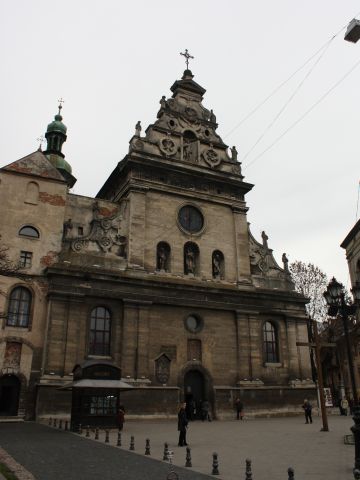 The church was built according to the drawings of the monk Bernard Avelides by the architect Pavel Rimlianin, and after his death in 1618 the construction was continued by Amvrosy Pryhylny. Since the church and monastery buildings stood outside the city, at the beginning of the XVII century they were surrounded by protective fortress walls and moats.
In terms of style, the modesty and simplicity of the two-story church building combines features of Italian and German Renaissance architecture. The facade of the Bernardine Church consists of different parts. The first and second floors were made by P. Rimlianin and A. Prychylny, and the decorative pediment (facade) was made by Andreas Bemer, a sculptor from Wrocław. The same Bemer built the 38-meter high tower of the church, which is an ornament of the monastery ensemble. In the middle of the 17th century a clock with a bell cast by Andrzej Frank was installed on the tower. The facades of the church are decorated with coats of arms of Poland and Lithuania, decorated with sculptures. 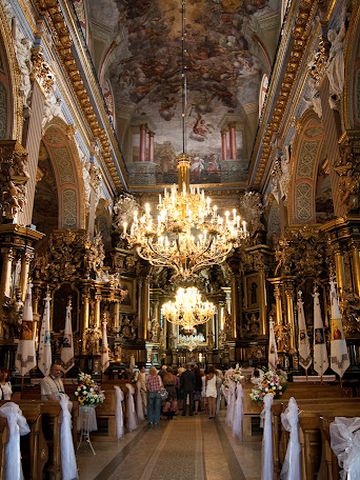 The lush Baroque interior is decorated with many carved wooden altars, sculptural reliefs and statues of saints made by the founders of Lviv Baroque plastic art T. Guder and K. Kutschenreiter.
The main altar was created in 1733, the vaults and walls of the church were painted by the monk-painter B.Mazurkevich and artists R.Bortnitsky, S.Shochinsky, I.Sorochinsky, P.Voliansky. The old painting was renewed by M.Yablonsky, T.Kopystynsky and J.Shidlovsky in the XIX century. The brushwork of the prominent Ukrainian artist M.Dolynsky belongs to compositions on the themes of «The Passion of Christ». Of great historical and cultural value is the excellent metal door, executed in the tradition of Ukrainian blacksmiths, the fence on the choir (in architecture the upper open gallery or balcony inside the church) by the Lvov master F. Sader, the altar image is a copy of the «Crucifixion of Christ» by P.-P. Rubens, the brush of the Krakow painter F. Lexitsky belongs to the canvas on the subjects from the life of Bernardine saints. The carved benches of the presbytery were made in 1640-1643 by Paul from Bydgoszcz.  In the early 20th century they were replaced by new ones made by Rarogiewicz on the model of the old ones, the remains of parts of which are kept in Lviv Museum of Ethnography and Arts and Crafts.
In 1976-1977 the complex of Bernardine Monastery was thoroughly restored. The old brickwork was opened, loopholes (narrow openings in the defensive walls for firing from cover) were restored, a covered gallery at the top, and the Glinianska tower with gates, crowned with a pointed spire, located on the axis of the former Glinianska tract (now Lychakivska Street).
At present, the former Bernardine Church houses the Greek-Catholic Church of St. Andrew, the patron saint of Russia.