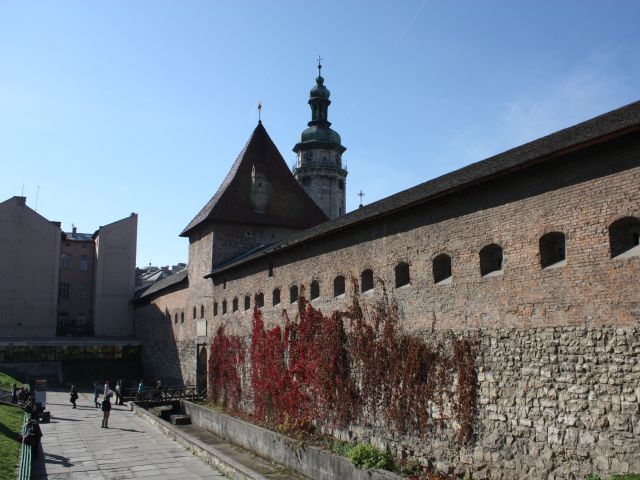
 The gate is one of the integral elements of the ancient city. One can enter the historic center of Jerusalem through one of seven gates — Jaffa Gate, Zion Gate, Dung Gate, Herod Gate, Damascus Gate or New Gate. German Potsdam is famous not only for its conferences, palaces, gardens and residences, but also for its three gates — the Hunting Gate, the Nauen Gate and the Brandenburg Gate. There were also the Telta Gate and the Berlin Gate, but they have not survived to our time.
As a city with a solid cultural baggage, moreover, fragmentarily included in the UNESCO World Heritage List, Lviv has its own famous gates — Galician and Gliniansky. These fortified passages in the wall allowed goods and food to enter the medieval city. Thanks to the guards and gates, guests were filtered, tolls were removed and potential invaders of other people’s goods were at least temporarily detained.
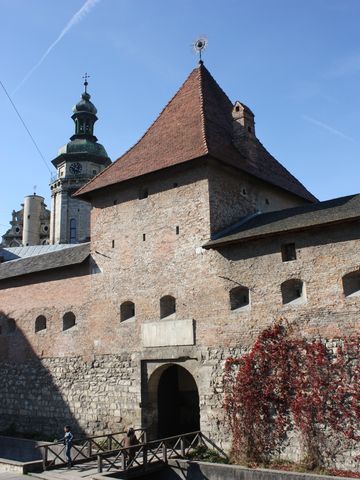 The Clay Gate or Entrance Gate is a structural element of a powerful stone wall with loopholes and towers, which was once connected to a ring of fortified city structures. The same stone wall was one of the parts of the defensive complex surrounding Bernardinsky monastery, adjacent to St. Andrew’s church, cells, smithy and stables.
The monastery began to be built in the XV century, while the church of St. Andrew began to be erected in the early XVII century, ringing the Bernardine stronghold with a moat, a rampart and a stone wall. The latter was erected using two materials. The lower tier, which completely covers the height of the gate, is made of travertine blocks. The upper half of the fortification is made of terracotta bricks, now covered with time. It is equipped with paired loopholes. The linear structure itself, complementing the monastery walls, forms a huge courtyard in the shape of a triangle.
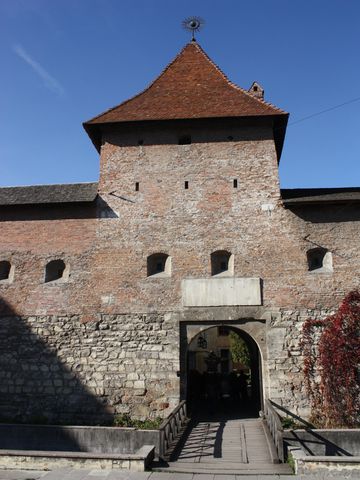 The clay gate, three human heights, possessing an arched passage, is located in the western part of the wall. In the inner space of the gate — in a kind of vent, there are six more loopholes, three in pairs on each side of the wall. Above the gate there is a pair of loopholes and a tower. The tower was built in 1618 with the help of the engineer F. Getkant. It has clear geometric forms. It has six observation windows, which made it possible to study the potential enemy when the gate was closed. Today it is covered with tiles matching the color of the bricks.
In front of the wall and gate today is a restored moat. Because of it, tourists, to get to the territory of the former monastery, need to pass over a stylized medieval, wooden bridge. These are the results of the reconstruction carried out in 76-77 years of the bygone century by the architects Novakievsky and Prysyazhny. Thanks to the enthusiasm of these two men, the inner wall of the fortification has also received a wooden gallery, such as it was here three centuries ago.
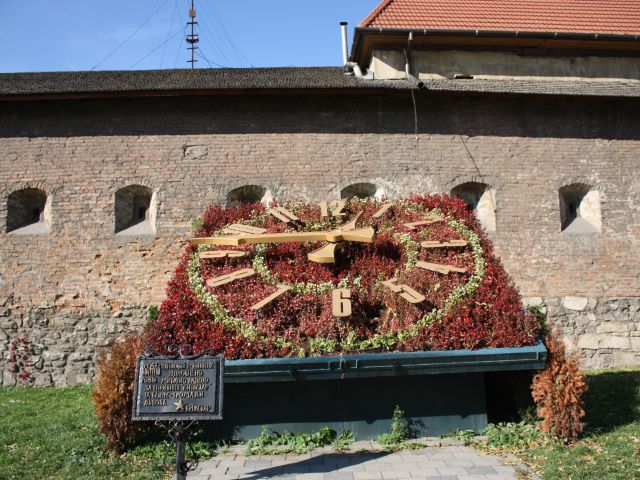 It is interesting, but specifically above the gate, in the tower, today nestles such a clever organization as «Ukrzapadproektrestavratsiya», engaged in the conservation of cultural property, organizing their restoration, subject to the allocation of funds and the selection of objects worthy of representing Ukraine in the UNESCO lists.
Thanks to the patronage of «Ukrzapadproektrestavratsiya» this landmark of Lviv has today such a view, as if someone from the Order of the Little Brothers, in a brown cassock, sandals and a short clobuk, on a tired horse, a messenger from the Pope entered the Glinyanskie gate or a cart rattled with wheels, on which water and food were delivered to the monastery. Not all the famous sights of Ukraine are able to convey the medieval atmosphere as effectively as the Lviv Glinyanskiye Gates do.