The history of the Armenian settlement in Lviv has its roots in the distant past. It is not without reason that the Galician capital for several centuries could boast one of the three largest Armenian colonies in Europe.
According to historical sources, Armenians appeared in Lviv since the times of Danila of Galicia. In princely times, Armenian settlements were located in the Podzamche neighborhood. The Armenian colony played a leading role in all spheres of social, economic and cultural life not only in Lviv, but also in other cities of Galicia, Pre-Carpathia and Volhynia. There was also an Armenian printing house and school in Lviv.
The new Armenian quarter emerged after Casimir II II moved the city center to the site of the modern Rynok Square. Not far from the center a separate plot of land was allocated for construction; later the street was called Armenian Street.
It was here that architect Doring built a small church of the Assumption of the Blessed Virgin Mary, which later became the Armenian Catedral Cathedral. This architectural monument has undergone a lot of changes over the centuries, getting additions and different layers. Ancient Russian, Romanesque-Gothic and traditional Armenian styles were combined in the architecture of the church.
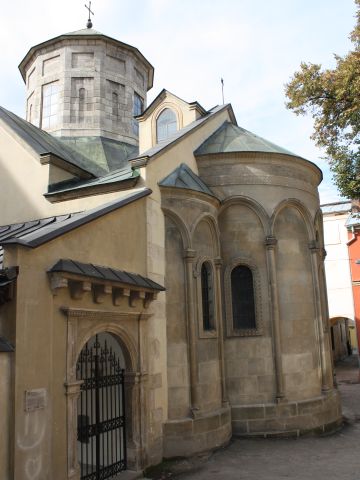
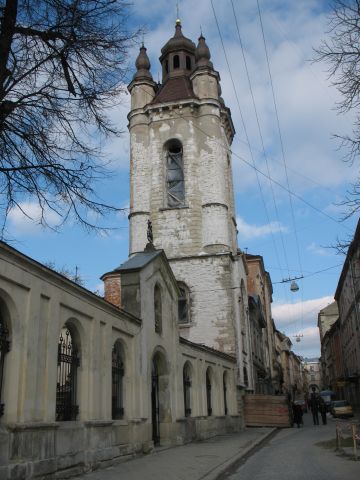
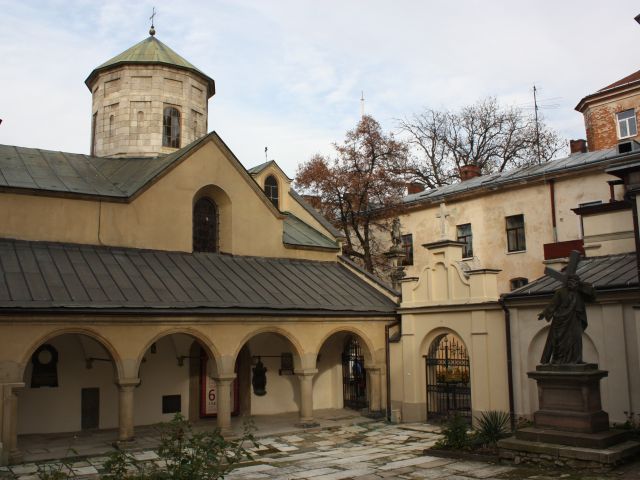
The oldest part of the church is a three-nave, four-columned church with three semicircular apses (an overhang of the building covered by a half-dome or a closed half-vault). The dome of the church rests on hollow ribs made of fallen clay pots. The high tower, built in 1571 according to the project of architect Peter Krasovsky, serves as a reliable landmark. Above the entrance, which leads to the courtyard of the Armenian Church, there is a sculpture of the Mother of God holding the little Jesus in her arms. Passing the entrance, we enter a small corner of the East. In the courtyard, opposite the apse, stands a decorative column with the figure of St. Christopher, placed here in 1726. Nearby are the building of the former Armenian bank (XVII century) and the palace of Armenian archbishops (XVIII century), as evidenced by the coat of arms on the facade. Together they create a peculiar architectural ensemble.
During his visit to Lviv in June 2001, the Armenian Cathedral was visited by Papa Papa. Pope John Paul II visited the Armenian Cathedral.