 Rynok Square along with the Town Hall is one of the best architectural ensembles of the city of Lviv. Such squares were in almost all cities of medieval Europe and were the center of social, cultural and economic life.
Rynok Square is considered to be the heart of Lviv Historical and Architectural Reserve, and is a single architectural ensemble, measuring 142 by 129 meters. Here were the palaces and houses of prominent citizens, the magistrate (the body of city government), was concentrated trade and here they also did the trial and execution. The architectural image of the square was formed in the second half of the XVI century during the heyday of the Lviv Renaissance. Each house was built according to an individual project and is a landmark of Lviv. The facades of the houses were three-windowed, and if someone wanted to increase the number of windows, it required a special permit and payment of a higher tax.
In the center of the square stands Ratusha with a high 65-meter tower, created in the XIV century. It was not only the center of state power, here were also held solemn events — weddings, banquets of noble citizens. 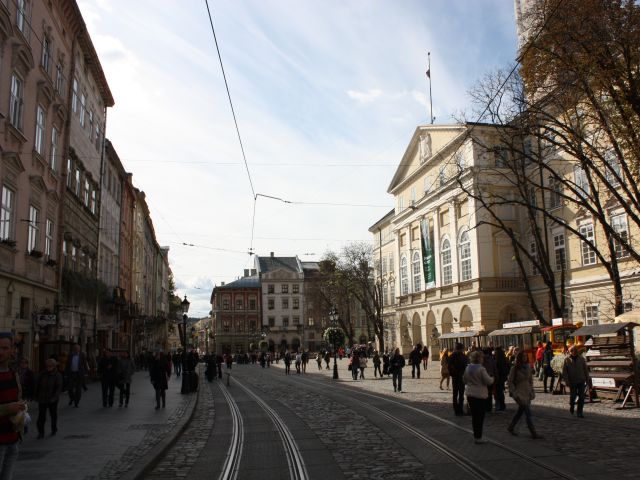 This architectural monument was often rebuilt, not once restored after fires. The Town Hall was first mentioned in 1381, when there was a fire and the entire city archive was destroyed. At the end of the XV century the Town Hall underwent significant changes, when in 1491 a new tower with an attic was built according to the project of architect G. Shteher. But the next fires in 1527 and 1571 did not spare the Town Hall. In 1619 a new building with a high Campian tower was erected. It stood for just over 200 years, and in 1826 the tower collapsed.
The modern Town Hall was built in 1827-1835 in the Classicist style. At the entrance are two stone lions holding shields with the city’s coat of arms. The new tower, built according to the project of architect I. Salzman, has a height of 65 meters. In 1852 the city clock was installed on it. Nowadays there is an observation deck on the top of the tower, which offers a magnificent panorama of the central part of Lviv. You can take a tour in the premises of the clock mechanism, where you will be told its structure and history.
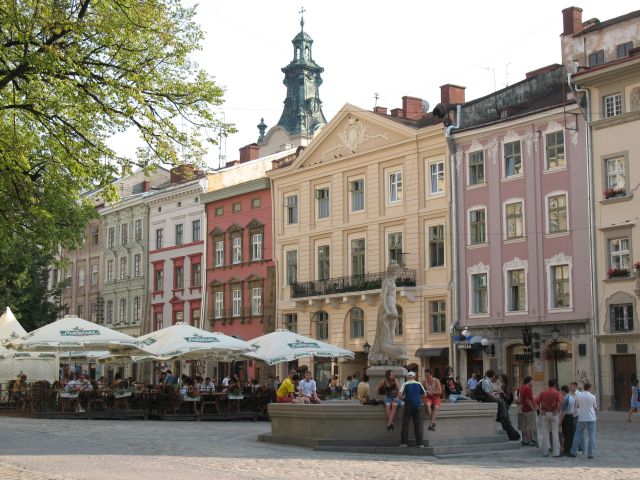 The corners of Rynok Square are fountains with statues of Neptune, Amphitrite, Adonis and Diana, made in 1793 by the famous Lviv sculptor G. Vitver. Each fountain has an octagonal bowl, in the center of which stands a character of ancient mythology.
The square is surrounded by 44 buildings, creating a unique open-air museum, almost on every building there is a security plaque: «Memorabilia of Architecture». Each building has its own history. Many of them have preserved elements of Gothic architecture of the XV-early XVI century.
Among the best buildings on the Market Square are house No. 4, known as the «Black Stone»; house No. 6 — Kornyakt’s house; house No. 2 — Bandinelli’s Palace.
House No. 2 was built in the late Renaissance style in the 16th century by a merchant and apothecary Janos Vedelsky on the site of a Gothic building. At the beginning of the XVII century this house became the property of the Florentine merchant Robert Bandinelli. He improved the first regular post office in Lviv opened here by Italian Domenico Montelupa. The facade of the house consists of a decorative relief depicting dolphins — symbols of good luck in trade and happy rescue on the waters.
House No. 4, the so-called «Black Stone», is one of the best monuments of residential Renaissance architecture. During its existence it changed several names: «Kamenitsa Kievskaya», «House of Lorencovich», «Kamenitsa Doktorovska». The current name «Black Kamenitsa» appeared in the XIX century and comes from the color of the wapniak stone. Its authors followed the basic principles of Renaissance architecture. The facade features reliefs, an attic topped with columns and carved obelisks. Above the portal in a halo is a statue of the Madonna. In 1926 this house was bought by the city and in 1929 the Lviv Historical Museum was opened here.
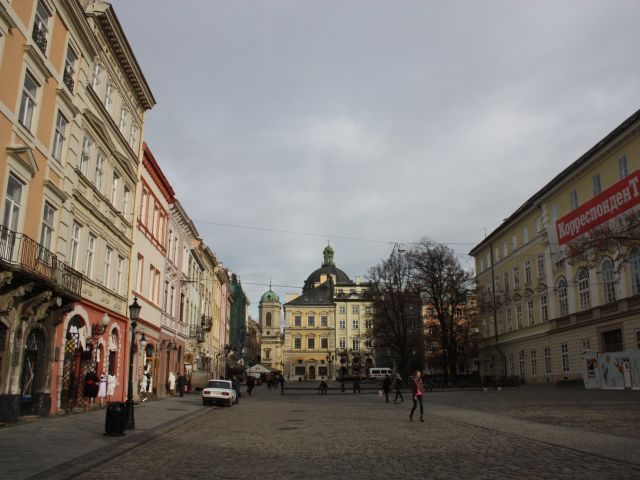 Not far from the «Black Kamenitsa» is another Renaissance building — the Kornyakt House, also the building of the Historical Museum. It was built in 1580 by architect P. Barbon for the wealthy merchant Konstantin Kornyakt. The Kornyakt Palace was once considered one of the most beautiful and majestic residential buildings in the city. In the austere facade one can feel the harmony of architectural forms. Two Corinthian columns on the sides of the portal emphasize the entrance to the building. Inside the building you get into the atmosphere of old Italian architecture. In the courtyard there is a unique three-tiered Renaissance arcade-loggia. One historical event is connected with this house: here in 1686 on the second floor, in the throne room, the «Eternal Peace» between Russia and Poland was signed. Nowadays, in addition to the museum, this building houses a cozy cafe, where you can listen to classical music concerts.