 «Apostle» and «Chapel», «Evangile Teachings» and «Psalter with the Hour Book», «Primer» and «Greek-Russian Church Slavonic Book for Reading» — just one book from this list would be enough to get into the historical annals. But they were all printed by Ivan Fyodorov, our famous first printer. Thanks to his work, books became free — they left the gloomy monastery walls and went out into the light, to the people, bringing them the joy of knowledge.
A man was born in 1520 in Petkovichi, a village on the border between the two countries. This is a village on the border between the modern Minsk and Brest regions. Ivan Fyodorov was educated at the former Krakow, now Jagiellonian University. Having received a bachelor’s degree, in 1530 the legendary «Drukar Moskvitin», as he later called himself, got into the entourage of Metropolitan Macarius. The latter offered the future first printer the post of deacon in the church of St. Nicholas of Gostun, which was located within the walls of the Moscow Kremlin. Only the young deacon devoted his time not to helping priests at services, but experimented with how to mechanize the process of reproduction of books, which earned him terrible dislike from the shop of scribes.
 When in 1553 the Tsar financed the construction of the Printing Court, Ivan Fyodorov embarked on the main business of his life. The only concession to the ministry and the «state customer» was that the first week of books was deprived of data about the first publishing house. Only the «Apostle» and the subsequent «Chapel» were dated and signed by «Drukar Moskvitin». But, after the tremendous success of Fedorov’s production, envious scribes set fire to the Printing Yard, and then to the new printing house, and began a campaign of harassment against the master, accusing him of using magic.
«Farewell, unwashed Russia» was written three centuries later by Lermontov. Ivan Fyodorov did the same, only without rhyming, leaving Moscow and moving to the territory of the Grand Duchy of Lithuania. At first he worked in the private printing house of Hetman Khodkevich in his estate in Zabludov. Later, the drukar in Ostrog printed the «Ostrog Bible», traveled to Western Europe and worked as a steward of the Derman monastery, appointed to this position by the Saxon Elector Augustus.
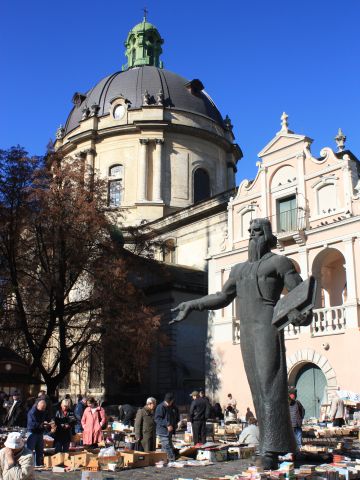
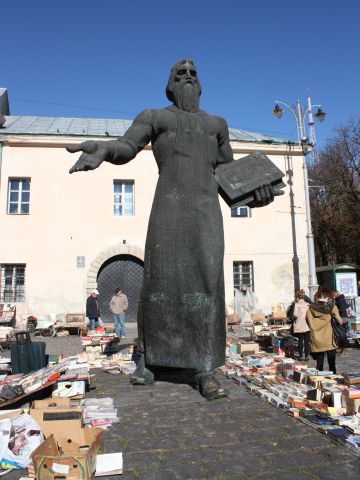
The last chord of the first printer’s life was the move to «God-saved» Lvov. Here he died in 1583. He was buried in the walls of the Svyatoonufrievsky Monastery. When in 1971 during the dismantling of the monastery wall were found the remains of Fedorov and his son, it became the reason for another surge of public interest in the first printer and served as a great reason for the construction of a memorial in his honor in the city. By the four hundredth anniversary of book printing in Ukraine, namely November 26, 1977, in the city appeared Monument to Ivan Fedorov, created by architect A. Konsulov and sculptors V. Borisenko and V. Podolsky. Podolsky.
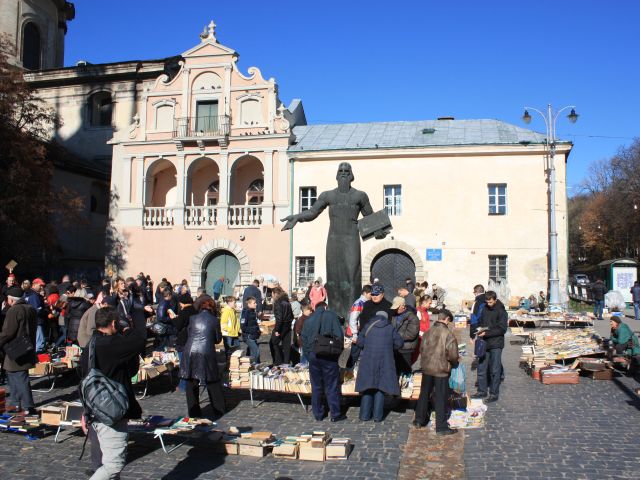 In contrast to the Moscow monument on the same theme, Lviv Ivan Fyodorov is like a Titan. The pious middle-aged man, whose muscular torso is wrapped in a craftsman’s apron, is walking towards people. In one hand the printer carries a book. The other hand, according to psychologists, demonstrates a gesture of openness and trust to others, to the world. Unlike hundreds of thousands of other monuments, the sculpture does not have a grandiose pedestal, it is placed only on a low granite platform. Therefore, it seems that Ivan Fedorov left his workshop for a short while and went out into the streets of Lviv, to the people, bringing them books and knowledge.
This Lviv landmark was installed in the historical center of the city, on Podvalna Street, next to Powder Tower, Dominican Cathedral and Uspenska Church. When on vacation in Lviv, every guest will see how harmoniously the monument to Ivan Fyodorov has blended into the urban landscape, and the work of the first printer has been continued in the city in the form of the largest book fair in Ukraine.