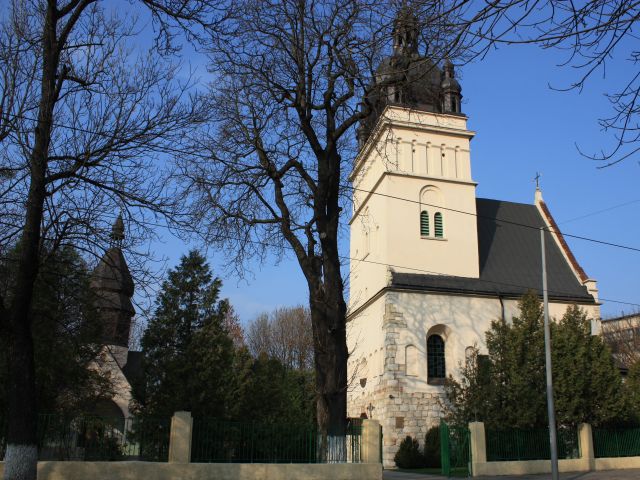
The neighborhood of Podzamche, a former suburb of princely Lviv, spreads out on the northern side of High Castle. The dominant feature of Podzamche as before and now remains the Church of St. Paraskeva Pyatnitsa.
According to the official version of the origin of the church — it served as an outpost outside the city walls on the so-called Volyn Way (the road to Volyn), a defense point for the inhabitants of the suburb. In the course of architectural and archaeological research in 1977-78 the foundations were discovered, which are attributed to the XIII century. It is more likely that the predecessor of the existing church was originally wooden, then stone.
Some researchers suggest that originally the church stood in the middle of the market square (the layout of which can be traced among the current development), so it was one of the central (probably parish town — unlike the princely St. Nicholas) in the heart (and not on the outskirts) of the princely city of Leo.
Anyway, but in later times, with the movement of city life to the area of Rynok Square, Podzamche became a suburb. Probably since then a new stone church (the first mention of which dates back to 1443) was erected in place of the wooden one, and although we have no idea what it looked like, we can assume that it also had a defensive character, since the life of a suburb outside the city walls required such a fortified defensive point.
Now the existing church was built in 1644 (in place of the one destroyed by fire in 1623) on the funds of the Moldavian owner (and at that time an emigrant in Lvov) Vasily Lupul, which is evidenced in particular by the Moldavian coat of arms with the image of a bull’s head under a star and a crown with the sun and the month on both sides, a saber at the top, a scepter and a princely crown, and the inscription:
«The sun and the month and the crown,
Sceptre palash defense,
«The head in the sun and the star.
«All thy clarity is notorious.
The temple of this zversh. roku AHMD August IE (that is, «the year 1644 August 15″)»
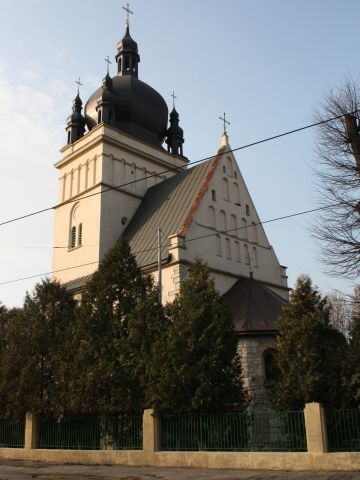
The church is dedicated to the patroness of Moldavia — St. Paraskeva. The church was consecrated in 1645. The church is made of broken stone in the lower part and brick in the upper part. It is one-nave, with a small narthex and altar. In plan it has the form of a rectangle with a faceted apse, much lower than the main part. Above the narthex rises a massive tetrahedral tower, which organically merges with the general mass of the building. With the total length of the temple of 22.75 meters the height of its tower is 44 meters. Therefore, despite the overall austere appearance, the church appears somewhat fragile.
The upper tier of the tower is decorated with a wide arcaded belt, and loopholes have been preserved there, which indicate its defensive character. The architecture of the monument does not have a clearly defined style.
The top in the form of a dome with four smaller towers («under Kornyakt’s tower«) was added during the restoration in 1908 according to the project of architect M. Luzhitsky on the place of the ancient hipped roof.
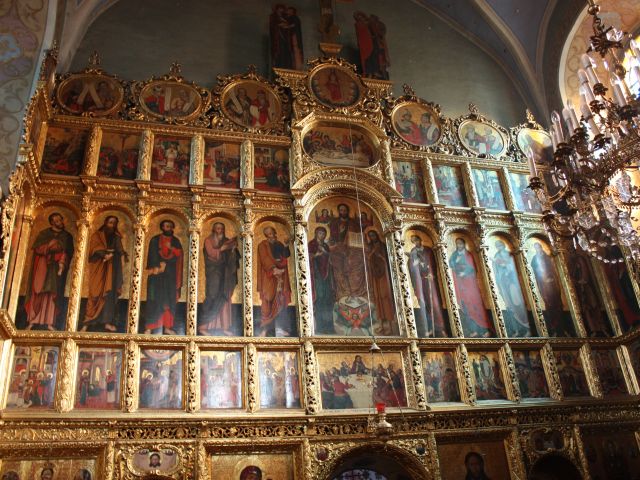
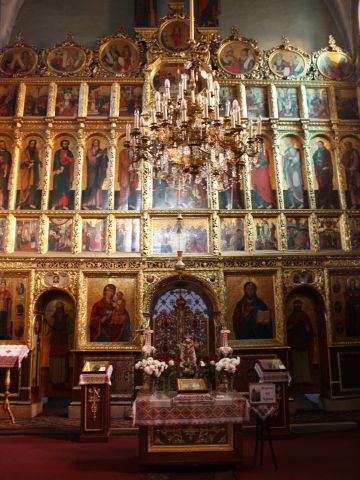
A valuable artistic attraction of the church is one of the oldest iconostases, created by Lviv artists at the same time with the construction of the church. The iconostasis of the Pyatnitska church is considered to be one of the most beautiful in Galicia. It consists of more than 70 icons arranged in six rows and represents a majestic complex of paintings and decorative carvings. This iconostasis is a monumental-decorative wall with a tectonically integral structure. Its main tiers — the so-called deesis, feast and passion tiers — are emphasized not only by horizontal but also by vertical divisions. In addition, a harmonious combination of its individual parts was achieved here by reducing the size of the icons of the deesis row and placing above it the tier depicting the «Passion of the Lord». The saturation of the work with decorative elements (relief openwork carving, recesses of niches that frame not only the central, but also other icons, which achieves a great play of light and shadow, etc.). Unfortunately, its authorship is unknown. In terms of style and artistic features it can be attributed to the workshop of a famous Lviv artist of the late XVI — first third of the XVII centuries. Fyodor Senkovych.
A new bell tower was built next to the church in 1996-1999 according to the project of Shvets.