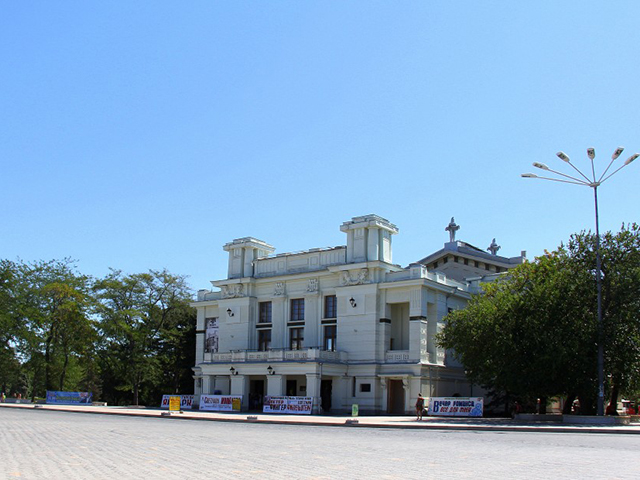
 Eupatoria is an illustrious Ukrainian resort with a clear specialization. Here are sent children and adults who suffer from chronic diseases of respiratory, reproductive, digestive systems or have metabolic disorders. The city has prepared a whole arsenal of «medicines» for the fastest healing of its guests — the sea and dry climate, sandy beaches that accumulate the energy of the Sun, as well as muds of Sasyk-Sivash and Moynatskoye lakes. Thermal mineral waters, released like genies from a bottle by the participants of the complex Hydrogeological Expedition in 1959, deserve a separate proposal.
To guests did not get bored in the process of treatment, Evpatoria has accumulated for them a whole «chest» of cultural values. Quality of local treasures can be compared with riches of Jerusalem, Rome or Istanbul. A real concentrate of secular attractions was the local Theatrical Square, located in the historic center of the city. In this seaside resort, it is no less important than the seafront. Everything from the opening of the holiday season to the nationally famous «festival of communal workers» is celebrated on Teatralnaya Square.
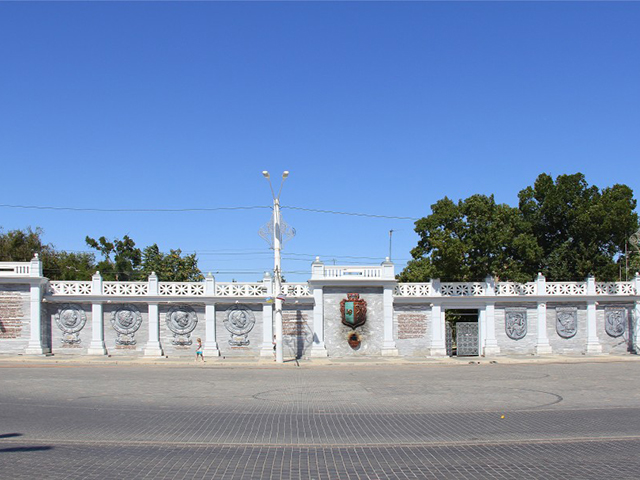 One of the most important decorations of the epicenter of Evpatoria’s social life is the Pantheon, similar to the one that adorns the Parisian Latin Quarter. On the wall of the color of the sea wave attached bronze shields with images of events or people who left a trace in the history of the city. On them you will see the silhouette of the ship of the founders of the polis — Hellenes from Ionia, and the image of the Kerch king Mithridates, who protected them from the Scythians. You will meet Catherine the Second, who gave Yevpatoria this name, and Sultan Mehmet, who built here the fortress Gezlev. In 2003 the Evpatoria Pantheon was decorated with a marble bowl with an eternal flame — so it was marked 2500 years since the founding of the city.
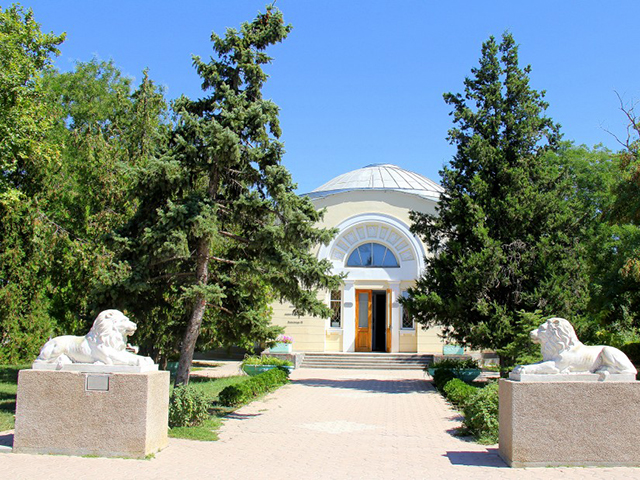
Not far from the memorial rises another attraction of the Theater Square — the public library. It was originally named after Alexander the Second, but was later renamed Pushkin Library. The delicate yellow, pseudo-antique style building of the library is ideal for filming movies about pre-revolutionary Russia. Opposite the library there are monuments to the pilot N. Tokarev and S. Duvan, the last dorevolutionary Russia. Duvan, the last pre-revolutionary mayor of the city.
 Naturally, the dominant building on Teatralnaya Square is Evpatoria City Theater. It appeared in the city in 1910. Its project Mr. Duvan ordered neither Italian nor Turkish architects, but local — Adam Henry and Pavel Severov. Only those who were born on the shores of the Gulf of Kalamitsky, and soaked in the spirit of the steppe and sea salt, were able to create this snow-white halls for Melpomene. It is made in neo-classical style. The shape of the theater is reminiscent of the Athenian Parthenon. All corners and windows of the three-story building are outlined with square columns. The same decorations are placed at the base of the portico at the entrance, and on the roof, instead of chimeras, goddesses and flying horses, a pair of mini Parthenons was erected. The Duvanovsky square begins behind the theater.
The authors of the «house for Melpomene» planned a large stage, a necklace of boxes and 750 seats in the hall. Initially, the theater was called the city theater, but in 1937 it was dedicated to A.S. Pushkin. Its work was «opened» by artists of the St. Petersburg Mariinsky Theater, and today the most stellar troupes and artists of various genres willingly perform here.
Choosing vacation in Evpatoria, every guest of this ancient city will be able to appreciate the architectural harmony of not only the Theater Square, but also other historical or sacral virtues of this city. Some of them are recognized sights of Crimea, and some of them are worthy to take a place in the list of world cultural treasures, carefully collected by UNESCO specialists.