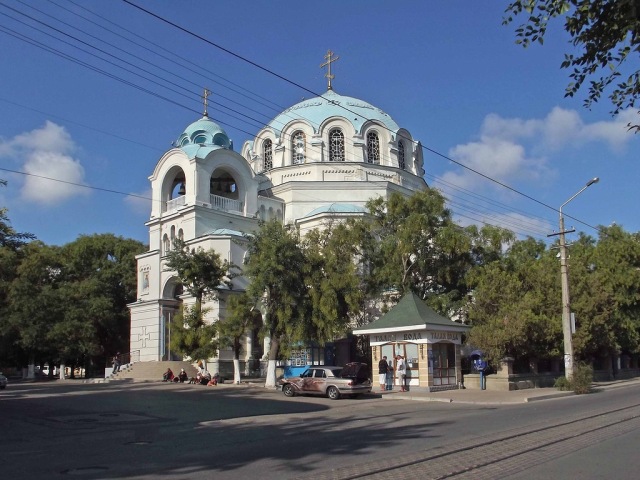
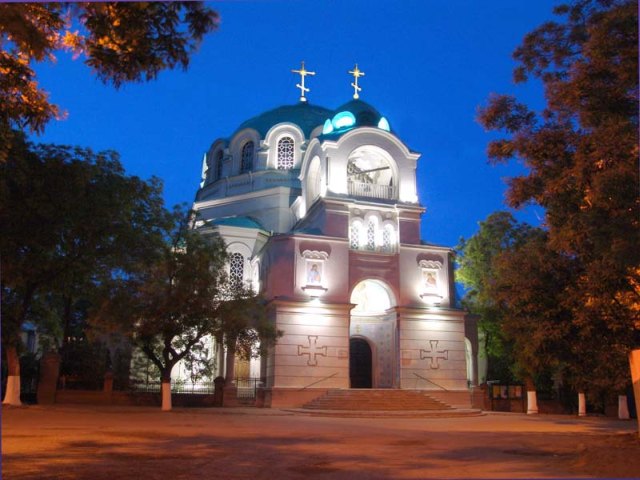
The cathedral in the name of St. Nicholas the Wonderworker, located in the center of the city, is especially beautiful. Evpatoria Cathedral is a miniature copy of St. Sophia in Constantinople. But so majestic Nikolaevsky temple became not immediately..
The first temple was built by the Greeks in the late XVIII century and consecrated in the name of St. Nicholas, the patron saint of seafarers and merchants. Over time, it became cramped for parishioners, so in 1806 built a new stone one, covered with tiles. This church suffered greatly during the Crimean War: the bell tower was destroyed, bells were broken, iconostasis, church books and archives were destroyed.
Thanks to the personal courage of the priest John Mangel and religious tolerance shown by the Turkish command, the church utensils were saved, they were taken together with the iconostasis to Odessa. The priest himself remained in the occupied city and supported his parishioners. Catholic services were held in the cathedral.
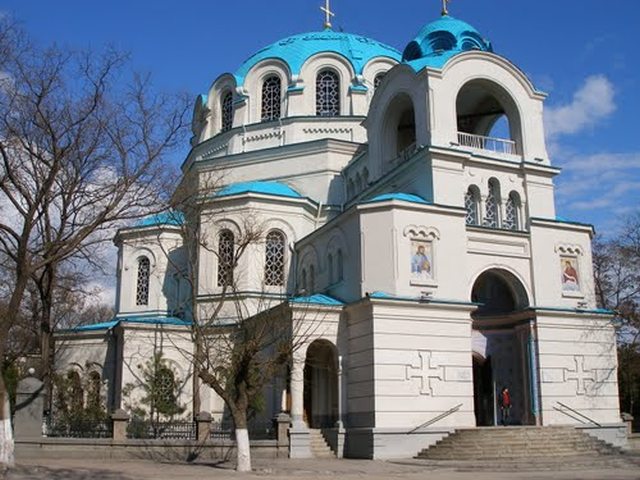
After the war it became clear that the temple should be rebuilt, as it became dilapidated, and the Orthodox population of Evpatoria increased, and the temple became small. They decided to erect a new cathedral in memory of the liberation of Evpatoria from the Anglo-Turkish troops during the Crimean War. The initiator of the construction of the new church was Archpriest Jacob Chepurin. For the construction in 1891 began to collect donations, and in 1892, by decree of Emperor Alexander III from the treasury was allocated 36 thousand rubles.
The solemn laying of the cathedral took place on July 11, 1893 with the participation of His Grace Martinian, Bishop of Simferopol and Tauride. And consecrated the new church was February 16, 1899 Eminence Nikon, Bishop of Volga. The cathedral was built next to the old church, in which all these years were conducted services.
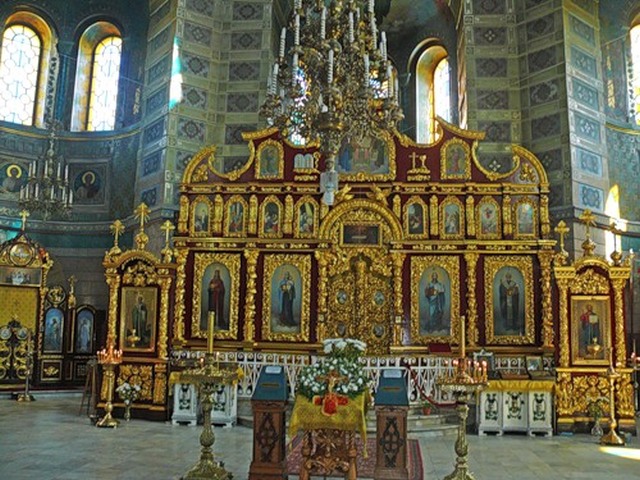
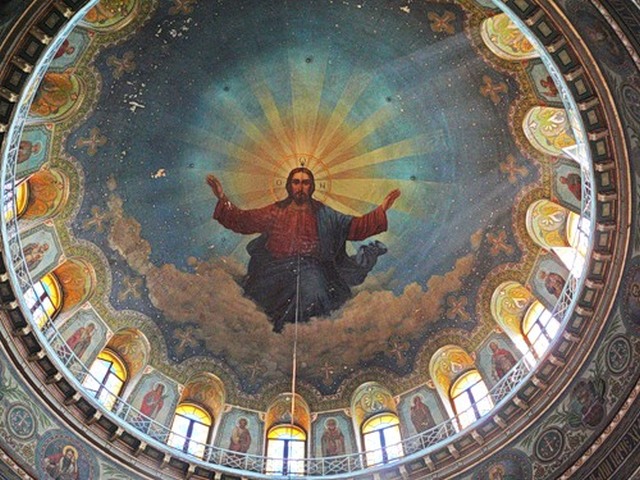
The Byzantine-style cathedral was designed by Alexei Osipovich Bernardazzi, the city architect of Odessa and chairman of the Odessa Technical Society. The contractor was the Sevastopol merchant Anany Savelyevich Paskhalidi, and the engineer Vyacheslav Gerinek supervised the construction work. He became the author of a number of engineering innovations used in the construction of the cathedral. One of them is a huge dome made of concrete, its diameter is 18 meters and its weight is 156.6 tons. In the upper part of the drum, the number of faces was doubled and a light window was made in each of them.
The cathedral struck the imagination of parishioners with its bright decoration. Paintings of domes, vaults and walls of the temple belonged to the teachers of the gymnasium Vitaly Sokolovsky and Sergey Stroev. The iconostasis was made by the Florentine carver Vannuki. The dome was crowned with a bronze and gilded cross created by the artist B. V. Eduards in Odessa. St. Nicholas Cathedral had a capacity of 2000 people.
Three altars were consecrated in the temple, the central one in the name of St. Nicholas of Myra, the Wonderworker. In the throne of St. Blessed Prince Alexander Nevsky kept Russian colors from the Crimean War. In the conch on both sides of St. Alexander Nevsky are depicted St. Equal-to-the-Apostles Princess Olga and St. Equal-to-the-Apostles Prince Vladimir. The left throne is consecrated in the name of the Apostle James Zebedeev, depicted here in the conch. On either side of him are the faces of St. James, brother of the Lord, and the Apostle Andrew the First-Called.
Archpriest Jacob Chepurin gave a lot of effort and energy to his favorite child — St. Nicholas Cathedral. In order that the construction of the temple did not stop when the funds ran out, he invested his own savings, mortgaged the property of his family. Jacob Chepurin died unexpectedly on November 29, 1898 and for his services was buried in the temple near the north side of the apse.
On May 16, 1916, Svyato-Nikolayevsky Cathedral was visited by Emperor Nicholas II and his family. In the temple was served a prayer service and proclaimed a tribute to the royal house and the entire Russian army.
During the years of Soviet power, the fate of the cathedral changed more than once. It was closed and reopened several times, at different times it was used as an art workshop or a warehouse for storing wheat. Because of this, the magnificent decoration of the cathedral was lost. And it barely escaped destruction during the Great Patriotic War: the temple was not blown up in time.
In 1999 St. Nicholas Cathedral solemnly celebrated its centenary. Above the main entrance pine branches laid out the dates: 1899 — 1999. In memory of this event a memorial plaque was installed at the entrance.