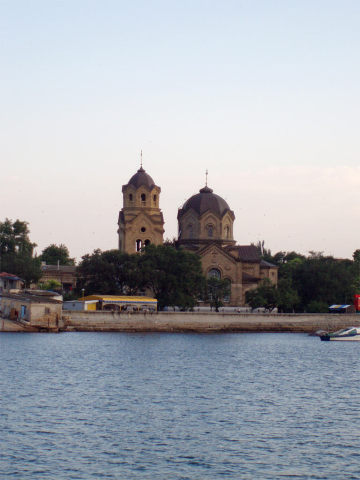
 In 1899, the Greek community of Evpatoria appealed to the Duma with a request to allocate land for the construction of the temple. In 1901, a plot of land in 600 square sazhens was freely given to the community. By 1907 the project of the temple was prepared, its author was the city architect A. L. Henry.
It was supposed to build a new temple on the donations of parishioners. But the funds came slowly, and the necessary amount was not collected. Therefore, in 1908 in the Duma on behalf of the community appealed to F. I. Vasilkioti, he asked for a subsidy in the amount of 5000 rubles. The governor of Evpatoria S. E. Duvan agreed to pay the subsidy in installments, each year by 1000 rubles. Personally from himself S. E. Duvan donated 400 rubles and a bronze chandelier. For his help in the construction of the temple, he was awarded by His Majesty the King of Hellenes with the Cross of the Holy Savior.
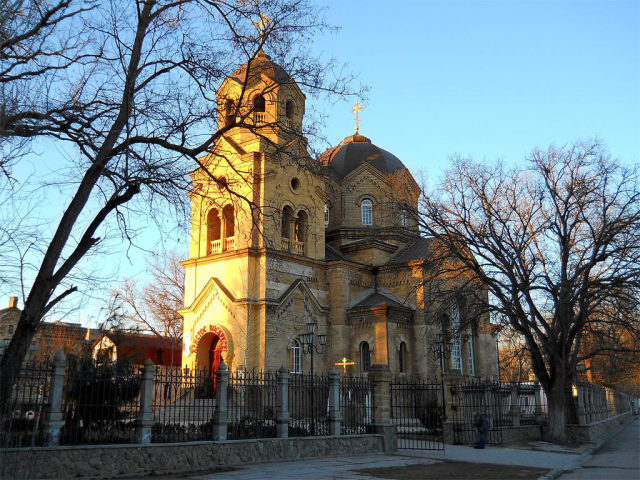 The construction of the church began on June 6, 1911, and on June 30, 1918 the new temple was consecrated in honor of the prophet Elijah. So, due to lack of funds, the construction of the temple was delayed for almost 10 years, and ended on the eve of the new era, when the persecution of the Church began. The temple of St. Elijah is built in the Greek-Byzantine style, in the plan in the form of a cross. The dome rests on an octagonal drum, each face of which ends with a pediment. The temple is decorated with thin pilasters, semi-circular arches, triple windows with stained glass. On the eastern side there is a pentagonal apse, the main entrance is designed in the form of an arch resting on two semi-columns.
The three-tiered bell tower of the Iliya church was dismantled in the 60s and restored recently.
After the revolution the church remained active. Its parishioners were Greek subjects, so the authorities did not immediately apply forceful methods. First they decided that bell ringing was unacceptable for socialist reality, so they removed the bells in front of the astonished parishioners. The congregation decided to defend its church, and for this purpose sent a letter to the Greek consul in Moscow with a request for help. Took the letter to the chairman of the Church Twenty Savva Fedorovich Kyriakidi. 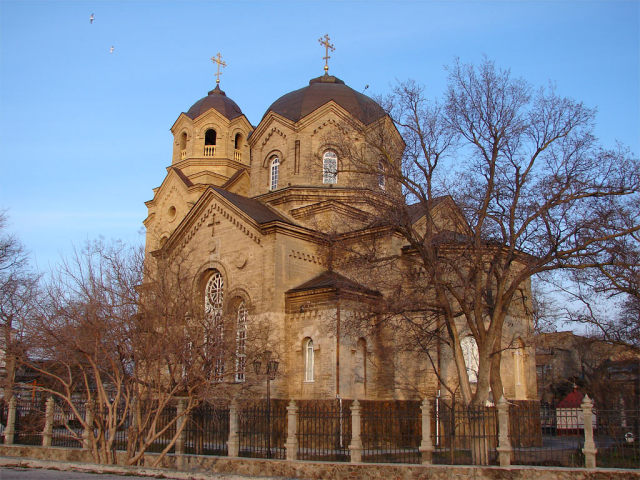 This appeal infuriated the authorities of Evpatoria, they accused the Greek community of slander. In 1936, the contract with the Greek community terminated because the parishioners were unable to repair the building. However, the state had no money either, and the temple was closed.
Since the late 50’s in the former St. Elijah’s Church organized a gymnasium. Today the bell tower and the temple are fully restored.
Recently a miracle happened in the temple with the temple icon of the prophet Elijah. An unknown artist depicted the prophet at the waist, in his hand he holds a scroll, his face is strict, his eyebrows threateningly shifted, gray hair and beard develops wind. When Iliinsky temple was closed, the icon was kept in St. Nicholas Cathedral. After the temple was restored, the icon was transferred to its native temple with special love and triumph.
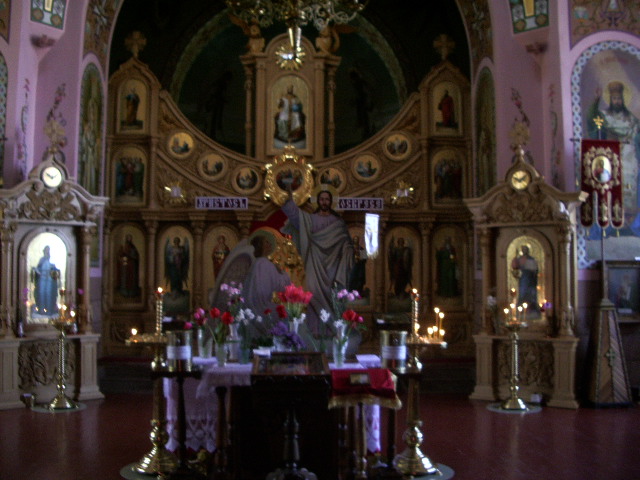 In 1999, on the feast of the Holy Trinity, an acolyte came to the church very early. While laying his hands on the icon of the Prophet Elijah, he saw in the rays of the morning sun on the glass that covered the icon, clearly outlines that repeated the image on the icon. The acolyte informed the rector about what he had seen, and the icon was moved to the altar. During the festive service the contours on the glass became clearer, and by the end of the feast the face of the Prophet Elijah could be seen.
On the instructions of Vladyka Lazar, a commission was established to examine the icon. When the members of the commission removed the glass, the imprint of the contours of the figure and face of the Holy Prophet Elijah was clearly visible on it, the best imprint was the hand holding the scroll. As if the prophet Elijah is calling us all to be more diligent in studying the Holy Scriptures, to live and act according to its precepts.