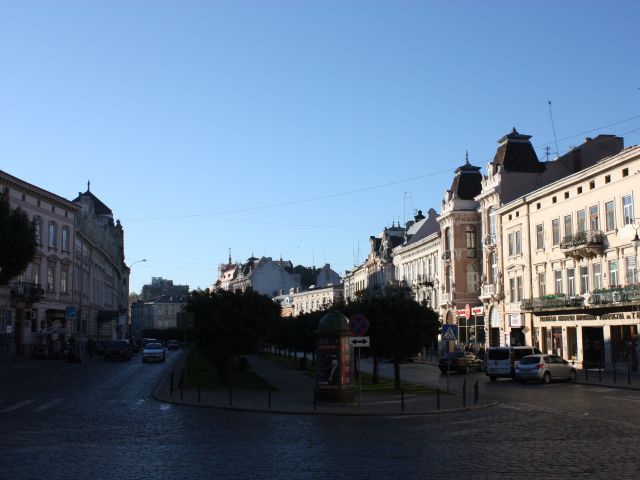
 Walking cozy old streets of Lviv can be endless — almost every street house of Galician district — the heart and soul of the city, is an interesting attraction that has its own history and causes a desire to admire the beauty of architecture. One of these streets is Shevchenko Avenue — its history is more than five centuries old, and no tour guide can ignore it.
Shevchenko Avenue is not far from another city «Korzo» — Liberty Avenue, so you can start getting acquainted with it right after a walk along the latter or before it. You can get to it right after Mitskevicha Square, where Svobody Avenue begins — this very square is considered the beginning of Shevchenko Avenue, and its South side passes into Saksaganskogo Street. Whether you wandered here by accident or came here purposefully, deciding to familiarize yourself with the most interesting corners of Lviv — this walk in any case will be memorable and will leave a lot of positive emotions.
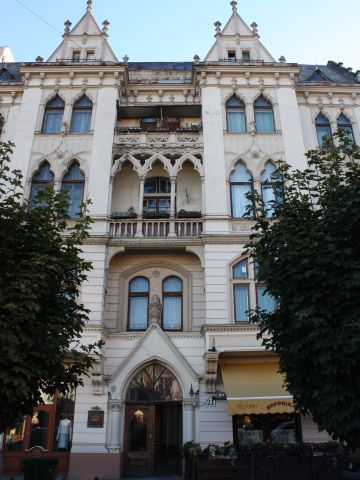 Every guest of this corner of Lviv is impressed by the fact that Shevchenko Avenue was founded in the Middle Ages! But then — in 1569, when the street was first mentioned in written sources, it was called Garbarska because of the fact that here lived garbari (tanners). In those times the street was one-sided and stretched along the bank of the Poltva River, the bed of which was where today you can see an alley of poplars. The river continued to exist here in the XVII-XVIII centuries, when the street was called Svyato-Ivanskaya (St. John), in honor of the figure of John Nepomuk installed on the bridge across it.
Jan Nepomuk was a Czech Catholic priest and confessor of King Wenceslas’ wife, who became a martyr (he was drowned in the river by order of the king because he refused to tell him about his wife’s love affairs). According to legend, after the death of the priest at the place of his death, people saw a halo with five stars in the water — this is how the saint was later depicted. Together with the ancient stone bridge, the statue of Jan Nepomuk over the Poltva River was a very picturesque scene, reminiscent of the Charles Bridge in Prague, where you can see the sculpture of the saint today.
«Hid» the river Poltva under a concrete dome only at the end of the XIX century. At that time (the works were completed in 1890) the street was already called Akademicheskaya Street, because in those years it faced the old building of Lviv University (academy). Old residents still call the avenue Academic Street, although it was renamed again in 1955. The new «patron» of the street was the Ukrainian poet and artist Taras Shevchenko, the founder of modern Ukrainian literature and literary Ukrainian language.
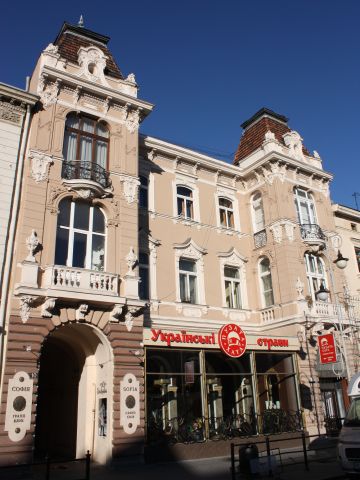 After the Poltva was closed off, an alley of poplar trees was planted on the street, which can still be seen here today, at the same time the avenue began to turn into one of the most fashionable streets of the city — fashionable restaurants, cafes, stores were opened in new beautiful buildings. One of such places was House No. 10, where a confectionery store was opened, which was later described by Stanislav Lem in the novel «The High Castle».
Until recently, on the first floor of the house No. 10, built in 1893, a confectionery store («Svitoch») is still in operation, with a large store window in place, the exhibitions of confectionery art in which so impressed S. Lem: «…I remember herds of pink pigs with chocolate eyes, all imaginable varieties of fruits, mushrooms, smoked meats, plants, some forest thickets and clearings. One had the impression that Zalevsky could repeat the whole cosmos in sugar and chocolate…». Today there is a catering center on this place. And today there are only memories of the oldest Lviv bathhouse of St. Anna, which was located in the courtyard of the house since 1810.
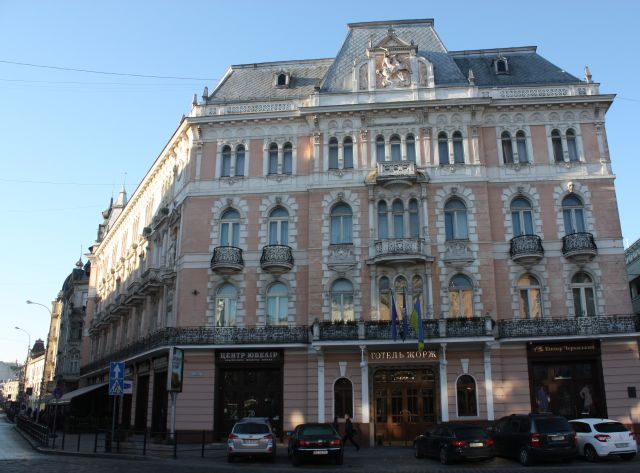 But it is worth to start looking around the buildings on Shevchenko Avenue, first of all, from the house No. 1 — the oldest. It was built in 1796 for the hotel «Russian», the owner of which was Georges Hoffman — a rich landowner. Famous people stayed in this house, including the writer Honoré de Balzac. Since the XIX century it is called «Georges» in honor of the first owner, although there is not much left of the original architecture — in 1899 it was rebuilt according to the project of architects G. Helmer and F. Felner.
Houses No. 8 and 9 deserve attention: in the first one is one of the oldest movie theaters in the city, in the second one there was a women’s gymnasium in the XIX century. Each house here attracts attention, charms with the slenderness and lightness of architectural forms, elegance of stucco and other decorative details. And here the house No. 17 impresses with its monumentality. It was built in 1912 by architect A. Zakharevich for the Chamber of Commerce and Industry (Lviv Stock Exchange), today it is the regional prosecutor’s office, but the most beautiful interiors have been preserved: stained glass and mosaics on the stairwell in 1909 by architect K. Fricha. Fricha, the meeting room on the second floor with panels by F. Vygzhyvalsky and high reliefs by Kurchinsky about the fate and life of man.
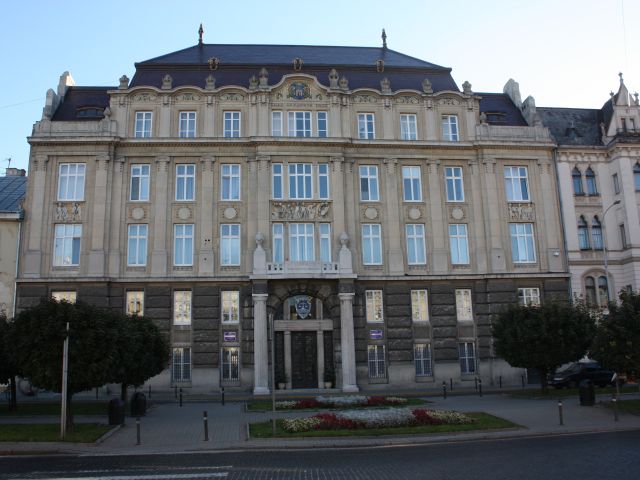 The house immediately following the former stock exchange contrasts with its neighbor in lightness and subtlety of lines and forms, reminding of the Moorish style. The panorama of the avenue is completed spectacularly by another architectural gem — house No. 27, which also attracts with its history. It was built in 1907. (architect Zbigniew-Brochvitch-Levinsky) house with a facade stylized as a medieval castle used to house a cult cafe, which was called «Scottish cafe» because representatives of the «Scottish mathematical school» liked to gather here. Among them were such famous persons in the mathematical world as S. Banach — the founder of mathematical analysis, S. Ulam, S. Mazur, G. Auerbach and many others. The «Scottish Book» of unsolved problems, which became famous in the world of science, was written in this cafe.
Such beautiful sights of Ukraine as on Shevchenko Avenue are the reason why Lviv, Kiev and other ancient cities of the country are now called one of the most impressive ancient European cities. Walking along this street, everyone feels cozy, charged with amazing energy, which can be felt in such beautiful and interesting places.