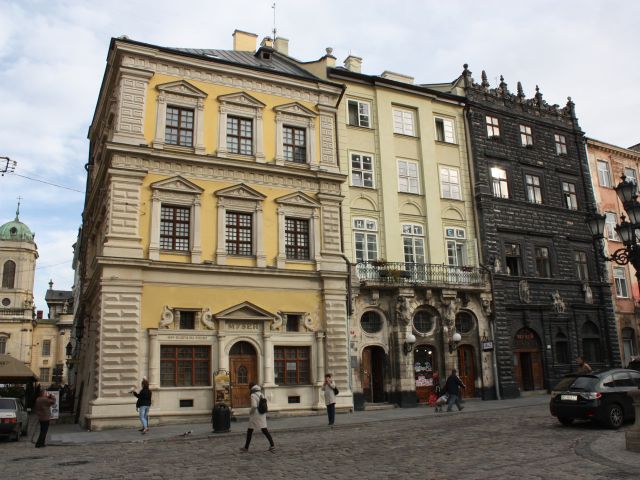
 What we take for granted today was unimaginable some 100-200 years ago. Once it was possible to get in touch with people in other cities only by means of letters, which took a long time and, sometimes, reached the addressee after irreparable events, which is widely reflected in classical literature. The memory of such times in Lviv is best preserved by the building located on Rynok Square — Museum of Post. This house is notable for tourists as a very interesting museum and architectural landmark of the city of Lviv, representing one of the beautiful examples of the late Renaissance.
Being on Rynok Square, it is impossible not to pay attention to Palazzo Bandinelli, as Lviv citizens often solemnly call this architectural monument: the building attracts with its restrained but charming beauty, which is enhanced by its distinctly antique appearance. This house was built by an unknown architect at the end of the XVI century for a Polish doctor and pharmacist Jarosz Vedelski — that is, it is more than three hundred years old! But today it is better known for housing one of the oldest post offices in Eastern Europe.
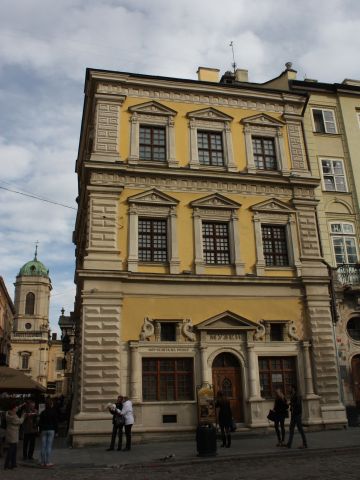 In 1629 the building was bought by the Florentine merchant Roberto Bandinelli, grandson of the famous Renaissance sculptor Bartalameo Bandinelli, who had recently settled in Lviv. After marrying a Lviv woman, Roberto decided to buy this house for his family, and soon, thanks to the patronage of Prince Stanislaw Lubomirski and Hetman of the Polish-Lithuanian Commonwealth Stanislaw Koniecpolski, he received from the Polish King Sigismund III the title of royal postmaster and the right to maintain a regular royal post office, which he opened in his house. Once a week — on Saturday, Lviv citizens sent and received letters from all over Europe in this house, it was the first post office on the territory of modern Ukraine. Such a significant historical fact could not but play a role in the fact that the Postal Museum was later opened in the building. Although Bandinelli’s endeavor ended rather sadly: the post office in house No. 2 on Rynok Square did not last long. The fact is that postal services turned out to be a very expensive privilege that few people could afford. Because of the heavy weight and the high cost of paper in those days, sending mail was equal to a day’s salary, and soon the Lviv Council had to abandon postal services, which ruined Bandinelli, who had invested all his money in the endeavor.
 In the following years, the building changed hands several times: after the Swedish conquest of Poland in the middle of the XVII century, the courtyard was used as a post office. Then in the beginning of XVIII century. the house is bought by the city judge, who opened on the first floor of the office, and then in the early XIX century. its owner is a German Karol Wild, who opened here one of the best bookstores in Lviv. Under Wild, the first engraving room in the city began to work here, and then — a literary and music salon, where the city bohemians gathered.
In 1737-39 the building was rebuilt, but the white-stone carvings on the window and door frames have been preserved since the 16th century, as well as the portal and the right window near it, decorated with dolphins. Since Soviet times the house belongs to the Lviv Historical Museum and due to lack of proper maintenance until 2008 it was closed for restoration, which began in the 1980s.
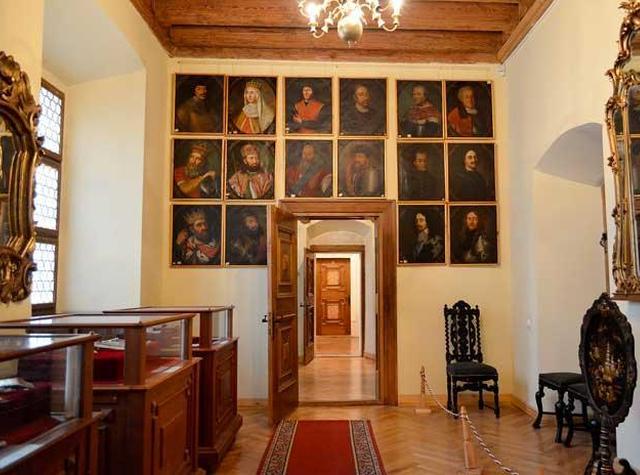
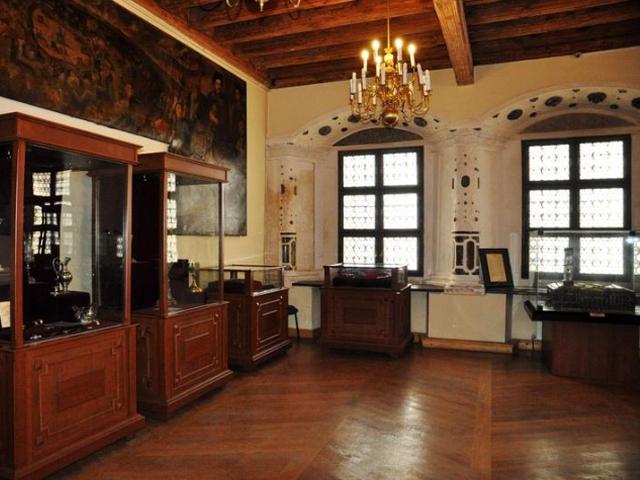 The grand opening of the Museum of Post was held on December 12, 2008. Its exposition is located in three halls on three floors of the building. On the first floor there is an exhibition of the Postal Museum itself, in which rare and very interesting exhibits of XVII-XX centuries (mail bags, weapons, old travel trunks, uniforms of letter carriers, first art postcards and other exhibits reflecting the history of postal business) are found. The second floor introduces guests to the continuation of the exposition of the royal halls of the Lviv Historical Museum: here you can see exhibits dating back to the XVI century (European silver, furniture, tapestries, etc.). On the third floor there is art, including not only paintings, but also a selection of old photographs of the city. There is also a gallery of portraits of Polish kings.
Getting to know the Postal Museum will be a valuable experience for anyone who wants to see Lviv’s most interesting museums and visit the city’s oldest houses with a rich and long history. A visit to the Bandinelli Palace will leave only pleasant and vivid memories.