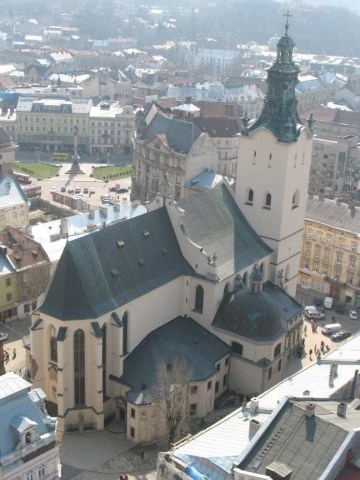
 Between Teatralnaya and Galitskaya Streets, at the exit to Rynok Square is the only landmark that has preserved the features of Gothic appearance — Latin Catedral Cathedral of the Assumption of the Blessed Virgin Mary. In the time of Galician princes one of the far outskirts temples — the Church of the Dormition — stood here.
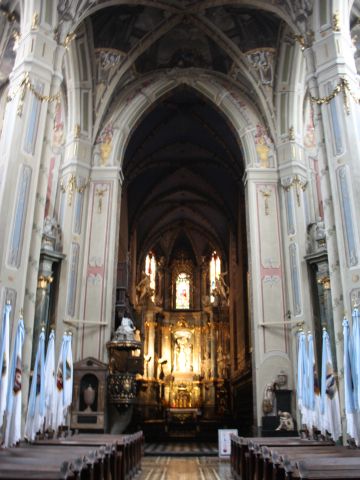
Polish King Casimir III ordered to demolish it, and in 1360 the first stone was laid in the foundation of the Latin Cathedral, which became an outpost of the Catholic Church in the western Ukrainian lands. Its first architect was P.Shteher. The cathedral was built slowly and only in 1479-1481 it was mostly finished. The forms of the cathedral are strict and majestic. Especially strong impression makes the interior with its tall columns, on which rest lancet arches and vault with Gothic nervures (protruding ribs of the Gothic frame cross vault).
The square around the cathedral has long been used to bury the dead citizens. Many large magnates, patricians, rich merchants considered it their duty to build a chapel-tomb in the cathedral or near it. Only in the middle of the 18th century all burials, tombstones and crypts were removed from the square, except for the Boimov Chapel and a number of others, which were added to the main body of the Latin Cathedral, and further burials were forbidden.
Boimov Chapel is a family chapel of the Boimov family, built in 1609-1615 in the late Renaissance style. The front wall is covered with continuous stone carvings. On the other facade from Galitskaya Street there are portraits of George and Jadwiga Boimov, on the third facade there is an image of St. George the serpent fighter.
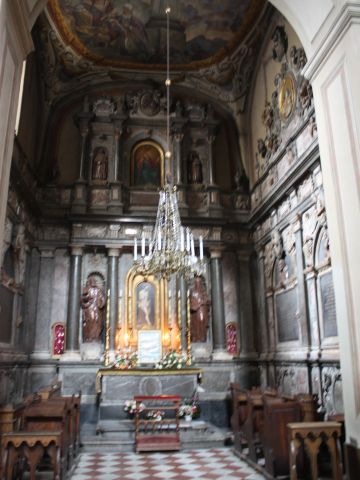
The Campian Chapel is built into the northern wall of the Latin Cathedral. The funds for its construction were provided in 1619 by Martin Campian, M.D., a doctor of medicine. Martin Campian, doctor of medicine, burgomaster of Lviv (head of the executive power — mayor). The entrance to the chapel follows the strict traditions of decorative plastic art of the Renaissance. On the side walls there are portrait busts of Martin and his father Pavel Campianov, high reliefs (a type of sculpture in which the convex image protrudes above the background plane for more than half of the volume) depicting prophets, apostles, evangelists (apostles, authors of the four canonical Gospels).
The Cathedral received its modern look in the 60-70s of the XVIII century. During its restoration Gothic forms were displaced fashionable at that time baroque. 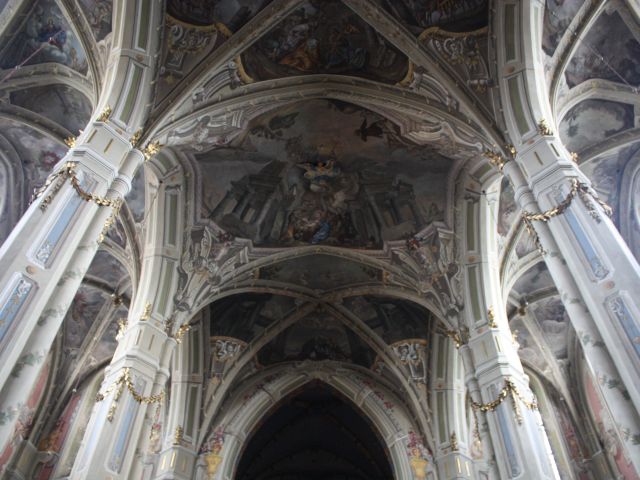 The project of restoration and management of construction works was carried out by the talented Lviv architect Petro Poleevsky. Instead of the bell tower, a high tower was built, which received a baroque finish, a new, very lavish and luxurious altar by Matvei Polejevsky was installed, new statues appeared around the cathedral. The walls and vaults were painted by the famous artist Stanislav Strojinsky. In addition, five chapels were dismantled and a new main entrance was built.
There are Turkish cannonballs hanging on chains on the walls of Kathedra, which were hung in 1672 after the siege of Lvov by the Turks.
In 2001. The Latin Cathedral was visited by Pope John Paul II.