It is strange that the Eternal City, i.e. Rome, thought that only Paris is worthy to be its twin. But just like the Italian capital, the historical center of the head city of Western Ukraine is protected by UNESCO. Just like in Rome, it is located on travertine rocks, is full of unique architectural masterpieces, and just like in the fiefdom of Remus and Romulus, the number of sights and people shaping culture in Lviv is much higher than the national average.
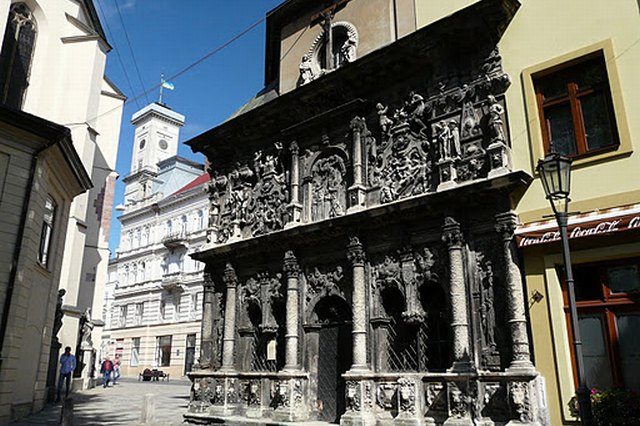
One such landmark that «makes» the atmosphere of the former capital of the Principality of Galicia-Volhynia is the legendary Boimov Chapel, located on Cathedral Square in building number 1.
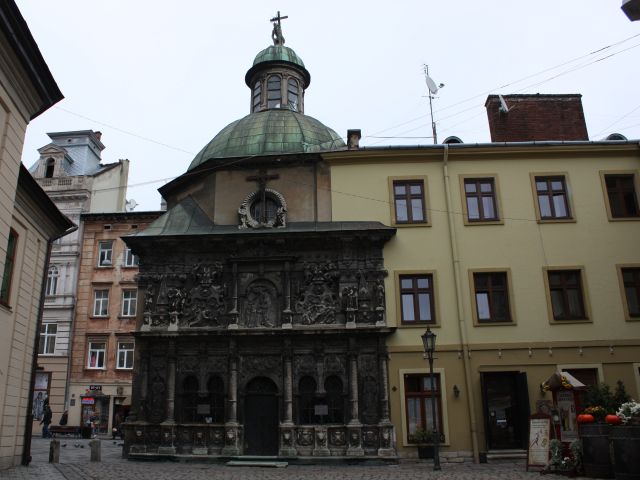
Its appearance is associated with the Latin Cathedral, «produced» by the architect P. Stecher and Co. in 1360. In the Middle Ages it was customary to bury the dead around one of the city’s finest Roman Catholic cathedrals. Not all of them, of course, but the city’s nobility, Polish soldiers, Russian voivods and Lviv volunteers who fell in battle with the Tartars. The latter were buried with a coffin covered with blood-colored velvet. There were many battles in those times, so around the Latin Cathedral quickly formed a mini-necropolis, which included the chapel of Milevskyi, Zamoyskyi, Crucifixion, Buchatskyi, Our Lady and Campians. What is not Rome, with its numerous cemeteries and Christian catacombs in the very center of the city? Over time, the local authorities, and the city had the Magdeburg Law, «covered up» the cemetery on Cathedral Square. Many chapels were demolished, except for the Boim chapel and those attached directly to the body of the Latin Cathedral.
The fact is that the chapel was the family crypt of the Boim family of Hungarian-Lvivian merchants. The founder of the family name, an influential merchant and moneylender, could afford to buy a plot of the city cemetery for the «needs» of his own family. George Boimov invited the architect Andrzej Bemer, the master of the city builders’ workshop and the author of the sculptural symbol of Lviv — a lion with a shield — to work on the family «pyramid». The work on the family tomb began in 1609 and was completed in 1617, already under the son of the chief Boehm — under Paul-Georg.
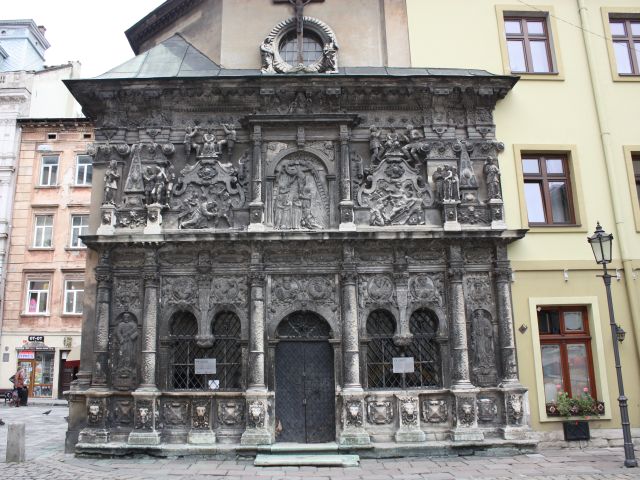
The chapel is a small structure shrouded in an aura of mystery and history. The square base of the building smoothly passes into the twelve-sided second floor, topped with a spherical dome with a graceful arched signature. It is believed that the prototype for the Lviv chapel was the Krakow chapel of King Sigismund the Third Vasa, built near the walls of Wawel. The western and eastern walls of the Boimov «pyramid» are covered with bas-reliefs. On the latter are preserved portraits of the first Boimovs, Georg and Jadwiga, who rested in it. In the middle of the chapel is richly decorated with alabaster moldings and stone carvings. Of particular interest to art connoisseurs is the interior painting of the dome-sphere, divided by three rows of caissons, and the sculpture «Pieta» by Jan Pfister. In this place a comparison with Michelangel’s Pieta, which gives a special meaning to St. Peter’s Basilica in Rome, is suggested.
The sights of Lviv differ from the architectural and cultural values of other Ukrainian cities. There is more mannerism and European spirit in them than in all the buildings of the country taken together, and domestic wildness allowed to keep their style and medieval spirit almost in pristine form. Therefore, in recent times, rest in Lviv has become very popular among the residents of the European Union, who found in this Ukrainian city the atmosphere, long since banished from their enlightened capitals and highly civilized cities.