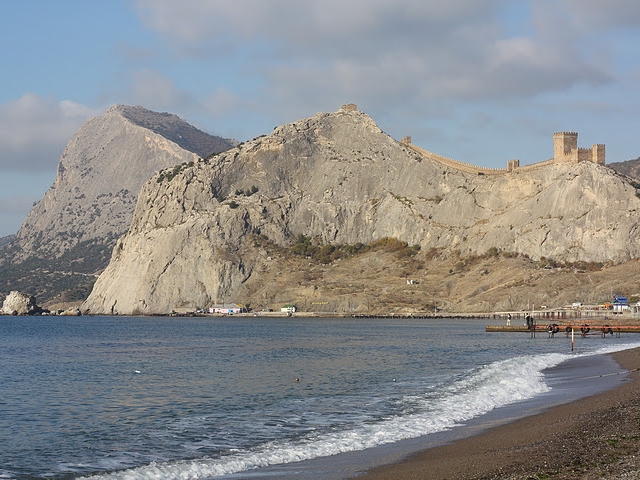
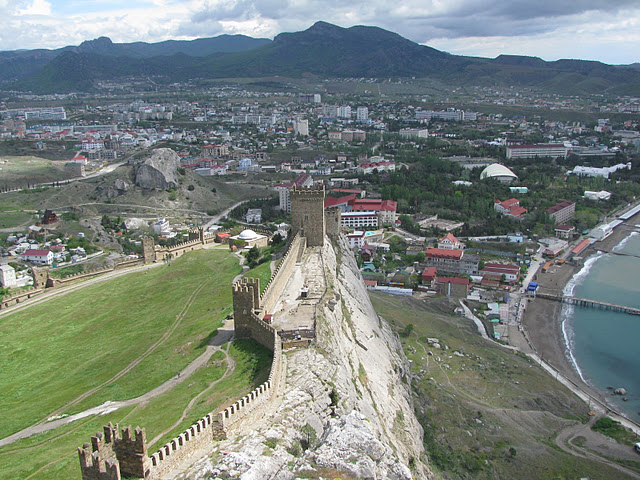
 Genoese or, as it is also called, Sudak Fortress is one of the most attractive sights of Crimea for tourists, which preserved the spirit and romance of the Middle Ages, presenting a picturesque picture over a high precipice and as if taking you back centuries ago. Today the Genoese Fortress in Sudak is a monument of medieval architecture of world importance, and more than five centuries ago it was a defender and home to hundreds of people.
Disputes about when exactly on the ancient coral reef above the high cliff appeared the first fortification, continue to this day. But the remains of defensive structures under the fortress walls found by archaeologists prove the assumption of many scientists: the construction of the fortress on the Kyz-Kulle-Burun mountain began in the VII century by the Byzantines.
That majestic construction, which occupied a huge area of almost 30 hectares, which can 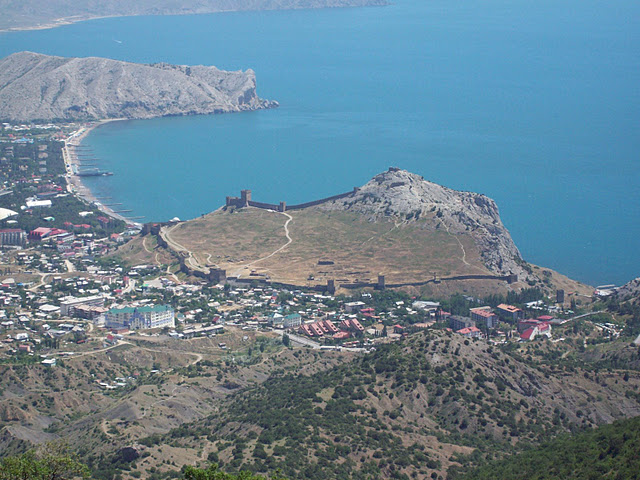 see today, was erected in 1371-1469 years by the Genoese. Genoese engineers built the fortress in the best traditions of Western European medieval fortification. Following the then existing canons, the builders erected two belts of defense. The lower or outer one protected the entire population of the fortress city from enemies, and the inner one — the citadel with the commandant’s castle, was the last stronghold of defense in case the enemies managed to break through the outer belt of defense, and was also the home of the rulers — commandants.
The lower belt of defense was a closed complex of 14 towers about 15 meters high and powerful 1.5-2 meter high walls from 6 to 8 meters. Each tower was named after the commandant during whose reign it was built, as evidenced by inscriptions on slabs in medieval Latin.
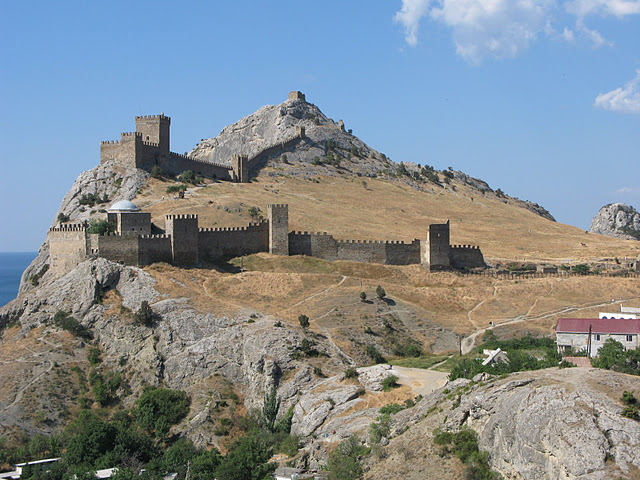 Today Genoese Fortress in Sudak is not completely preserved, but most of the complex of fortress structures can be seen today — after more than five centuries. Still as formidable rise 12 of the 14 towers, precedes the entrance to the territory of a massive complex of entrance gates to the fortress, preserved ancient mosque, freestanding Port Tower, Commandant’s Castle and standing above all the fortress structures Watch Tower, which is associated with ancient legends.
According to one of the legends, the queen of Sugdea (the ancient name of Sudak) did not respond to the love of one of her generals. Then he betrayed her and helped the Genoese to capture the city. Having cursed the betrayer, the queen climbed to the top of the tower and threw herself down from it, crashing on the rocks. Another legend tells of a brave Russian girl who was captured by the Tatars and because of homesickness threw herself down 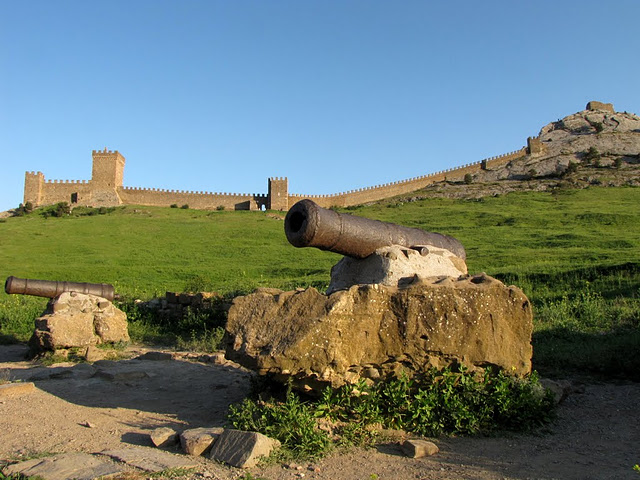 from the tower into the abyss. The second legend echoes the feat of a patriot who inspired the Zaporozhian Cossacks to fight for freedom at the cost of her life. Because of these legends, the tower got its second name — Maiden Tower.
Impressive, as if emerged here not at the will of man, but at the dictates of nature Genoese fortress in Sudak for many centuries experienced one excitement after another. And, despite its impregnability, was repeatedly conquered — so strong was the desire of different peoples to possess this place. In different periods, in addition to the Genoese, it was under the control of the Polovtsians, the Golden Horde, the Turks. But despite such a difficult fate, this amazing construction has survived to our times.
 Today, paying tribute to the memory of chivalry, feats of warriors who once defended the fortress, every year since 2001 fans of knights’ duels, connoisseurs of ancient architecture and its unique atmosphere gather here. The festival of historical reconstruction «Genoese Helmet», held in August, takes participants and spectators back centuries. As once upon a time, armored warriors fight here again, performances about the life of the Middle Ages are played out, horse tournaments are held.
Having been here at the festival or at any other time, every guest of Sudak understands why the Sudak fortress is talked about as the most interesting attraction of Crimea, invaluable attraction of Ukraine. And why the famous Russian historian and publicist M.P. Pogodin wrote about it «In all Europe there are no ruins more picturesque than these: no Rhine castles can compare with them».