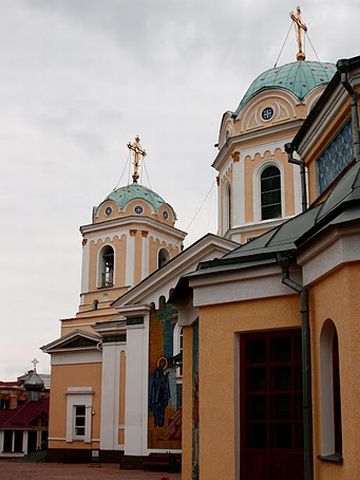
 During the years of popular unrest at the beginning of the last century, and then the Great Patriotic War, many temples and religious buildings of Simferopol were seriously damaged. Were partially or completely destroyed, blown up or looted. But such a sad fate bypassed Svyato-Troitsky Nunnery, or, more precisely, the Holy Trinity Cathedral, on the basis of which the monastery was created.
The Cathedral of the Life-Giving Trinity was erected in 1868. However, the first wooden Greek church was built here long before that — in 1796. On the basis of the church since 1826 worked Greek gymnasium. The fact that the current name of the street on which the church is located — Odessa Street, was assigned to it since 1946, and before that, due to the fact that many Greeks have long lived here, it was called Greek.
In place of a small wooden church in time it was decided to erect a spacious cathedral, the wooden structure was dismantled, and in 1868 the new church, consecrated in honor of the day of the Holy Trinity, opened its doors to parishioners.
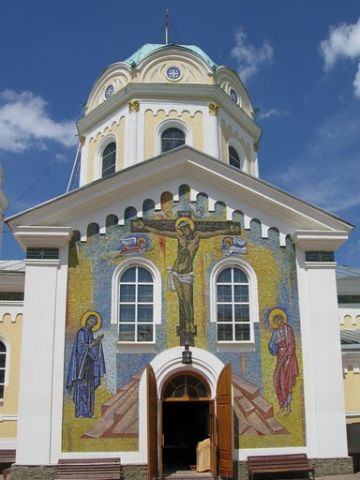
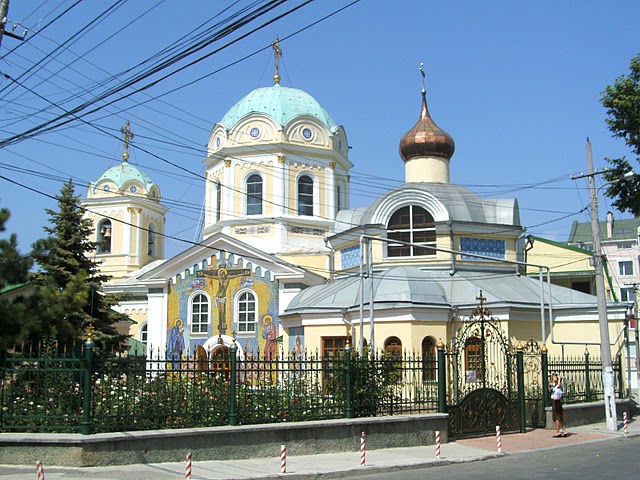 The building of the cathedral was built according to the project of architect I.F. Kolodin in the classical style. In plan it has a cruciform shape with a towering in the middle octagonal light drum, and above the left side chapel erected a low bell tower. The facade of the temple is richly decorated with decorative patterns and mosaic images, as well as on the outside of the building are decorated with thin pilasters and capitals of the Corinthian order, light arcature. The domes of the temple and the bell tower are painted in blue color and crowned with openwork crosses. This is how the Holy Trinity Cathedral reached our time from the middle of the XVIII century.
The cathedral is no less beautiful inside: the image of the Lord is depicted under the dome, and on the sails one can see the images of the four evangelists. One of the two side chapels of the cathedral is dedicated to Saints Constantine and Helen, and the second to St. Nicholas of Myra.
In Holy Trinity Cathedral are kept revered in the whole Crimea relics, which come to see which parishioners come not only from all over Ukraine, but also from other countries of the world. These are the relics of St. Luke, who performed during his life and continues to perform after death miraculous healings and miraculously renewed icon «Image of the Most Holy Mother of God Sorrowful». The last shrine, which became all-Crimean, has an amazing story.
 The icon was brought as a gift to the church by one of the residents of the city. The image was dim and dark, and the image was barely recognizable. The icon was placed in the altar, and two weeks later — on the feast of the Dormition of the Mother of God it was miraculously renewed. The parishioner who donated the icon to the church came to the feast and did not recognize it — the icon became bright and renewed. However, the hand of the restorer did not touch the icon. A commission was convened, after which the veneration of the icon was blessed, and in 1999 it went around the Crimea and became a recognized shrine.
Despite the attempts of the Soviet authorities to abolish Svyato-Trinity Cathedral, undertaken in the most difficult period for the church — the 30s of the last century, the temple was saved, including thanks to the efforts of the Greek community. However, for the salvation of this temple gave the lives of two of its ministers. Bishop of Simferopol and Crimea Porfiry (Gulevich) and Archpriest Nicholas Mezentsev were shot in 1937 and 1938. In 1997, the Church consecrated the dead priests as locally honored saints.
The temple, preserved thanks to the sacrifices and faith, became a monastery in 2003. Today, on the territory of the Holy Trinity Convent, in addition to the cathedral — a famous attraction of Simferopol, there is a small light Baptismal Church of Elijah the Prophet and a chapel. Many tourists coming to holiday in Crimea are happy to visit this really bright and holy place.