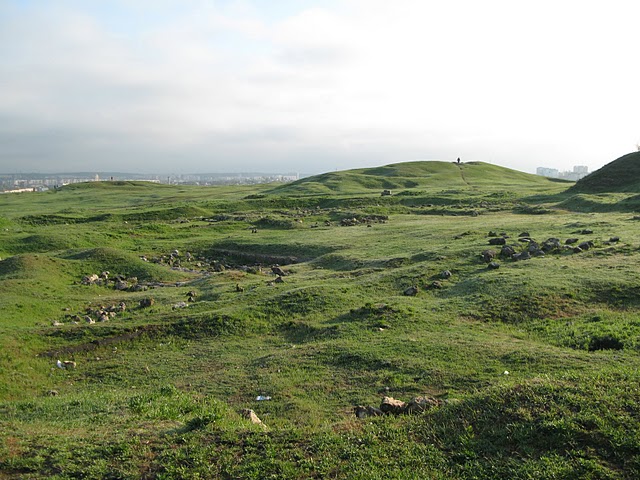
 On the southeastern outskirts of Simferopol, on the Petrovsky Rocks Plateau is the capital of the late Scythian state — Scythian Naples. To discover the ancient city for our time helped by chance. When in 1827 the inhabitants of Simferopol transported stones from the plateau for further construction of the city, a Russian nobleman, connoisseur of antiquities A.I. Krym-Girey saw on one of the wagons marble slabs with inscriptions in ancient Greek and the image of a Scythian horseman. After this event, archaeological excavations and research were conducted here for decades. They found walls with Greek inscriptions, Roman and Greek coins, a fragment of a marble bas-relief (a type of sculpture in which the convex image protrudes above the background plane by no more than half of its volume) depicting Scythian kings, presumably Skilur and his son Palak. Thanks to the research, a sensational discovery was made of the capital of the late Scythian state, Naples of Scythia. The exact time of the foundation of the city is unknown, but it is assumed that it was laid in the III century BC, and its heyday came in the II century AD. For the construction of Naples was chosen a very fortunate place, both in terms of defense and economic. The city occupied an area of about 20 hectares. Located at the crossroads of trade routes, it quickly became the economic and political center of the Late Scythian state. From the north-east the city was protected by the massif of Petrovsky rocks, from the western side there was the so-called Petrovskaya gully — a narrow gorge. And only the southern side required serious defense, here was built a crenellated wall 2 meters thick and 4 meters high.
As evidenced by archaeological research, which was conducted in the middle of XX century, to enter the city were 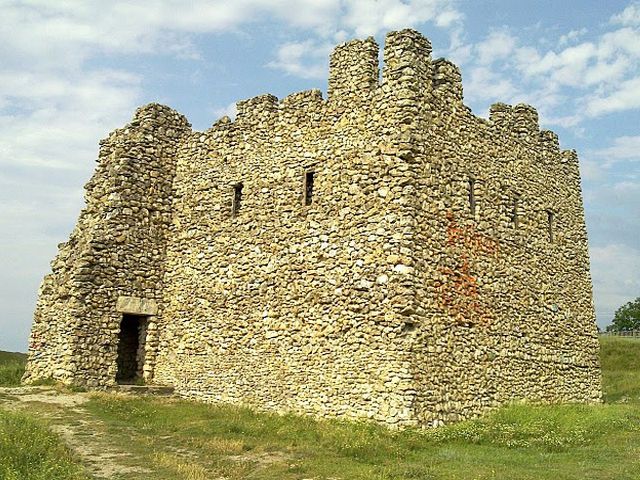 constructed the main — central gate, which was used by the king and his retinue, guests of the capital and the highest nobility. Apart from them, there were also Western and Eastern gates in the southern wall.
During the same excavations the tomb of the king Skilur himself and many burials of representatives of the Scythian aristocracy were found. Remains of residential buildings were also found. Scientists concluded that professional military men lived here, who in peacetime bred horses, traded and made weapons. The Scythian aristocracy built their houses in the western side.
Of great historical interest is the royal mausoleum of Skilur, which has preserved a large collection of ancient Scythian household items.
As well as the exact date of foundation, it is also unknown when Naples of Scythia ceased to exist. It is known that the city was destroyed by the Goths, although after their invasion the natives returned. It is believed that Naples was finally devastated by the Huns (IV-V century).