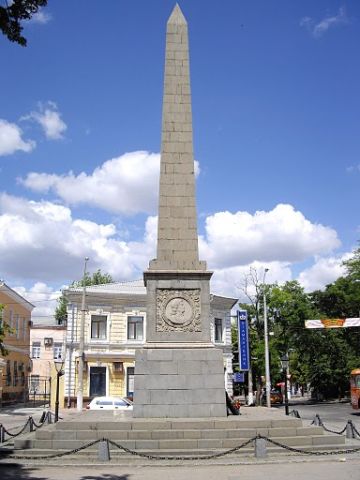
 This landmark is considered a symbol not only of Simferopol, but of the whole Crimea. Dolgorukovsky Obelisk, established on September 29, 1842 in honor of the victory of the commander’s troops over the Tatars and Turks, reminds of an important historical event when the Crimea was liberated from invaders, and the Russian Empire gained access to the Black Sea.
The tall and bright monument — Dolgorukov obelisk, was erected at the expense of the grandson of the commander V.M. Dolgorukov at the intersection of Karl Libknecht and Zhukovsky Streets, on the central square of the city opposite Alexandro-Nevsky Cathedral. Such an honorable place for the obelisk was chosen by the governor-general of the Novorossiysk region M.S. Vorontsov himself, and the construction became the first monument in Simferopol.
The project of Dolgorukov obelisk was designed by Professor Shtreikhenberg. The monument, thanks to the use of two types of marble turned out to be monumental and organically complemented the architectural composition of the nearby streets.
The height of the Dolgorukov obelisk from its base to the top was 20.6 meters. In shape it is a tetrahedral prism with a pyramidal end. The four steps on which the pedestal is set were made of dark diorite with red veins, and the tetrahedral pedestal was created from several types of marble. The spire was also made of diorite. Four eighteenth-century cannons mounted around it completed the composition.
The monument was decorated with medallions made by Streichenberg from white Carrara marble, 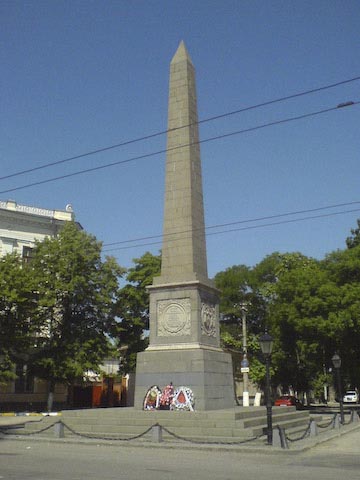 installed on the four sides of the pedestal. The bas-relief composition that decorated the northern side of the pedestal depicted V.M. Dolgorukov in profile, on the southern side one can see the coat of arms of the Dolgorukov princes, the western bas-relief depicted a hot hand-to-hand fight around the figure of a double-headed eagle, and the eastern bas-relief represented the image of Dolgorukovs handing laws to the conquered nations.
Dolgorukov obelisk has not reached our time in its original form. In the 20-ies all medallions were torn off the monument, also other details of the monument and one cannon were lost. Restoration of the obelisk and medallions, made of concrete and not corresponding to the original ones, was carried out in 1952. And in the 80s, the pedestal and the spire were restored.
Despite the fact that Dolgorukovsky obelisk today does not fully correspond to its original appearance, to see it seeks all coming to holiday in the Crimea tourists. As before, this composition makes a strong impression due to its monumentality. As before, Dolgorukovsky obelisk reminds of the feats performed by our ancestors for the benefit of the Crimean peninsula. And no matter what events took place in the years following the appearance of this attraction of Simferopol, the Dolgorukov Obelisk will always be a testament to those historical events and one of the most beautiful monumental buildings of the city.