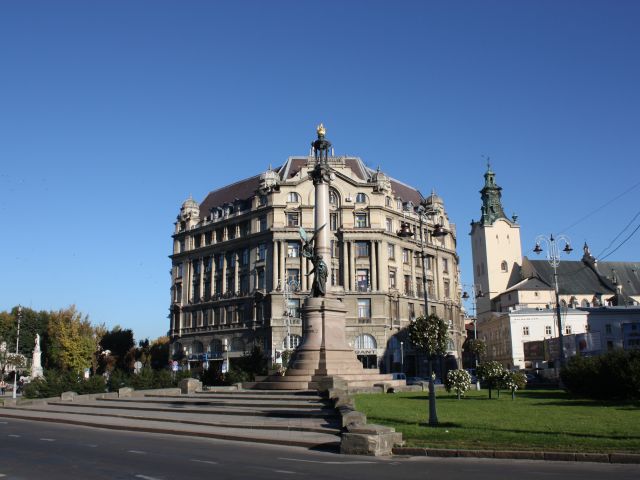
 The works of Adam Mickiewicz are equally loved in Poland, famous for its haughty and noble traditions, and in Belarus, which has not yet fully said goodbye to communism. His poems are read in Lithuania, proud of its European Union status, and in the epicenter of nationalism in the lands of Western Ukraine. Everyone from «the taiga to the British seas» admired the poet’s easy slogan, and a certain Pushkin, who is Alexander Sergeyevich, confessed in a conversation with Zhukovsky that the author of «Conrad Wallenrod» simply put him under his belt with his skill.
The greatest rights to Mickiewicz and his work is claimed by Poland. Probably because the poet’s father was a Pole, an impoverished nobleman. But Adam’s mother was a baptized Jew. At the same time, the main mouthpiece of European romanticism was born in what is now Belarus, and received his education in Vilna, that is, in today’s Lithuanian Vilnius. Mickiewicz worked in France, his best sonnets were dedicated to the Crimea, and he died in Constantinople, then the capital of the Ottoman Empire. But Mickiewicz wrote mostly in Polish, so no one resented that the body of the poet was laid to rest in the cultural capital of our neighbors — in Krakow, in a luxurious sarcophagus, in the semi-darkness of Wawel Cathedral. And in the center of Sukenice, on the main square of the former residence of Polish kings, the first, most magnificent, monument to the great poet was erected.
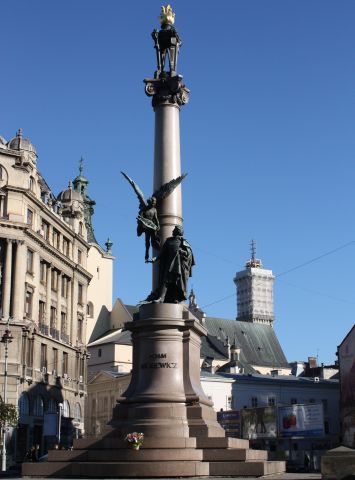 Besides Kraków, Warsaw and Vilnius, Poznan and Weimer, Gdansk and St. Petersburg have their own Monument to Adam Mickiewicz. The Polish community of Lviv did not stay away from the idea of glorifying the poet. A competition was announced for the best monument to this titan of European romanticism. In 1898, on December 10, the birthday of Mickiewicz, the winning project, chosen from 28 variants, was proclaimed. It turned out to be Anton Popiel’s robot, using the idea of writer Adam Krechowiecki.
After a very labor-intensive complex, the robot, the entire Polish community of Lviv, patrons of the arts, local intellectuals and guests from the cities associated with the name of the poet, on December 30, 1904 gathered on the former Mariacka and present-day Mickiewicz Square for the unveiling of the monument. The world was presented with a column on a pedestal, the total height of which was 21 meters. On a granite base, at the foot of the column stood a bronze Mickiewicz. An angel carrying a lyre flew down to him from the top of the monument. The sign at the top of the column became the basis for a gilded bowl with fire, symbolizing the incendiary power of the poet’s words. The bronze folds of the angel’s toga and Mickiewicz’s cloak are in diagonal symmetry, thanks to which the Lviv monument is recognized as one of the most harmonious monuments existing on earth.
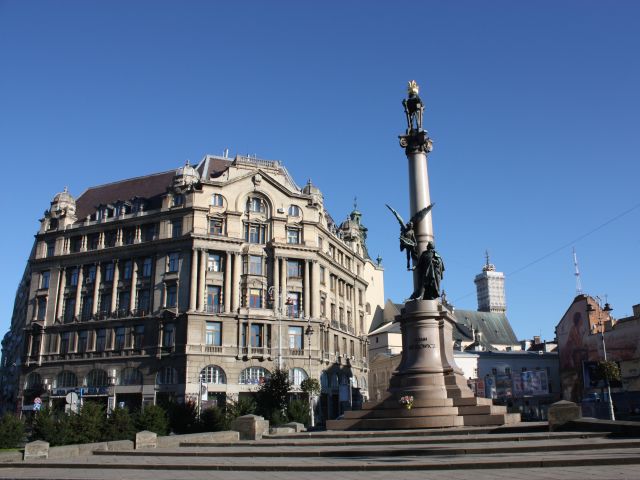 The entire creative set — Mickiewicz, the Angel and the lyre, are set on a marvelously beautiful, rounded granite pedestal. The stone was delivered from Italy. It differs from domestic rocks by its amazing ochre color, pierced with green veins.
Given the fact that for more than a hundred years that Mickiewicz and Co. stood on «their own» square, time has covered the bronze figures with patina. Therefore, it is now that this attraction of Lviv, like vintage brandy, has infused and acquired its best color, that is, it has reached its peak form. Visitors who come on vacation to Lviv will have the opportunity to admire the amazingly beautiful monument of one of the best European poets, who spends his days in the company of his own Angel and the statue of the white marble Virgin Mary, located next door.