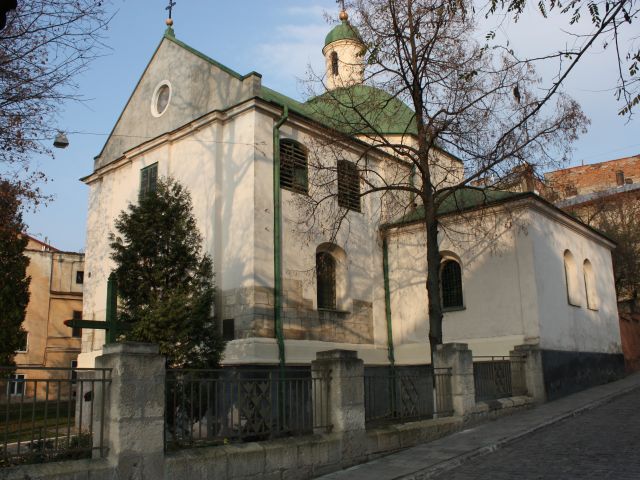
 The oldest architectural monument of L’viv is the church of Saint Nicholas of Myra, the protector from natural disasters, the patron saint of fishermen and sailors. It is located at 28 B. Khmelnitsky St. under the Budelnitsa Mountain.
The first mention of the church dates back to 1292, as a court temple of the prince; later it belonged to the craftsmen of the shoemaker’s shop. The church is triple-nave, triapsid, with two domes. The cross-dome plan brings it closer to the Orthodox temples widespread in ancient times in the territory of Kievan and Vladimir-Suzdal Rus.
The church was repeatedly restored after destruction, so its structure merged the traditions of the classical Byzantine-Russian cross-dome plan with the Romanesque building technique. The modern iconostasis was made in 1947-49, the walls were painted in 1955-57. The frescoes of the main facade were done by Peter Kholodny.
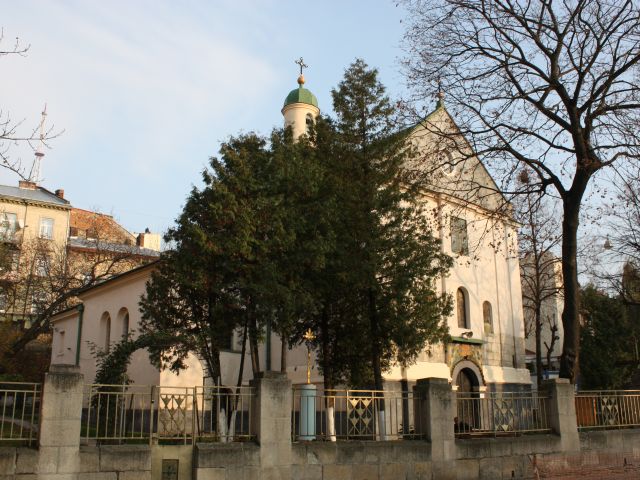 In its appearance and size the church is close to public monumental buildings, designed to repel the onslaught of enemy troops. There are no opulent portals, imposing decoration, and low doors and small windows resemble loopholes imposing military fortress (narrow openings in the defensive walls for firing from cover), able to withstand a long siege of the enemy. The majestic simplicity and laconism of architectural forms are associated with a ringed vigilante.
The general plan, the lower part of the walls and apses (protrusions of the building covered with a half-dome or a closed semi-vault) made of hewn white limestone have been preserved from the ancient church building. The upper part of the walls and the roof, as well as the sacristy (a place in the altar or a separate room in a Christian church for storing liturgical vestments of priests and sacred vessels) were erected in the XVII-XVIII centuries. Despite the architectural layers of later eras, the Church of St. Nicholas is a valuable historical monument of Galician architecture.