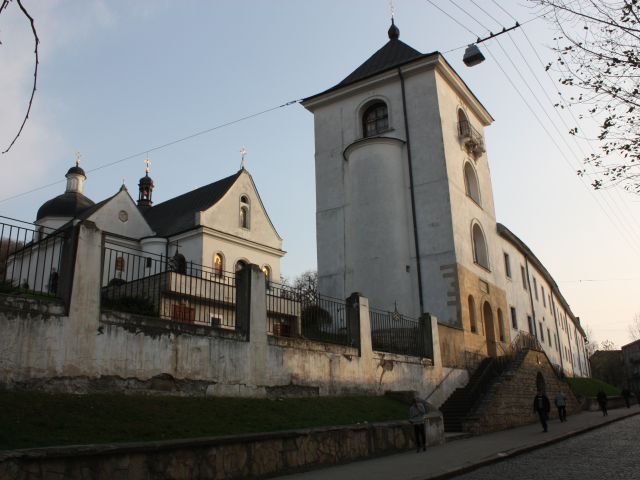
National traditions of Ukrainian architecture are inherent in the architecture of the monastery church of St. Onufrius, ascetic, legendary Persian prince, patron saint of women in labor. The church is located in the Podzamche district, at 36 B. Khmelnytskyi Street. Ukrainian traders, artisans, apprentices and the urban poor have long settled in this area, piously preserving the old customs and manners.
Back in the time of Prince Lev Danilovich there was a wooden temple, at which in the middle of the XV century was built a monastery of the Basilian order (Catholic monastic order of the Byzantine rite), but all these buildings burned down. On this place Prince Konstantin Ostrozhsky erected a stone church, which became the core of the modern one.
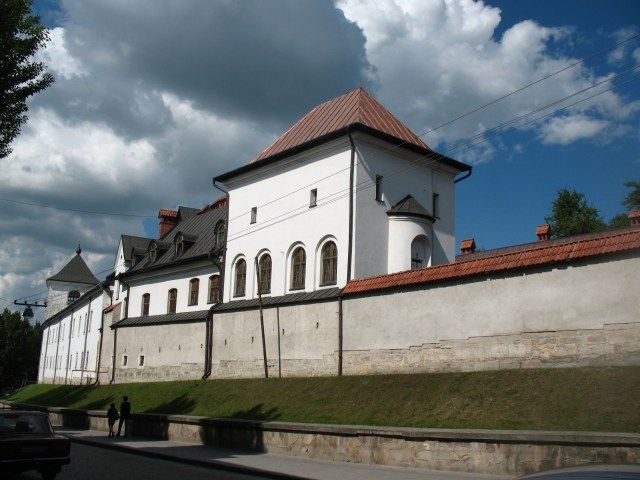
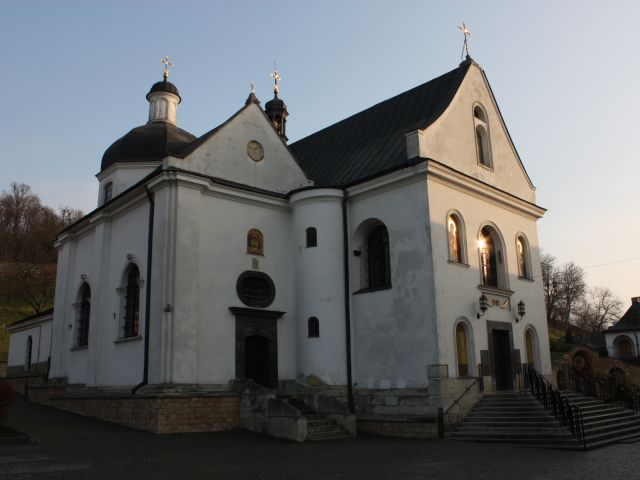
After the expansion of the altar part in 1701, connection in 1776 with the Chapel of St. Trinity standing next to it, construction of a stone staircase (1780), belfry (1821) and the third nave (1902) the church acquired its modern appearance. Back in 1693-1698 all church buildings and the monastery were surrounded by walls, the remains of which have survived to this day. The simplicity and laconism of the ancient Ukrainian architecture are organically combined with the noble restraint of the Renaissance portal (the main entrance of a large architectural structure) and facades, pilasters (vertical protrusions of the walls, conventionally representing columns) and windows. The church icons by Modest Sosenko are executed in the spirit of Byzantine tradition, and the iconostasis itself was created in 1909 on the model of the Krasnopuschansky iconostasis of the XVIII century.
According to legends, in one of the cells (monks’ dwelling in the monastery) of St. Onufriyev Monastery, the first printer Ivan Fyodorov on February 15, 1574 completed his «Apostle» — the first book printed in Cyrillic alphabet in the Ukrainian lands. After his death in 1583, the great enlightener was buried in the monastery cemetery. Over his grave was erected a tombstone with the inscription: «Ivan Fedorovich Drukar Muscovite, who by his diligence Drukarstvo zanedbaloe renewed. He died in Lvov in the year of the AOPG decemvria Є. Drukar of books not seen before». Unfortunately, neither the grave of the printers nor the tombstone have survived to this day.
Since 1977 the Museum of Ivan Fedorov, his predecessors and followers worked in the monastery. In 1990 the monastery buildings were handed over to the Basilian Order