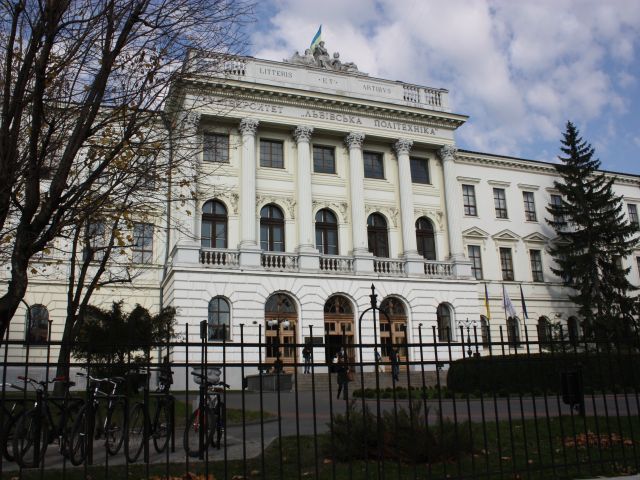
 Lviv Polytechnic University is the oldest technical educational institution in Eastern Europe and Ukraine, which has a rich and interesting history. It is associated with the names of many famous scientists and public figures, famous all over the world. The building of the main building of Lviv Polytechnic is located in the very center of Lviv on S.A. Bandera Street and is of great interest to tourists.
Stepan Bandera, the leader of the movement for the independence of Ukraine, was one of the graduates and teachers of Lviv Polytechnic University, and today the main building of the educational institution stands on the street named after him. The beautiful building with a rich history immediately attracts attention, being located on a small square away from the other houses.
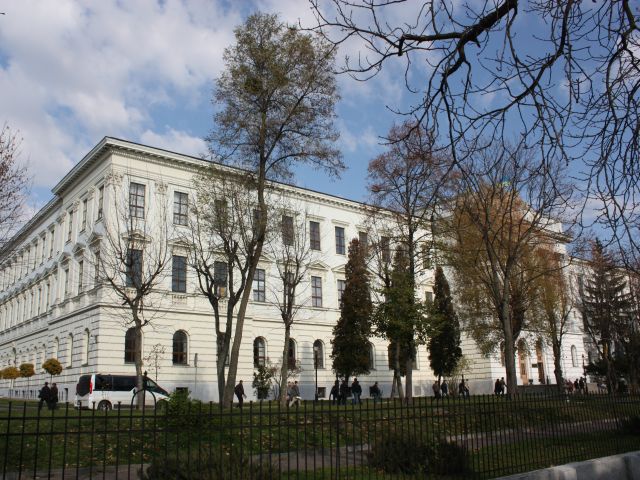
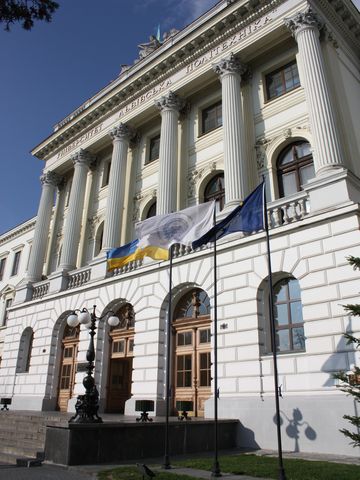 The main building of the Polytechnic was one of the first buildings in Lviv built in the style of historicism. The architect Julian Zakharevich, who gave the city other beautiful buildings, such as Potocki Palace, was the author of the project, according to which the main building was built. For several years Zacharewicz was the rector of the Polytechnic. The construction lasted 3 years — from 1874 to 1877, and as a result, one of the main architectural dominants appeared on Bandera Street, which at that time had a different name — Novy Svet.
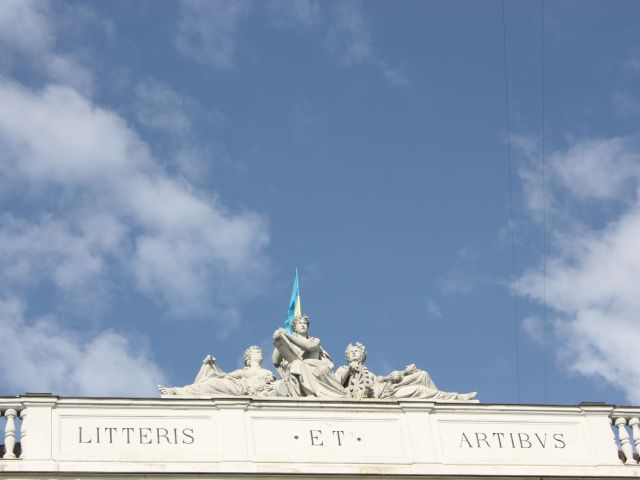
The building has three floors, in the center of the front facade — a risalite with six columns of the Corinthian order, in the end of which there is an attic with a sculptural composition created by sculptor Leonard Marconi. The sculpture represents three figures that symbolize the three departments that were housed in this building: engineering, architecture and mechanics. Under the attic you can see the inscription in Latin «Litteris et Artibus» (sciences and arts). This decoration of the front facade made the building bright and gave it a solemnity, the idea of which is continued by the richly decorated interiors with paintings and sculptures.
 Stucco, sculpture, painting — all this can be seen in the interiors of the main building of Lviv Polytechnic. A special pride is a collection of 11 paintings, placed in the Assembly Hall. These paintings were recreated by students (masters of the Krakow Art School) of the outstanding Polish painter Jan Matejko according to his sketches and under his guidance. The customer of the canvases was the Austro-Hungarian Emperor Franz Joseph, who, visiting the school in 1880, wanted to present it with paintings that would symbolize the technological progress of mankind. On 11 canvases Jan Matejko was able to express the philosophical development of thought and science as the basis of technical and spiritual progress, which can lead mankind to shameful death or happiness on Earth. The canvases are painted in oil and are of great spiritual, historical and artistic value, they are considered a talisman and the main treasure of Lviv Polytechnic University.
 Imperor Franz Joseph, leader of the national liberation movement S. Bandera — these are just two names from the huge list of famous people associated with Lviv Polytechnic. Its graduates and teachers were famous scientists (S. Banach, J. Franke, V.P. Sigorsky, N.G. Maksimovych, K. Bartel, V.V. Secretariuk, etc.). Secretariatuk, etc.), public figures (L.Y. Roketsky, Y.V. Lutsenko, I.P. Kochev, S. Wiesenthal, R.I. Shukhevich) and many other famous people.
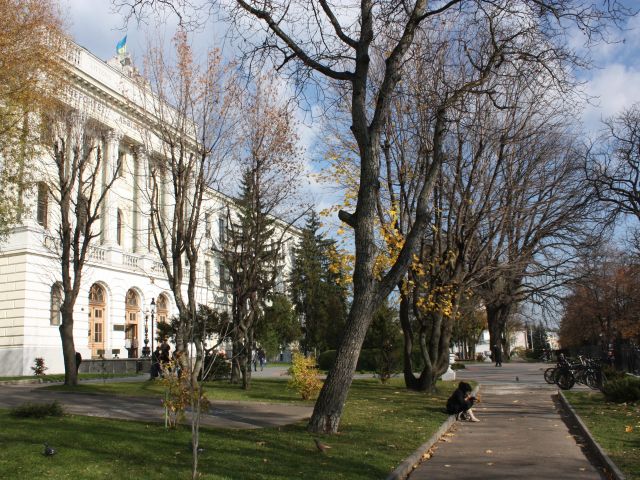 The Lviv Polytechnic grew out of a three-class technical school founded in 1817 and has a very rich history. During its existence it was called Real-Trade Academy, Technical Academy, Polytechnic School, State University «Lviv Polytechnic», and today it bears the proud name of the National University and is rightly considered one of the best universities in the country. In 1877, the first telephone conversation in the territory of Austria-Hungary took place in the main building (between the chemical department of the Academy and the assembly hall). Another interesting fact: on the roof of the main building there was one of the best astronomical observatories in the country since 1877 (today there is a GPS station there).
In the history of Lviv Polytechnic University there were both remarkable and tragic events: on the night from July 3 to July 4, 1941 fascists shot a group of university professors — 40 people who made a great contribution to the development of education and science were killed. But despite such sad pages of history, Lviv Polytechnic survived, and from 1844 to this day gives the country new highly qualified personnel. Today about 30 thousand people receive education in Lviv at this university — Lviv Polytechnic still fulfills its mission, being one of the best educational institutions of the country and Europe, and one of the interesting attractions of Lviv.