«Above all, I am a resident, and I will save you, my fortress, my citadel … »
( Antoine de Saint — Exupery )
.
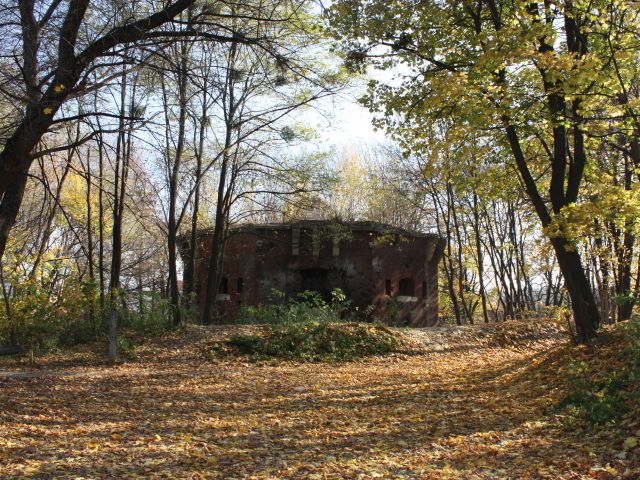
This quote on the shield installed next to the romantic in its ruins Small Maximillian Tower of the Lviv Citadel has become a kind of symbol of defense of this still little known, romantic and at the same time terrible in its tragedy attraction of Lviv.
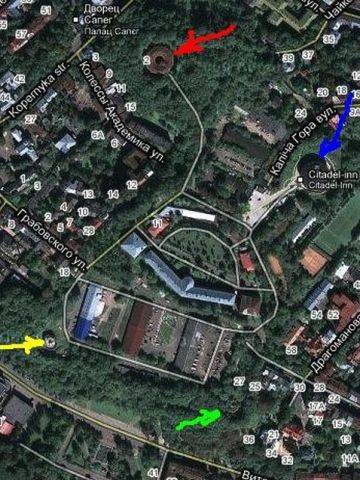
The complex of Lviv Citadel buildings can be reached by a winding street with a strange name Kalicha Hora (or Kotsyubinskogo or Grabovskogo streets). The name of the street is known since 1450, when cripples and beggars settled here, and later St. Lazar’s Hospital was founded (later moved down to Copernicus Street). The street ends in a mountain, which gives its name to Kaliča Gora, and is reached by steps.
The strategic and defensive importance of Kalicha Gora and the neighboring mountains Szembeka (Wronowski) and Pelczynski (Poznańska) (average 325 m above sea level) was known since the times of Chmielnitcheny.

It was easy to control the Sokilnicki road from Lviv to Stryj from the mountain that descended rapidly to the present-day Copernicus Street. However, the city squeezed in its strong walls until the time did not require separate powerful fortifications in the suburbs, so the construction of fortifications on the mountains of the current Citadel was not penetrated.
However, times changed, military technology, tactics and strategy changed, and so did the need for defensive structures. The new power of the Habsburg Monarchy, under whose jurisdiction Lviv fell at the end of the XVIII century, ordered to dismantle the fortifications of the city center, which actually lost their significance because of the change in the principles of warfare (instead of the concept of fortified cities, the concept of fortified territories appeared) and because of the rapid development of the city, which no longer fit within the tight confines of the city center. Therefore, already in 1849-50 a project of building new fortifications on the equalized mountains of Kalečiai, Šembeka and Pelčinský was developed. The authors of the project officially remained unknown, although it is assumed that they were architects of the Austrian Ministry of War H. Ressig and J. Vondruska. The construction was carried out during 1852-56.
 .
.
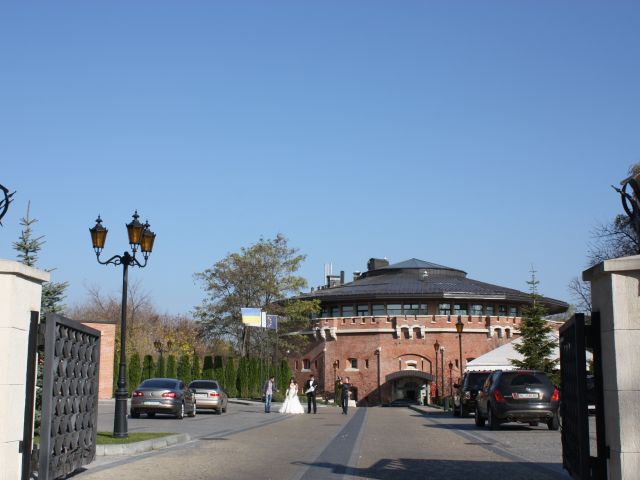
Part of the fortifications of the Lviv Citadel are four towers that were designed for artillery defense of the city’s approaches to the Citadel. These towers resemble the prototype tower of J. Montalembert, a French military engineer, one of the co-founders of the polygonal system theory. Montalembert’s drawing of the tower, published by Montalembert in 1776, was used as a basis by Austrian Archduke Maximilian Joseph d’Este for the fortification of Linz on the Danube (32 casemate towers in a somewhat simplified form than Montalembert had designed). In the Habsburg monarchy, these towers were called Maximillian towers (after the name of the archduke) or Linz towers. Moving deep into the fortifications of the Citadel, you can soon reach the main building, which contained the barracks of the garrison. The square artillery towers were attached to the barracks building on both sides, and like in the Maximillian towers, the ground level contained the living quarters (but with gun embrasures on both sides of the windows). On the other two floors were artillery stations with loopholes for long-range guns, also with small loopholes on the sides. The barracks had an entrance on the opposite side of the barracks, decorated with sculptures of lions, which disappeared without a trace during World War II.
And behind the barracks building in the direction of the Small Maximillian Towers was the stadium where the first soccer matches were held in Lviv. Its stands were arranged on the earthen defense ramparts.
From the barracks building you can go south to the half-destroyed tower. This is the Small Maximillian Tower No. 3. This tower and the neighboring 4-tower were called small because they were half the diameter of the first two (18 m instead of 36 m) and had no courtyard. The fort was connected with the outer fortification detinets through a wooden bridge spanning over the fort’s dry moat. When raised, the canvas of the bridge covered the gate of the main entrance, and an additional obstacle was a water cistern built under the bridge.