 The building in which the Lviv State University of Life Safety is located was erected in the middle of the XIX century by order of the Austro-Hungarian Emperor Franz Joseph and on the funds allocated by him and with the assistance of the Kaiser’s adjutant general Count Gruner. On February 28, 1851, during the solemn stay of the Emperor of the Austro-Hungarian Empire in Lviv, the representatives of the city petitioned for the construction of the House of War Invalids for the soldiers of Galicia, maimed in battle, so that they could have a decent life in their own land. The Emperor granted this request and ordered the building to be erected according to the plan of the famous architect Theophilus Hansen and the funds in the amount of 700 thousand zloty guilders.
The city authorities for the construction of the monumental complex together with the chapel on the proposal of the mayor of Lvov Karol Goepflingen — Bergendorf, allocated a plot of land in the estate Pilikhovsky, near the path leading to the foot of Mount Kortuma (now Kleparovskaya Street, 35) area of 1251 square sazhen, at a price of 11406 gold guilders and 40 krazer. The representative office of the capital city of Lvov, convened on this occasion, donated for the construction of the House of Invalids the above-mentioned city plot with an oak forest and provided the city brickyard for free use.
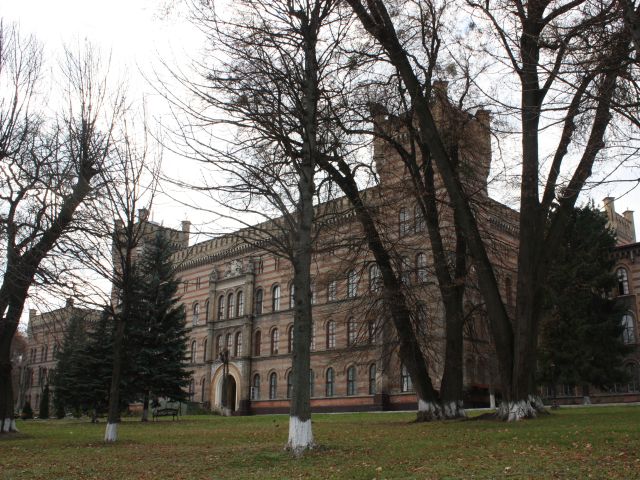
The House of Invalids was designed by Theophil Hansen in the arcade style (Rundbogenstil), with facades made of common brick (divided into yellow and red stripes by color). Under the direction of Edward Kaller, construction work began in 1855 and was completed in 1863. The architecture of the building is dominated by monumentalism, realized through a large stretch of the structure (the length of the main facade is 165 meters!), typical of Hansen’s work at that time.
 .
.
The House of the Handicapped consists of an imposing central part, with corner towers, and symmetrical side wings that terminate in pavilions. The facade of the house is decorated with artistic sculptures and bas-reliefs. The young sculptor Cyprian Godepsky and the sculptor Abel Perrier were invited to carry out these works. On the façade of the building, on either side of the coat of arms of the Austrian state, two majestic sculptures are installed: Warrior in the figure of a man drawing a sword from its sheath and Serenity in the figure of a woman wearing a laurel wreath with a palm branch in her left hand and a scroll of paper in her right. At the feet of the sculpture lie a palette and a brush, as symbols of Science and Art. These figures, two meters high, are made by a master of dense sandstone.
Above the opposite gates, outside and inside the courtyard of the house, there are four bas-reliefs symbolizing the figures of women — Warrior and Victory.
On the facade of the house there are 26 sculptural elements and 8 bas-reliefs, which have survived to this day. Many sculptural elements of the building, particularly on the inner side of the building, have been lost. Among them are the statues of four famous Austrian field marshals and generals — Archduke Eagle, Count Radetzky, Prince Schwarzenberg and Count Spick. The frescoed hall has also not been preserved.
The monumental idea of the House of Invalids belongs to the best examples of Viennese borrowings in the history of architecture in Lviv.
The dedication of the House of Invalids took place with great solemnity on October 4, 1863 on the day of the Emperor’s name day. Authorized by the bishop to conduct this religious act was Mr. Fieldsuperior P. Bradowski. At 8:00 a.m., according to the canons of the Catholic Church, the chapel was dedicated, and then the building itself.
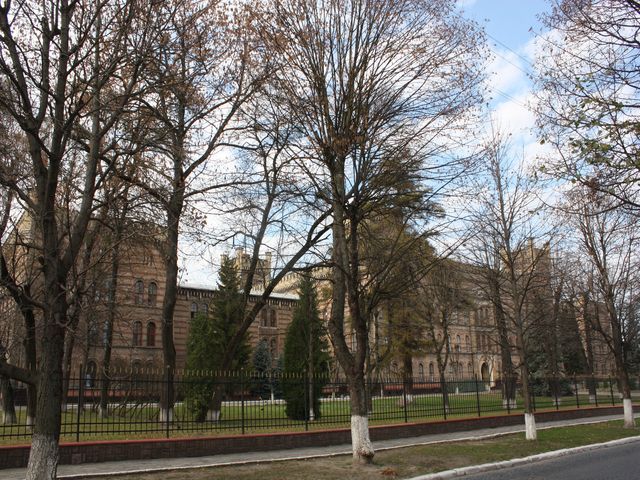
The three-story building was designed to house and board five hundred disabled people. The central part of the structure was for officers, while both wings were for junior officers and soldiers. In the four towers, in the central part of the building, there was the room of the commandant-general, here was also his office. One wing of the building was adapted into a military hospital, as a phylum of the garrison hospital.
After the reunification of the western regions of Ukraine in the united Ukraine in the building in 1939-1941g . stood 233 regiment of the NKVD (in / h 7480). During the Great Patriotic War, the house was not damaged and August 10, 1944 in it again placed in / h 7480.
By decision of the Ministry of Internal Affairs of the USSR in May 1954 in the house was placed Kiev fire and technical school, which was relocated to Lviv. Later it was renamed Lviv Fire and Technical School of the USSR Ministry of Internal Affairs.