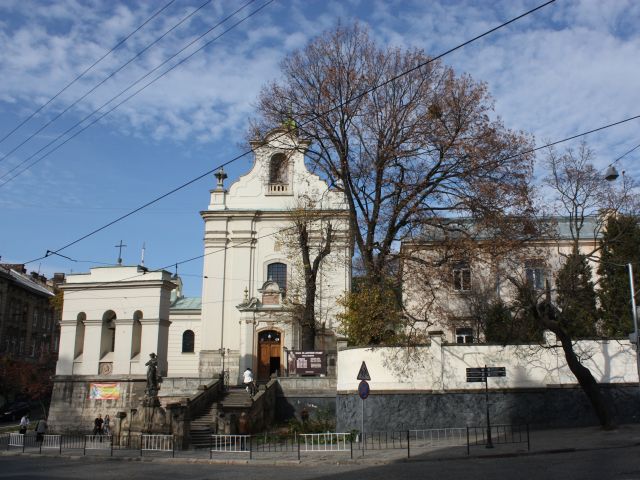
The Church of St. Anthony is located east of the city center, on a hillside near the upper part of the former Lyczakowski suburb, between Zankowiecka and Solodowa Streets, on a corner plot, surrounded by a wall.
The wooden monastery burned down in 1648, when the Cossack army of Bogdan Khmelnitsky and the Tatar horde of Tugai Bey approached Lviv. On this place in 1669, Prince Konstantin Krzysztof Vishnevetsky funduval construction of a stone church, which was not completed, so in 1672 during the siege of Lviv it was destroyed by the Turks.
In 1718, construction was started again according to a new design by the architect Paul Anthony Fontana. In 1739 the church was consecrated.
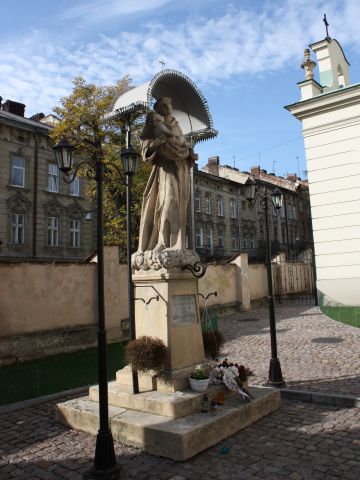
The modern Baroque facade of the church was received in 1765 during the rebuilding designed by Franz Kulchitsky. At the same time, a sculpture of the Virgin Mary of the Immaculate Conception made by Sebastian Fezinger was installed at the staircase leading to the church. He is also credited with the figure of St. Anthony of Padua, which stands at the open stone bell tower designed by Josef Markl in 1818.
The church is a stone church made of brick, one-nave, with a faceted apse, prismatic additions of chapels and sacristy. It has baptized vaults and gable roof with a small tower on the axis. The two-tiered facade is divided by pilasters and finished with a rocaille pediment with a niche (1765). The window openings have rounded endings. A three-arched bell tower was added to the church from the south-west. From the side of Lychakivska Street a stone staircase leads to the main entrance of the church. Behind the church there are several sculptures of the XVIII-XX centuries.
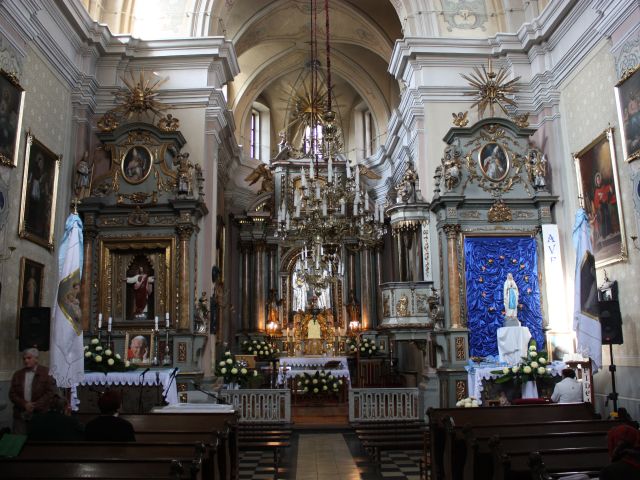
In the interior of the church there are altars from the Baroque period, several easel paintings from the 19th and 20th centuries. Of great value is the late Gothic icon «The Virgin Mary with Christ and St. Anna», created around 1520. The church also keeps portraits of its founders — Prince Konstantin Vishnevetsky (1633-1686) and his wife Anna of Chodorovski, painted in the late 17th century.
The Franciscan monastery was abolished during the reforms of Emperor Joseph II and in 1786 the church became a parish church for the Roman Catholics of Lychakovsky suburb.
The Church of St. Anthony was, together with the pulpit, the only Roman Catholic church that was not closed under the Communist regime.
In recent years, the building of the monastery of the Order of the Friars Minor Convent of St. Francis of Assisi was built near the church, on the side of Malaya Street. The former parish house, built in Baroque style, now (2009) houses the music school No. 4.