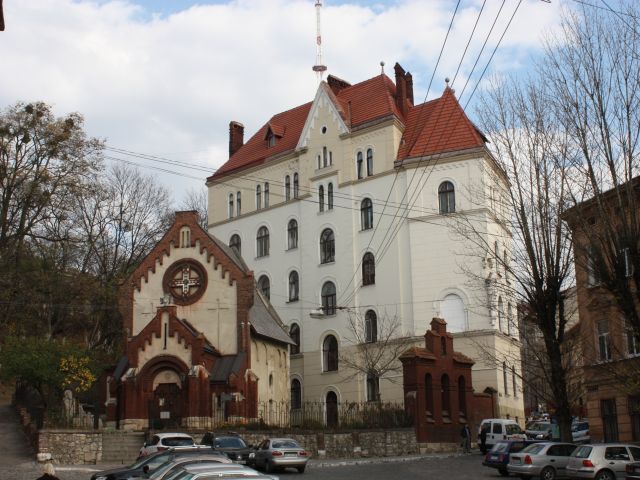
 The Church of John the Baptist is located in one of the oldest districts of Lviv, on Stary Rynok Square — the commercial center of princely Lviv. This place was well known outside the city as well. Important trade routes passed near the square: from Kiev to Western Europe, from the Black Sea to the shores of the Baltic.
According to legend, the church was built for the wife of Prince Leo Constantia, the daughter of Hungarian King Béla IV, in 1250. After the death of the Countess, she was supposedly buried in the underground of the church. 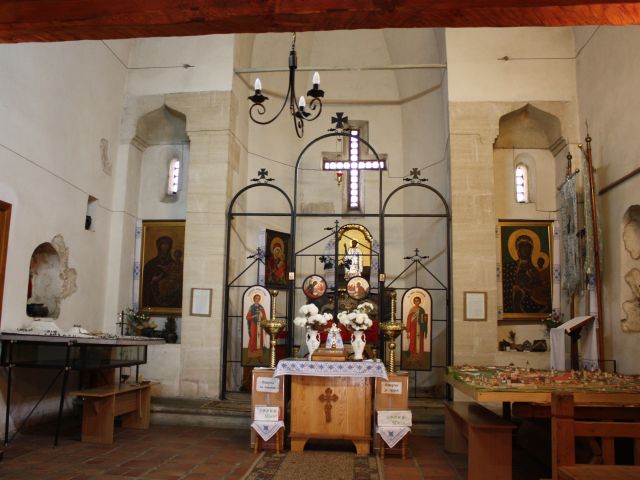 The church is small, one-nave (an elongated room bounded by a number of columns or pillars), with two narthexes and one faceted apse (a ledge of the building covered with a half-dome or a closed half-vault).
The Church of St. John the Baptist does not make a great impression nowadays. Like many other buildings of that time, it was rebuilt many times, and not much of the antiquity has been preserved here. The most thorough restoration, which greatly changed the appearance of the church, was carried out according to the project of Julian Zacharievich, who rebuilt the church in the then fashionable Neo-Romanesque style.
On January 21, 1992 the Museum of Ancient Monuments of Lviv was opened in the Church of St. John the Baptist.