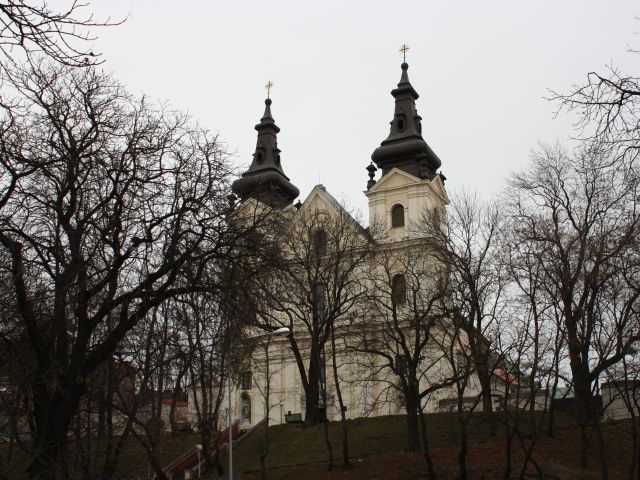
 Carmelite Church is one of the most striking architectural evidence of the former luxury and current glory of Lviv, the eternal capital of Galicia. The city owes the appearance of this baroque masterpiece to Jakub Sobieski. He was the father of Jan the Third, King of the Polish-Lithuanian Commonwealth and one of the most respected Polish generals. The magnate traveled all over Europe, kept a travel diary, was alternately married to maidens from the Vishnivetsky and Zolkiewski families, participated in the Battle of Khotyn, wrote Latin manuals for his sons, and held the position of Krakow’s kasztelan, the most important voivode in medieval Poland. By the way, he was succeeded in this position by the odious Jeremiah Vishnivetsky, the bogeyman of all rebellious Ukrainian villagers.
Being in euphoria after the conclusion of Stumsdorf truce with the Swedish kingdom and being, at that moment, in special honor of King Wladyslaw the Fourth, generous and successful Jakub decided to create another good deed and at the same time to strengthen the position of Poland on its eastern cordon. 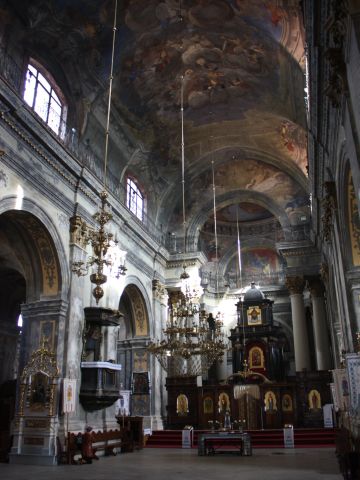 The Kastelan of Kraków allocated money to build a church in Lvov. And since the monks of the «mendicant» order of barefoot Carmelites enjoyed his greatest favor, the new house was intended for them. In parallel, there is a version about the secret fortification function of the building, skillfully disguised as a beautiful temple.
The construction of the Carmelite church was started in 1634. There is no exact data, but it is assumed that the project was designed by Jan Pokorovich, son of the famous Lviv architect Adam de Larto. When the church was completed at the end of the XVII century, a Baroque building of amazing beauty and nobility was presented to the attention of the citizens — a motley mixture of Ukrainians and Poles, Russians, Jews and Armenians. 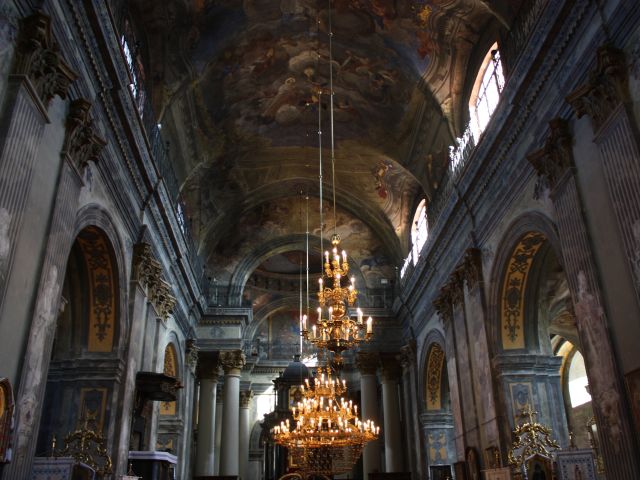 The Barefoot Carmelite Church was built of travertine stone in the shape of a Latin cross, in which the longitudinal crossbar predominates over the horizontal one. The body of the temple is covered with a double pitched roof. The facade is decorated with pilasters and a tall panel. The sacral space is bounded by two towers enriched with several tiers of Baroque finials.
In 1731 it came to the decoration of the interior. A team of painters from the Baroque homeland was sent for this purpose. Italian G. C. Pedretti and his pupils, among whom a local painter B. Mazurkevich quickly joined, painted the interior walls of the Carmelite barefoot refuge in the best traditions of the style. A little later, the painting of the temple was continued by the artist G. Tchaikovsky, who depicted the pictorial history of the barefoot Carmelite order.
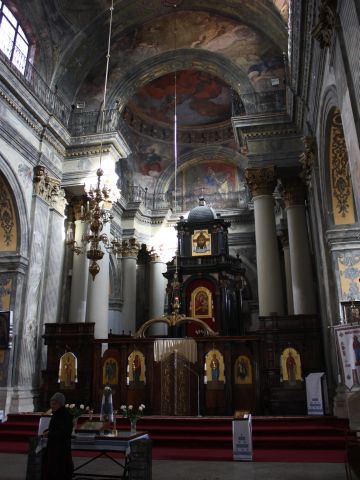 The head altar of the church deserves special attention of the public. It is made by sculptor A. Prohenkovich from Ashford black marble. Adjoining the temple is the monastery — a rectangle of cells with a clearly marked courtyard.
The fortification properties of the temple were successfully used in 1648 during the invasion of Lviv by the Cossacks of Bogdan Khmelnitsky. In 1704 the church was conquered by the troops of Charles the Twelfth. Battle of local scale monastery became famous in 1748, when the Carmelites waged war with neighbors — the monks of the Capuchin order, trying to block the believers access to the wrong God’s temple. This sacred war entered Lviv’s history under the name of «monachomachy».
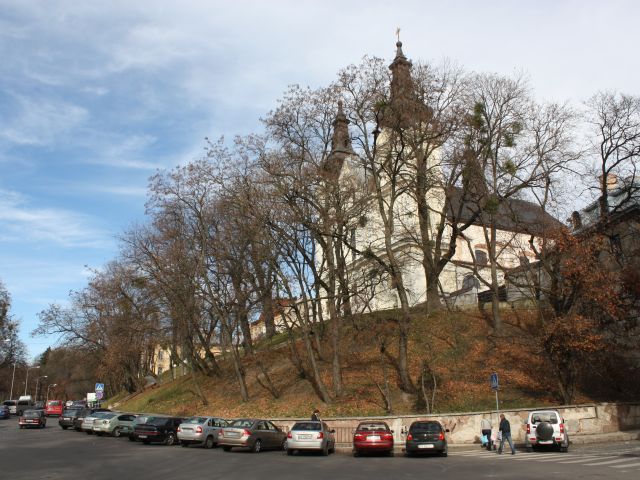 The Carmelites owned the temple and monastery until 1792. After that the church was renamed and dedicated to the Madonna and later to the Holy Spirit. At the beginning of the 20th century it was known as the Archbishop’s and Seminary Church. Under the Soviets, the church was recognized as an architectural monument, and its garden was chosen as a meeting place by the most informal, advanced and musical youth of the city.
When the Union collapsed, the whole church was «transferred to the balance» of the Ukrainian Greek Catholic Church under the name of the Church of Archistratigus Michael, and the monastery went to the Order of Studites. Therefore, today this attraction of Lviv is an active one. Everyone can enter the church, listen to the service and admire the preserved frescoes, priceless altar and perfect forms of the nave. The former Carmelite temple has taken its rightful place in the sonnet of sights of Ukraine and is a true, living and exciting, decoration of Lviv.