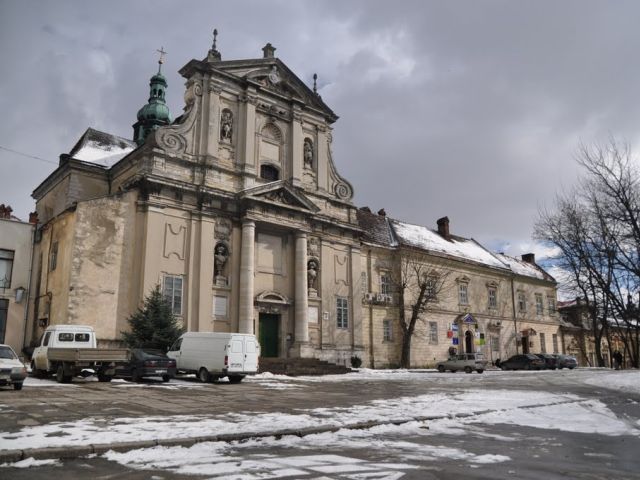
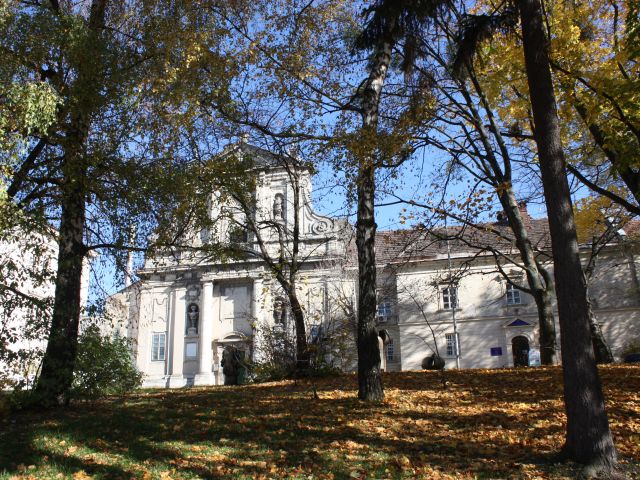
The Church of the Presentation of the Lord is a former church of the Mother of God of Gromnichy and the monastery of the Carmelite barefoot monks, an architectural monument in Lviv on Vinnichenko Street, 30.
The church and the monastery of Carmelite barefoot were erected on the soils provided by Jacob and Theophilus Sobieski. Initially the buildings were wooden. The project of the stone church was developed by the Italian architect Giovanni Battista Gisleni in 1642. The facade of the temple of Santa Susanna in Rome by architect Carlo Maderno served as a model. Construction began in 1644 and was supervised by Jan Godny. From 1683 the construction was supervised by Tomasz Dubinski. The construction continued intermittently from 1644 to 1692. It was completed thanks to the fund of King Jan III Sobieski. Originally consecrated as the Church of the Mother of God of Loretto. At the end of the 18th century, the Austrian authorities closed the church and housed a warehouse. It was returned to the Catholic Church in 1842 at the request of Lviv Archbishop Franz Pistek. The church was re-consecrated to the Mother of God Gromnichy (Purification of the Lord).
 .
.
In the 19th century, three Lviv archbishops — Franz Pisztek, Lukasz Baranecki and Franz Xaverius of Vezhlei — were buried in the crypts. In 1940, part of the monastery was given to the Lviv Medical Institute. The church and monastery continued to operate until 1946, when the whole complex was handed over to the military. In 1976 the temple was handed over to the Regional Department of Quality, Metrology and Standardization (now it is the Scientific and Research Institute «Sistema») for the exposition. At the time of independence the temple was given to the Ukrainian Greek Catholic Church. In 2009, the chapel at the temple was transferred to the use of the Roman Catholic Church. Now in the temple are held services of the Eastern and Western rites.
The temple is located on the even side of Vinnichenko Street, facing it with the main facade. It is built of brick and partly of hewn stone. One-nave with a transept, in plan has the shape of a cross. Oriented on the west-east axis. The monastery adjoins the church from the south and east and has its own courtyard.
 .
.
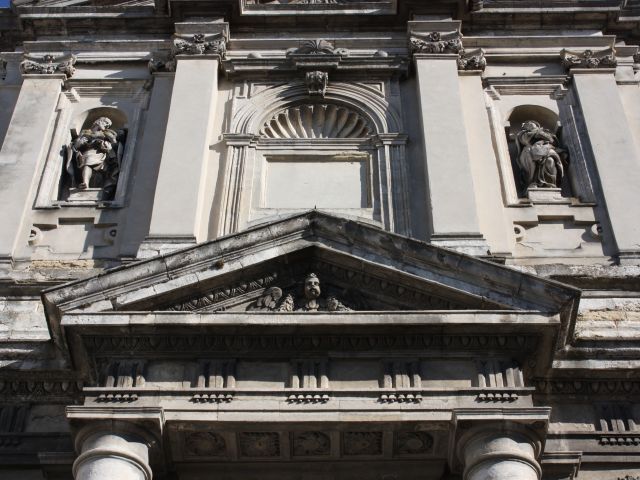
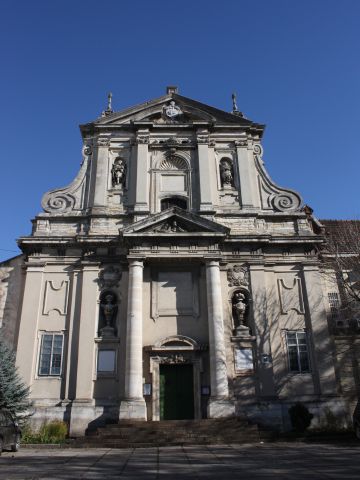
At the intersection of the transept with the nave of the church is placed a small dome topped with a signature cross. Each wing of the transept is overlapped by a single cross vault. The presbytery is rectangular in plan, narrow from the nave, raised relative to it on one step, covered with one strand of the cross vault. To the left of the presbytery the sacristy is attached, to the right — the chapel, where the entrance is arranged from the transept. The chapel is covered with five strands of cross vaults. On both sides of the chapel under the vaults cut through 3 windows. The facade of the temple is divided into two tiers by a cornice, frieze and architrave. In the niches of the first tier are decorative vases, and on the second — sculptural figures of St. Joseph and St. Teresa. St. Joseph and St. Terrza, executed in 1688 by Andreas Schwaner. The portal is flanked by two columns supporting a frieze with triglyphs and a triangular pediment. The second tier is divided by four pilasters, flanked by stone volutes and finished with a triangular tympanum with a cross. The tympanum is decorated with the Sobieski and Danilovich coats of arms.
It is known that the first wooden temple had three altars. Paintings and decorations of the stone temple were destroyed after its occupation by the military in the late 18th century. After the building was returned to the Roman Catholic Church in 1842, restoration was carried out. At the end of the XIX century the firm of Jan Sliwinski mounted a small organ. Piotr Wijtowicz made the side chapel of St. Joseph (1916) and later the second side chapel of the Protectress of God (after 1925). In 1929-1931 renovation works were carried out in the monastery and in particular in the chapel adjacent to the church. In the chapel an altar of the Mother of God was installed. The interior of the chapel was painted by Jan Rozen and his pupil Kazimierz Smuczak. The church has a new alabaster high altar, designed by Józef Szostakiewicz at the alabaster factory in Żurawno. The sculptures of the altar were made by Jadwiga Horodyska. In 1976 «Ukrzapadproektrestavratsiya» carried out restoration of frescoes in the chapel, all religious objects were removed from the church, some sculptures were transferred to the museum «Olesky castle», some objects were transferred to the Museum of the History of Religion. The coffins of the archbishops were taken from the crypts.