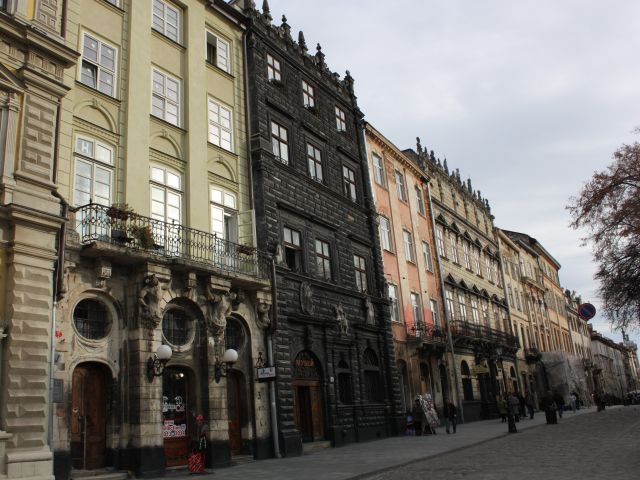
 The house on Market Square, 4 is a unique architectural monument of the XVI century, the so-called «Black Kamianica». Back in the early XVI century. on this site stood a medieval house, destroyed by fire in 1511. The owner of the plot, Jan Košner, gave it to his son-in-law Andrew from Kiev in 1519, who built the house known as the Kiev House. The house burned down in a fire in 1527, but was rebuilt and became known as Košnerivsky. In 1588 the owner of the plot became an Italian from Chios Tomazzo where Alberti demolished the old building and during 1588-1589 erected a remarkable 2-storey Renaissance stone house. According to Lviv researchers the authors of the project could have been Peter Barbon, Paul Romanin or Peter Krasovsky.
In 1596 the house became the property of merchant and apothecary Jan Lorencovich and his wife Regina, who completed the third floor of the kamenitsa and opened one of the first pharmacies in Lviv. The name of Lorencovitch’s Kamenitsa was strengthened in the memory of Lviv citizens by his son — very respected in the city councilor Jan Julian Lorencovitch. His son-in-law — Dr. Martin Nicanor Anchevsky inherited the stonemasonry in 1645 and made a thorough restoration of the house in 1675-1677 under the direction of architect Martin Gradovsky. The facade of the house was decorated with sculptures of saints, a magnificent Baroque attic was installed, the stone portals of the 1st and 2nd floors were renewed, above the main portal was placed the personal sign of the Anczewski’s — a lion with a sword in its paw in a laurel frame, on the cartouche were embossed letters — M.A. — SR — MD — CL . («Martin Anczewski, secretary to the king, MD, Counselor of Lviv»). 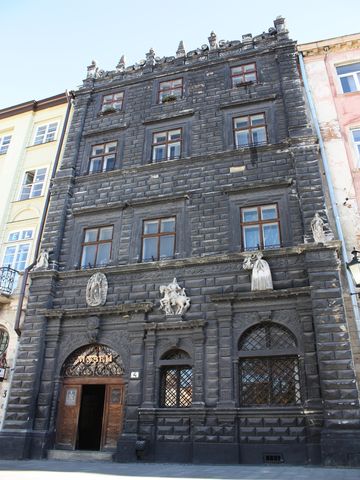 On the cornice of the portal — a sculpture of the Mother of God was installed. Above the hay window — the figure of Martin — the patron of Dr. Anczewski, on the ledge of the large window of the bureau — St. Stanislaw Kostka, canonized in the early 16th century, the patron of youth. On the capitals of the side pilasters are the figures of Jan of Dukli, the mythological savior of Lviv, and St. Luke, the patron of doctors.
Kamenica is one of the best examples of bourgeois construction of the Renaissance. The facade is covered with «diamond rust», portals and windows are decorated with carvings with vine motifs, heads of angels and birds.
The interior of the house is sumptuously decorated. Some rooms have preserved ceilings with carved wooden beams. Beautifully decorated with stone carvings of inter-window niches. The deep recesses of the 2nd floor windows form an advantageous bench from which it is good to watch the market traffic. During the restoration in 1884, a fourth floor was added between the attic and the third floor, and the attic openings were replaced with windows.
In 1911 the Kamenica was purchased by Emil Roinski, a doctor of law, whose funds were used for the following restoration of the building. In 1926 E. Roinski sold the Kamenica to the city.
By the resolution of the Magistrate dated 26.03.1926 it was assigned to the place of concentration of monuments of Lviv’s past. During the restoration works the building was adapted for museum purposes and on September 22, 1929 there was a solemn dedication and opening of the Historical Museum of Lviv.
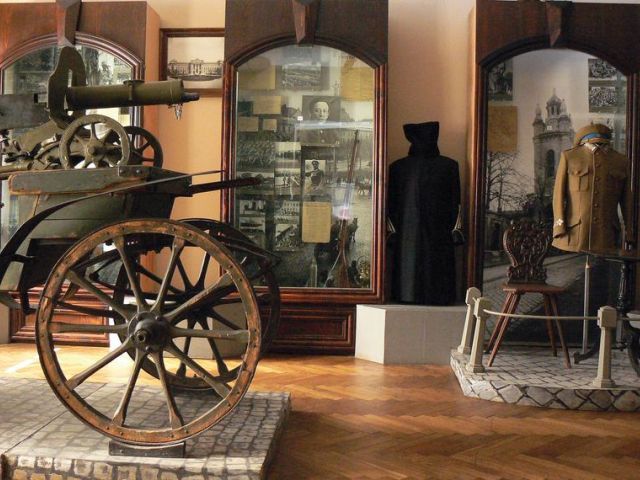 Today, the premises of the house contain expositions of the departments of the history of the Ukrainian Diaspora (2nd floor), the liberation struggle of Ukraine (3rd floor), the history of Western Ukrainian lands of the second half of the XIX-XX centuries (4th floor), the collection and the museum’s collections. (4th floor), fund and service rooms.
The Department of the History of Ukrainian Diaspora covers some fragments of the three main streams of the Ukrainian emigration movement, the chronological framework of which covers the end of the 19th — end of the 20th centuries. XIX — end of the twentieth century. The Department of the History of the Ukrainian Diaspora covers individual fragments of the three main streams of the Ukrainian emigration movement, whose chronological framework covers the late 19th — late 20th centuries. Among the museum exhibits covering public activities, the reconstruction of Ukrainian women’s clothing from the times of Kievan Rus (IX century) to Hetmanshchina (XVIII century), made by the New York group of the Union of Ukrainian Women, as well as elements of uniforms of the Ukrainian youth organizations of America «Plast» and UYM attracts special attention. The sights collected in the exposition help to understand more deeply that Ukrainians living outside Ukraine are a significant branch of the Ukrainian people, which replenishes the treasury of our common history, science, culture and art.
The exposition halls of the Department of History of Western Ukrainian Lands present materials revealing the history of our region in the period from 1914 to 1941. The exhibits of the Department’s exposition help visitors not only to understand the historical processes that took place in the Western Ukrainian lands in the interwar period, but also to evaluate the national liberation movement in other territories of Lvov from Ukraine.
Location: Lviv, Rinok Square, 4.
Top Attractions