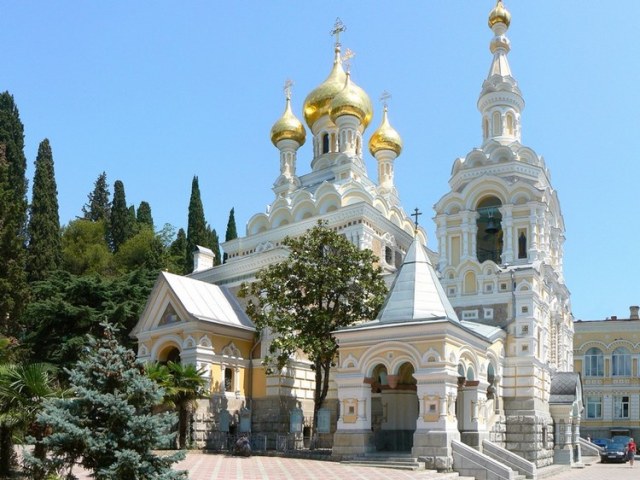
By the end of the nineteenth century, the city had grown and Yalta residents decided to build a large cathedral.
The history of the cathedral’s construction is connected with the Russian imperial house. The Cathedral of Alexander Nevsky was built in memory of the Russian Emperor Alexander II, who died on March 1, 1881 from a bomb that exploded at his feet.
March 1, 1890 established a construction committee, which was headed by a famous engineer, scientist, local historian A.L.Berthier-Delagard. The committee consisted of thirty respected Yalta residents. Baron A.L. Wrangel donated a large plot of land located near the construction site.
The first project of the temple was developed in 1889 by architect K.I.Eshliman, but it was not approved. The new project was entrusted to N.P.Krasnov, who worked in co-authorship with P.K.Terebenev. On March 1, 1891 on the tenth anniversary of the death of Emperor Alexander II, a solemn laying of the foundation of the new temple took place.
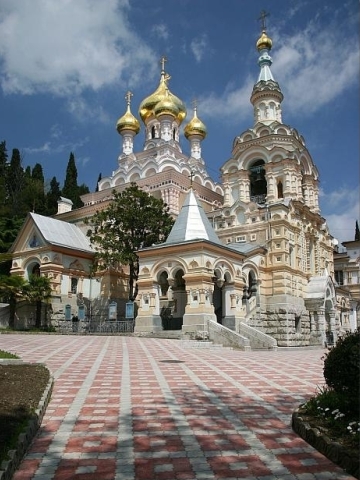
Archbishop Martinian served a prayer service right on the construction site. The first stone of the future temple was laid by Empress Maria Feodorovna.
For the temple, the architect chose the Old Russian style, using a lot of decorative architectural elements: pilasters, portals, kiotsev, hearts. The cathedral was built two-tiered, with open galleries and a hipped porch. It was painted in white and pink colors, which made it elegant and festive. Icons for the church were made in Mster, Vladimir province.
11 bells for the three-tiered bell tower of the cathedral were cast in Moscow, the main bell weighed 428 poods. All the bells were donated to the church by the Crimean wine merchant and philanthropist N.D.Stakheev.
The consecration of the cathedral took place on December 4, 1902 by Archbishop Nicholas. The solemn service was attended by the imperial family, who arrived from Livadia.
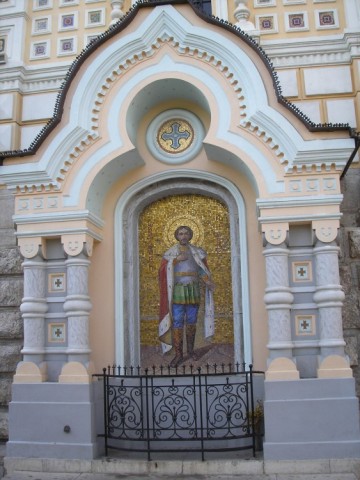
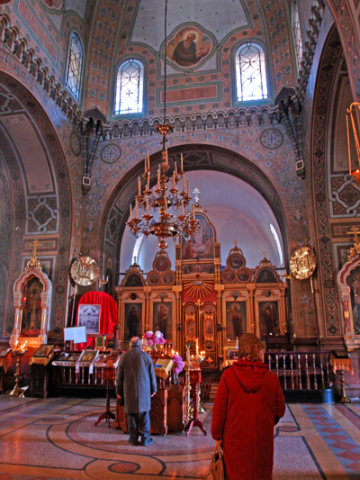
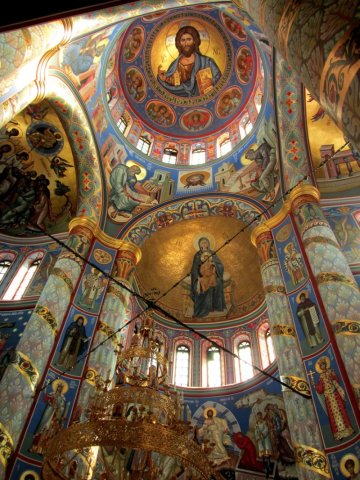
The splendor and extraordinary beauty of the external appearance of the temple had to be combined with the interior decoration. Therefore, in 1901 held an all-Russian competition, the winner of which would be able to design the interior of Alexander Nevsky Cathedral. The first place was taken by the architect S.P.Kroshechnik. According to Krasnov’s designs, the Kiev artist I.Murashko painted the iconostasis, he also made a continuous painting of the dome and walls in the Byzantine style. On the outer side of the temple, in a granite frame-kiote located mosaic panel with the image of St. Prince Alexander Nevsky. The mosaic was made by the students of the Venetian master Antonio Salviati.
The temple is double-domed: the upper throne is consecrated in the name of St. Alexander Nevsky, and the lower — in the name of St. Artemia, this saint the church honors October 20, on this day died Emperor Alexander III. All the domes of the cathedral were covered with gold.
In the same style with the temple was later built a two-story house of the parable, reminiscent of the Old Russian terem. Its author was M. I. Kotenkov. In 1903-08 another house with three floors was built, here there was a large assembly hall for the Alexander Nevsky Brotherhood.
This house housed a parochial school and a shelter for the infirm. The school was named after Tsesarevich Alexei.
Orthodox Brotherhood of the Holy Prince Alexander Nevsky was established by decree of Emperor Alexander III and the Tauris Ecclesiastical Consistory at the Simferopol Cathedral on November 23, 1868. The founder of the brotherhood was Archbishop Guriy (Karpov). The tasks of the brotherhood were diverse: to create parochial schools, to provide them and churches with material assistance, to build new churches, to care for the poor, elderly and orphans, to fight against schisms and sectarianism. During World War I, the Alexander Nevsky Brotherhood and the community of the Red Cross Sisters of Charity collected gifts, medicines and herbs for soldiers, organized infirmaries and sanatoriums for the wounded.
The first archpriest of the cathedral was Alexander Yakovlevich Ternovsky, who previously served in the church of St. John Chrysostom.
The temple shared with the parishioners the hardships of the revolution and civil war, here only supported the faith in people, the cathedral guarded and protected people’s lives. In 1918, during the bombardment of Yalta Red Guards in its walls sheltered residents of the city.
In June 1918, in the lower church was buried in the funeral service of F.M.Dostoevsky’s wife Anna Grigorievna. She was buried in the cemetery in Alupka, and only many years later her ashes were transferred to the Alexander Nevsky Lavra in St. Petersburg, where F.M.Dostoevsky is buried.
In 1938 the cathedral was closed. The bells were removed and sent for melting. A sports club was organized in the church.
Divine service in the cathedral was resumed in 1945 and has not stopped since then. The building of the parochial school, where the teacher’s house used to be, was returned to the church.