If we use the statistics for the current year, it turns out that only 0.21% of the modern population of Ukraine are Armenians. If you look up the data for 1926, it turns out that on the territory of the country, people who belonged to this nationality, there were 10.6% of the total mass of citizens of the Ukrainian SSR. It is believed that before the revolution in some regions of Ukraine, and especially in cities, the number of Armenians reached 15-19%.
The first Armenians came to Kievan Rus in the XI century. They were called by the Kiev princes, expecting help in the war with the Polish king Boleslav. After the victory, many representatives of this ethnos decided to stay on the fertile Ukrainian land. At the same time, they carefully kept their culture, language and mentality.
Some Armenians settled in Kiev, serving the Russian princes. Some moved to Lvov, taking advantage of the invitation of Prince Lev Danilovich. But the largest number of former mercenaries chose the Crimean peninsula, whose climate and landscapes maximally reminded them of their homeland. The largest diasporas from the XII to the XV century were formed in Cafe, present-day Feodosia, Sudak and Yalta.
There were so many Armenians in Crimea that in some medieval chronicles the peninsula was called Greater or Maritime Armenia. The main occupation of these people was trade. They were the main intermediaries in commercial transactions between the Caucasian kingdoms and the principalities of Kievan Rus.
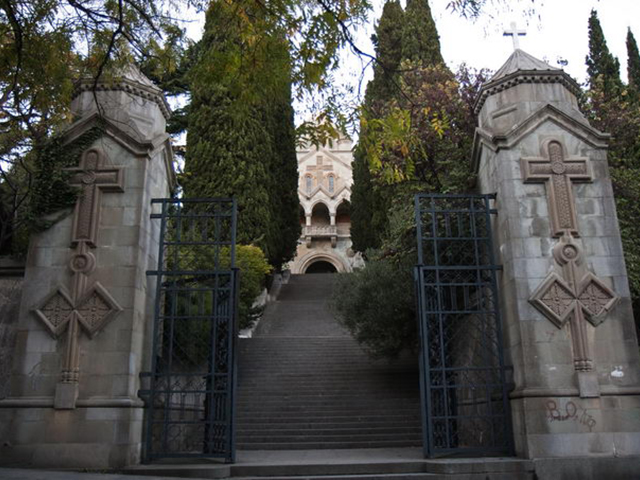
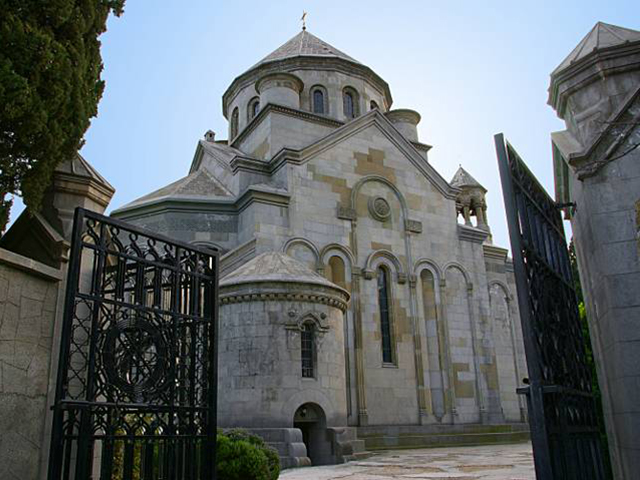
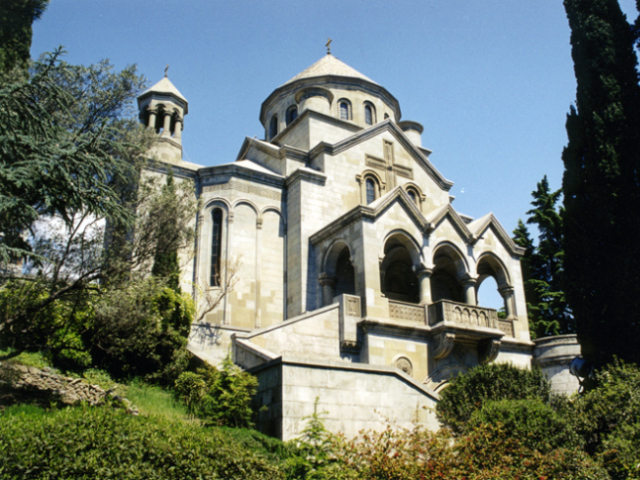
The descendant of those merchants was Yalta’s Poghos Ter-Gukasyan. He became one of the richest people in the South Coast at the beginning of the last century, trading in Baku oil and Ukrainian wheat. In 1905 Ter-Gukasyan lost his favorite daughter Ripsime — the girl died of meningitis. In memory of her, her father decided to build a monument — a church, beautiful and sad at the same time. In the same year the project of the building was ordered from the best Armenian architect of that time — Gabriel Ter-Mikelyan, and a plot of land on the Darasan hill was bought, from which an excellent view of Yalta, the sea and Ai-Petrinsky yaila can be seen. According to Ter-Gukasyan’s wish, the prototype for the Yalta temple was the Cathedral of St. Hripsime, erected in Echmiadzin in 689.
A huge role in the creation of today’s so-called Armenian Church in Yalta belongs to the artist Vardges Surenyants. He took care of the external decoration of the stone walls of the building and its interior decoration.
 .
.
The most difficult task was, according to the artist’s own memories, to satisfy the desires of an unstable and impulsive customer. More than a hundred times he rejected the sketches of Surenyants. Edits and alterations, expansion and reduction of the estimate depended only on the fluctuations of the oil exchange rate and the condition of Ter-Gukasyan’s gouty leg.
The Armenian Church was built from volcanic tuff carved from the body of Cape Foros. This rock is relatively soft, so it became a fertile base for the bas-relief, openwork lace girdling the entire building. The building itself is stylized under the early Christian churches. The ground floor of the Yalta temple is a crypt. The bodies of Ter-Gukasyan’s daughter and two sons, who could not stand the test of their father’s wealth, were laid to rest in it. The rectangle of the temple itself, covered with a broken roof and crowned with seven different-sized domes, was built over the crypt. On the roof, directly above the burial place of the girl, rises a graceful rotunda. The entrance to the «house» of Ripsime is on the western side.
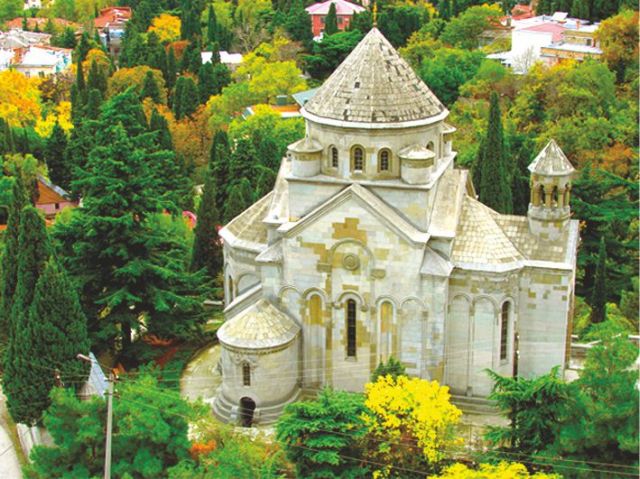
One of the most valuable things about the cathedral is considered to be its wall paintings. Before 1917, Surenyants had time to paint only the dome. Blue and white flowers, angels and ornamentation allow comparing this fresco with the works of Renaissance titans in the temples of Perugia, Florence and Milan. After the revolution the financing of the works stopped, and until 1920 the artist painted the walls at his own expense. Until he fell ill, died and was buried under the walls of the Church of St. Ripsime.
Today, the Armenian Church is considered one of the most beautiful and significant temples of Yalta. Such a luxurious nature is willingly used in their works by filmmakers. Among the latest movies «The Master and Margarita» was filmed here, replacing the views of Jerusalem. Today the temple belongs to the Armenian Apostolic Church of Krym. It serves only festive liturgies and sometimes holds concerts of classical and spiritual music.