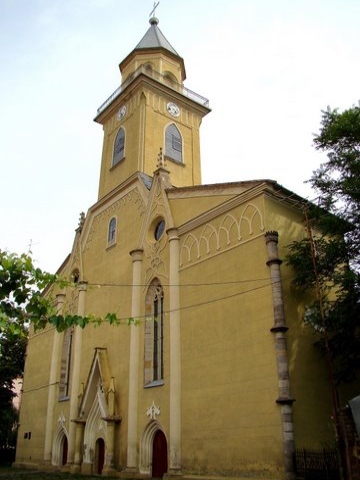
 The Roman Catholic Church of the Exaltation of the Holy Cross is one of the most beautiful buildings in Beregovo, the oldest building in Transcarpathia. It is with this church legend connects the founding of the city, for more than 900 years it has been the spiritual home of the inhabitants of Beregovo. And for tourists the church is of great interest due to its unique architecture and venerable age.
According to legend, the founder of the temple and the town around it was a shepherd Sas. On the place where the majestic church now stands, he once found a pot filled to the top with gold, and by building the temple and the town he decided to thank the heavens for the treasures given to him. Anyway, one thing is certain — the church was founded in the XI century, and this is confirmed by several supporting stones, which are located above the northern arch — one of them is engraved with the date «1100».
Historians believe that the appearance of this attraction of Transcarpathia the city owes to the Saxons, who moved to Beregovo in the XI-XII centuries. The church was originally built in Romanesque style,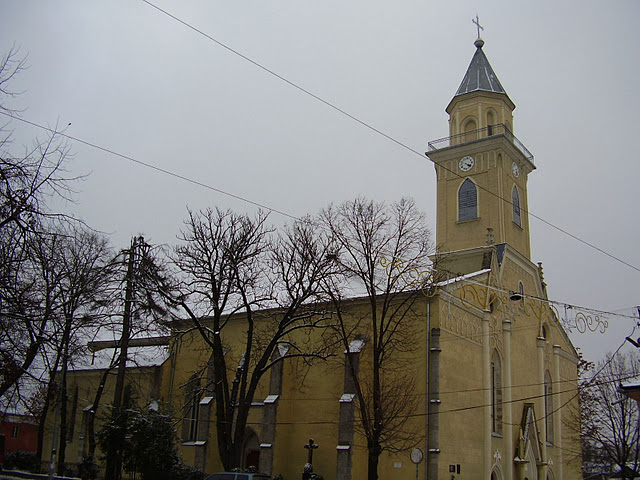 but numerous reconstructions due to several destructions that hit the monastery changed its appearance. Gothic style prevails in the architecture of the church, and Romanesque features can be seen today on the western and northern facades. On the west are semi-columns with a crenellated end, and on the north are the oldest fragments of the structure — the head of a lion and a man.
The high tower of the church with a gallery, which is topped with a blue dome crowned with a cross, is visible from all parts of the city. The bright, large church is considered a real decoration of Ferenc Rakoczy II Square, despite the fact that it is adjacent to such equally famous architectural sights of the city as Casino Bereg (Golden Peacock) and Graff’s Court (the palace of Prince Gabor Betlen). The inhabitants of Beregovo appreciate and take care of the ancient building, which according to legend is the ancestor of the whole town. However, despite this care and love, the town has lost its spiritual abode several times.
In 1241 the church was partially destroyed by the Tatars, and the reconstruction was finished only in 1418, as evidenced by the inscription in Hungarian under the triumphal arch. It was after this reconstruction that the church acquired the Gothic features that can be seen today — tall narrow lancet windows and portals, ornaments on windows, vials, portals, buttresses.
 A new misfortune befell the church in 1657: the Poles, who were chasing Prince György Rakoczy II, broke into the monastery during the service, killed everyone in it and set it on fire. The inscription scratched out by the Poles on one of the walls, «An eye for an eye, I repay my debt, dear neighbor!» (Vicem pro vice reddo tibi, bone vicine!), recalls this tragic event.
In the following time the church was destroyed and rebuilt two more times. It acquired its final appearance, which can be seen today, after the restorations of the mid XIX-XX centuries. In honor of the Exaltation of the Holy Cross it was consecrated in 1846 under Count Schönborn, who hired the architect Albert Tichler to restore the cathedral.
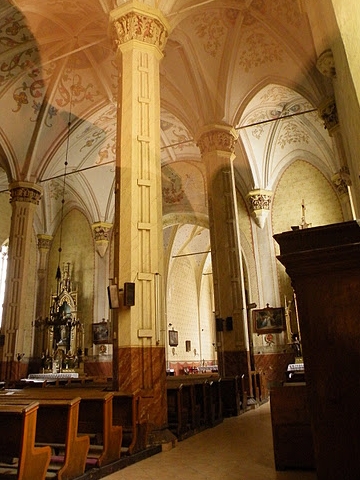
The church is bright from the outside, but inside it is semi-dark. Massive columns, narrow glimpses of light shining through the lancet windows, the mesmerizing sounds of the organ — the atmosphere inside the church seems to take you back several centuries. The Hungarian language in which the services are conducted enhances the impression. To feel the originality and mystical charm of this attraction of Ukraine, it is visited by many guests of the city, and bright, unusual impressions of what they have seen and heard remain with them for many years.